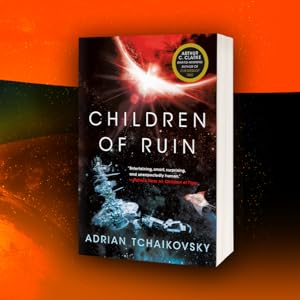
desertcart.com: Children of Ruin (Children of Time, 2): 9780316452533: Tchaikovsky, Adrian: Books Review: Like the First Novel, but Pumped Up on Steroids - Kudos to Adrian Tchaikovsky for his new book: Children of Ruin is not just as good as, but even better than its prequel. This is a feat very few writers can pull off. The first book, Children of Time, followed the accidental development of a sentient arachnid civilisation on a planet terraformed and abandoned by humans and its inevitable stand-off with the last survivors of the human kind fleeing from a ravaged and uninhabitable Earth to a planet they think is rightfully theirs. Grand-scale, epically ambitious and, most importantly, biologically plausible, Children of Time was an enormous reward to read. However, it was also sleepy and long-winded, with a somewhat languid plot and entire chapters that read more like a Discovery documentary than genuine fiction. This is why I was hardly ecstatic when I found out that there was going to be a sequel—but, boy, was I proven wrong! The plot of Children of Ruin kicks off exactly where Children of Time ended: with a joint expedition of humans and arachnids, long living side-by-side peacefully, to another human-terraformed world, which has been sending inscrutable radio signals. This expedition’s timeline goes side-by-side with the timeline of the human terraforming crew millennia before, as it starts terraforming one of the two Goldilocks planets in the system and makes a terrifying discovery on the other one. The plot reminds very much of and its structure copies, for the most part, Children of Time, with the same uplifting of a sentient Earth-based species, this time octopuses, and with the same imminent stand-off between civilisations. But despite this lack of originality, Children of Ruin does all of this brilliantly, while the added horror subplot and a much, much tighter writing ensure a much more engaging plot. Adrian Tchaikovsky more or less takes what was best about Children of Time: the audacious scale and the plausible biology, and infuses it with so much more dynamics and energy as to you keep you on edge the entire time, something the first book was only able to do at the very end. What is perhaps most appealing about both Children of Time and Children of Ruin though is Adrian Tchaikovsky’s incredibly optimistic view of the universe, where the unknown is an opportunity rather than a threat and where differences do not necessarily need to be resolved by conflict, but can end up in mutually beneficial cooperation. This is an incredibly different outlook than that of most modern authors and also a very likeable one, considering the times we all live in. Review: Three stars for first half and five stars for the second - I had a high hopes for this book because I loved “Children of Time” and prepared myself for a reading feast starting from page one. It did not happen. After reading 40% of the book I was ready to give up. I was happy to meet next versions of Portia, Fabian and Dr. Avrana Kern again. I also enjoyed meeting the new character, another crazy scientists obsessed with octopuses. But the plot seemed disjointed and moving slowly. Part of the problem was that many events take place in cyberspace and in virtual reality build by interactions of computer programs and alien intelligence. I guess the general idea was to show humans facing phenomena that are beyond our comprehension. I am OK with that but if things are beyond our comprehension how one does describe them? It can be done by analogies to familiar events and if such analogies do not exist the description should be brief. Long pages describing them in details were very tiring, bordering on boring and did not clarify anything for me. Maybe these parts would make more sense to somebody more familiar with computer programming and/or linguistics. So instead of being engrossed in a story I plodded through it hoping that it will get better. And about 40% into the book it actually did. The multiple plot lines came together and started making sense. I gave up on trying to understand how brain implants work and how exactly humans communicate with octopuses and started enjoying the general picture of (fascinating) octopus society ruled by emotions and separate nerves centers within their bodies. Surprisingly, and to my big relief, the most alien form of life appearing in the story was using plain human language to communicate and its “we‘re going on an adventure” cry was a brilliant touch. Bottom line: Three stars for first half of the book and five stars for the second make a 4 stars average.
| Best Sellers Rank | #23,111 in Books ( See Top 100 in Books ) #20 in Hard Science Fiction (Books) #94 in First Contact Science Fiction (Books) #341 in Space Operas |
| Book 2 of 4 | Children of Time |
| Customer Reviews | 4.3 4.3 out of 5 stars (16,961) |
| Dimensions | 6 x 1.25 x 9 inches |
| ISBN-10 | 031645253X |
| ISBN-13 | 978-0316452533 |
| Item Weight | 1.08 pounds |
| Language | English |
| Print length | 416 pages |
| Publication date | May 14, 2019 |
| Publisher | Orbit |
P**V
Like the First Novel, but Pumped Up on Steroids
Kudos to Adrian Tchaikovsky for his new book: Children of Ruin is not just as good as, but even better than its prequel. This is a feat very few writers can pull off. The first book, Children of Time, followed the accidental development of a sentient arachnid civilisation on a planet terraformed and abandoned by humans and its inevitable stand-off with the last survivors of the human kind fleeing from a ravaged and uninhabitable Earth to a planet they think is rightfully theirs. Grand-scale, epically ambitious and, most importantly, biologically plausible, Children of Time was an enormous reward to read. However, it was also sleepy and long-winded, with a somewhat languid plot and entire chapters that read more like a Discovery documentary than genuine fiction. This is why I was hardly ecstatic when I found out that there was going to be a sequel—but, boy, was I proven wrong! The plot of Children of Ruin kicks off exactly where Children of Time ended: with a joint expedition of humans and arachnids, long living side-by-side peacefully, to another human-terraformed world, which has been sending inscrutable radio signals. This expedition’s timeline goes side-by-side with the timeline of the human terraforming crew millennia before, as it starts terraforming one of the two Goldilocks planets in the system and makes a terrifying discovery on the other one. The plot reminds very much of and its structure copies, for the most part, Children of Time, with the same uplifting of a sentient Earth-based species, this time octopuses, and with the same imminent stand-off between civilisations. But despite this lack of originality, Children of Ruin does all of this brilliantly, while the added horror subplot and a much, much tighter writing ensure a much more engaging plot. Adrian Tchaikovsky more or less takes what was best about Children of Time: the audacious scale and the plausible biology, and infuses it with so much more dynamics and energy as to you keep you on edge the entire time, something the first book was only able to do at the very end. What is perhaps most appealing about both Children of Time and Children of Ruin though is Adrian Tchaikovsky’s incredibly optimistic view of the universe, where the unknown is an opportunity rather than a threat and where differences do not necessarily need to be resolved by conflict, but can end up in mutually beneficial cooperation. This is an incredibly different outlook than that of most modern authors and also a very likeable one, considering the times we all live in.
K**Z
Three stars for first half and five stars for the second
I had a high hopes for this book because I loved “Children of Time” and prepared myself for a reading feast starting from page one. It did not happen. After reading 40% of the book I was ready to give up. I was happy to meet next versions of Portia, Fabian and Dr. Avrana Kern again. I also enjoyed meeting the new character, another crazy scientists obsessed with octopuses. But the plot seemed disjointed and moving slowly. Part of the problem was that many events take place in cyberspace and in virtual reality build by interactions of computer programs and alien intelligence. I guess the general idea was to show humans facing phenomena that are beyond our comprehension. I am OK with that but if things are beyond our comprehension how one does describe them? It can be done by analogies to familiar events and if such analogies do not exist the description should be brief. Long pages describing them in details were very tiring, bordering on boring and did not clarify anything for me. Maybe these parts would make more sense to somebody more familiar with computer programming and/or linguistics. So instead of being engrossed in a story I plodded through it hoping that it will get better. And about 40% into the book it actually did. The multiple plot lines came together and started making sense. I gave up on trying to understand how brain implants work and how exactly humans communicate with octopuses and started enjoying the general picture of (fascinating) octopus society ruled by emotions and separate nerves centers within their bodies. Surprisingly, and to my big relief, the most alien form of life appearing in the story was using plain human language to communicate and its “we‘re going on an adventure” cry was a brilliant touch. Bottom line: Three stars for first half of the book and five stars for the second make a 4 stars average.
J**Y
Entertaining and suspenseful
An entertaining, suspenseful, imaginative story. It is a bold evolutionary drama with appealing science and technology. The characters are courageous, curious, and emotive, individually and among colleagues, aliens, friends. The novel has a broad and deep appeal. The writing is vivid, clear and concise. It is a compelling sequel to Children of Time. Nothing is lost in this second book of the series. I look forward to the third book, Children of Memory.
D**N
Very good continuation to C hildren of time but not as good. I hope the next one brings a plot as God and as original as the first book.
C**W
This is innovative sci-fi. Great series. Well worth reading.
ア**入
読み始めると止まらなくなる。
V**T
Currently forcing my way through the final 170 pages. It has been a slog from the start. Thus far, the book could have been about half it's length without missing anything. Will not be picking up book #3 after this.
J**)
Some of you may know that Children of Time is one of my absolute favourite novels. I love the incredible scope, storytelling, and world that Tchaikovsky captures on the page. Children of Ruin is a fantastic sequel that expands on everything that made the first book great, all while serving a compelling and gorgeous story. Children of Ruin expands well on the story initially told in Children of Time, but still manages to hold onto the things I loved from the first book. I can go on and on about how brilliant the storytelling in Children of Time is, as well as the incredibly intricate way he manages to show an entire culture evolving from primal hunters to a space-faring society. I absolutely loved the way that the spiders were presented and how they evolved in the first book, and was so worried that we wouldn’t get anything as interesting in Children of Ruin. However, he manages to show a similar evolution of a non-human society that doesn’t feel like a rehashing of the Portiid society. I loved the way life was explored, expanded on, and evolved on both Nod and Damascus. I loved that this book had so many horror elements to it. I loved the way the Portiids and humans interacted not only among themselves, but toward a new species. I loved the backstory of the terraformers. Basically, I just loved this book. We get a good mix of our favourite Portiid descendants — Fabian, Portia, and Bianca — as well as human descendants of the Gilgamesh’s crew. It was so interesting to see how humans and Portiids are still getting to know each other and adjusting to each other’s customs, despite the generations between first contact and their present situation. Seeing them, particularly Helena and Portia, attempt to communicate with each other and with the the new species was just fabulous. If you liked Children of Time, I really think you’ll enjoy Children of Ruin. Although it feels a lot like the first book in terms of general plot and story structure, Children of Ruin introduces so many new elements and continues to expand and explore familiar themes. Children of ruin combines elements of creeping horror with some of my favourite science fiction tropes — space exploration and first contact. Throw in a healthy dose of linguistics, and you have this absolutely brilliant book.
Trustpilot
2 months ago
2 weeks ago