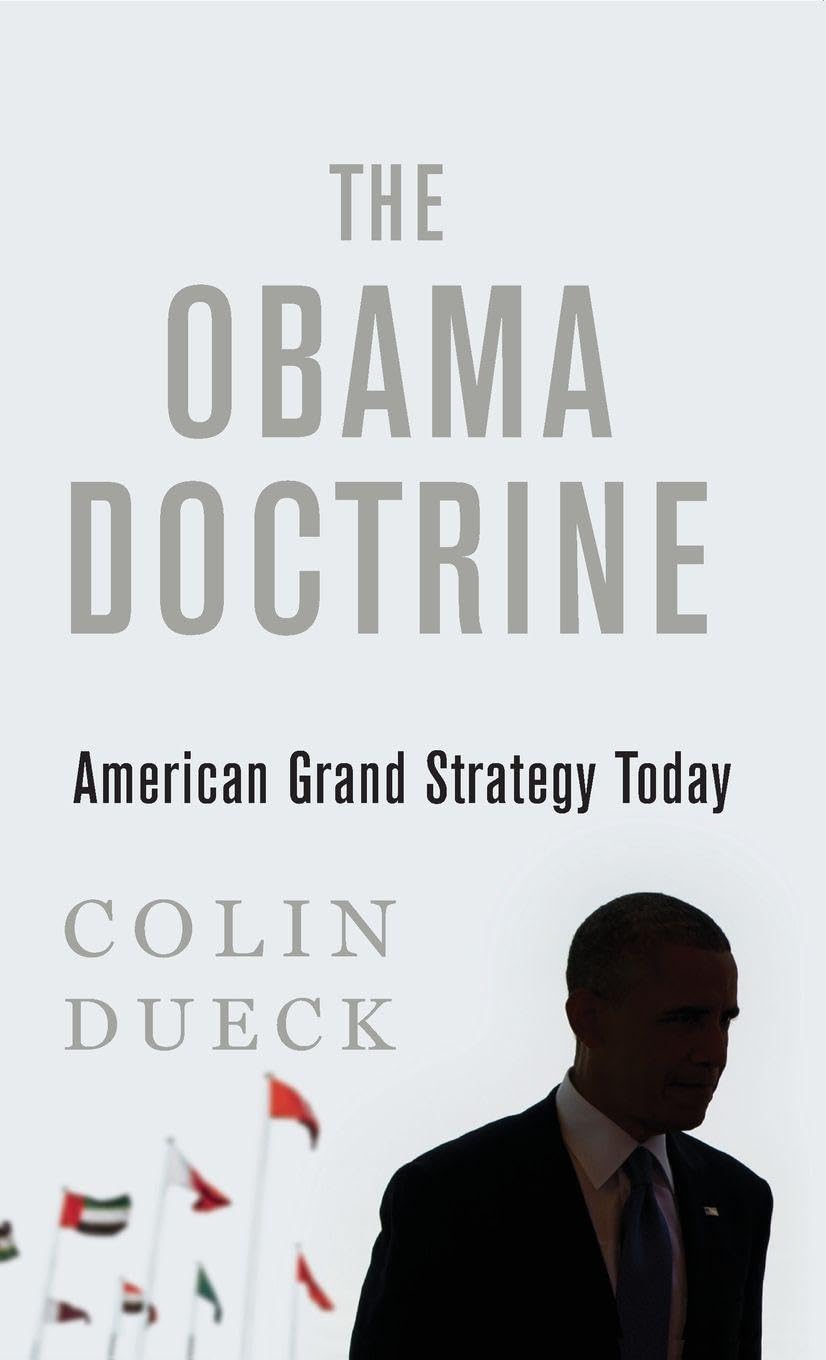
The Obama Doctrine: American Grand Strategy Today [Dueck, Colin] on desertcart.com. *FREE* shipping on qualifying offers. The Obama Doctrine: American Grand Strategy Today Review: Blame Obama (Not!) - As a student of foreign policy, I must state that this is one of the best books on the subject that I have ever read. There is enough information here to easily fill a multi-semester graduate level college class. And the timeliness of it is extraordinary, current up to late 2014. And it is written in easily understood language and style. The author sets out to explain, in a mostly non-partisan manner, the ideas behind the strategy that President Obama follows in making foreign policy decisions. I will quote the author’s own words to explain: “At the end of the day, Obama’s highest priorities are domestic, and that this have had a powerful effect on his foreign policy choices…..He has said, in his own words, that he looks to “transform this nation”, “end wars”, and focus on “nation-building right here at home””. The author states: “the purpose of Obama’s grand strategy has been to retrench America’s strategic presence overseas without undue risk to basic U.S. interests, and to encourage new patterns of international cooperation through diplomatic accommodations”. After discussing the pro’s and con’s of this strategy, Dueck concludes that Obama’s strategy has not worked as planned. The author suggests that this is because of incorrect assumptions made, a reticence to come to decisions, and an inability to “impose a serious coherence on specific…U.S. policies”. The author believes that Obama decided early on that the main focus of his presidency would be on domestic issues, and that he would try to not jeopardize this focus with controversial foreign policy issues. Dueck spends the latter part of his book on “Republican Alternatives to the Obama Doctrine”. I don’t know why he decided to single out the Republican’s, his points could easily be adopted by and crafted to either political party. He lists suggestions on how foreign policy could be better crafted. He places emphasis on a more coherent and consistent strategy, so foreign actors would be better able to predict how we will respond to issues. I highly, highly recommend this book to anyone interested in the upcoming presidential election. You will not be disappointed. I received this book as an early reviewer for NetGalley, in exchange for a fair review. The fair review was easy, as the book was so great! Anyone who follows my reviews knows that a “5 star” rating is a rare occurrence for me. I have no hesitance in giving Dueck's book 5 stars! Review: Liberals won't like it, but what else is new - A consistent and fairly insightful critical treatment of the Barack Obama's disastrous foreign policy. Liberals won't like it, but what else is new? Dueck argues that Obama has prioritized his domestic agenda, and has been totally unwilling to allow foreign policy concerns to endanger that agenda. In the process, the President has allowed U.S. national security to reach a parlous state, in part for purely ideological reasons. There is also more than hint that, given his background, Obama could not possibly have been an effective foreign policy president . . . he lacked the background and experience to be effective.
| Best Sellers Rank | #1,306,562 in Books ( See Top 100 in Books ) #474 in Political History (Books) #605 in Political Parties (Books) #726 in International Relations (Books) |
| Customer Reviews | 4.0 out of 5 stars 16 Reviews |
O**N
Blame Obama (Not!)
As a student of foreign policy, I must state that this is one of the best books on the subject that I have ever read. There is enough information here to easily fill a multi-semester graduate level college class. And the timeliness of it is extraordinary, current up to late 2014. And it is written in easily understood language and style. The author sets out to explain, in a mostly non-partisan manner, the ideas behind the strategy that President Obama follows in making foreign policy decisions. I will quote the author’s own words to explain: “At the end of the day, Obama’s highest priorities are domestic, and that this have had a powerful effect on his foreign policy choices…..He has said, in his own words, that he looks to “transform this nation”, “end wars”, and focus on “nation-building right here at home””. The author states: “the purpose of Obama’s grand strategy has been to retrench America’s strategic presence overseas without undue risk to basic U.S. interests, and to encourage new patterns of international cooperation through diplomatic accommodations”. After discussing the pro’s and con’s of this strategy, Dueck concludes that Obama’s strategy has not worked as planned. The author suggests that this is because of incorrect assumptions made, a reticence to come to decisions, and an inability to “impose a serious coherence on specific…U.S. policies”. The author believes that Obama decided early on that the main focus of his presidency would be on domestic issues, and that he would try to not jeopardize this focus with controversial foreign policy issues. Dueck spends the latter part of his book on “Republican Alternatives to the Obama Doctrine”. I don’t know why he decided to single out the Republican’s, his points could easily be adopted by and crafted to either political party. He lists suggestions on how foreign policy could be better crafted. He places emphasis on a more coherent and consistent strategy, so foreign actors would be better able to predict how we will respond to issues. I highly, highly recommend this book to anyone interested in the upcoming presidential election. You will not be disappointed. I received this book as an early reviewer for NetGalley, in exchange for a fair review. The fair review was easy, as the book was so great! Anyone who follows my reviews knows that a “5 star” rating is a rare occurrence for me. I have no hesitance in giving Dueck's book 5 stars!
G**N
Liberals won't like it, but what else is new
A consistent and fairly insightful critical treatment of the Barack Obama's disastrous foreign policy. Liberals won't like it, but what else is new? Dueck argues that Obama has prioritized his domestic agenda, and has been totally unwilling to allow foreign policy concerns to endanger that agenda. In the process, the President has allowed U.S. national security to reach a parlous state, in part for purely ideological reasons. There is also more than hint that, given his background, Obama could not possibly have been an effective foreign policy president . . . he lacked the background and experience to be effective.
R**S
The book covered a phase of successful foreign policy by ...
The book covered a phase of successful foreign policy by Obama that prevented a larger war that was not recognized by the mainstream press.
A**R
Foreign Policy vs. Domestic Programs
This review is on the book “The Obama Doctrine” by Colin Dueck, that I found in my public library. This is a most interesting book. The “Doctrine,” of course, refers to foreign policy. In an unbiased style, the author sets out his very studied and detailed pro and con assessments of the President’s foreign policy, most of which seem very plausible. You can be lulled into thinking you are reading a really unbiased account. However, the conclusion is not unbiased. The conclusion is that no matter how well meaning, the President’s foreign policy is a complete failure, because of his costly domestic programs. Language on page 255 begins to make clear the purpose of the book. “. . . American conservatives . . . agree that President Obama has introduced an unnecessary regimen of higher taxes, hyperregulation, and excessive debt that in combination discourage economic growth and take the country further than ever from the distinct US traditions of limited government.” So we solve the President’s foreign policy failure by return to the distinct US traditions of limited government without costly domestic programs in order to encourage economic growth? Funny thing, our economy now is robust—more American cars are made and sold than ever; unemployment is the lowest ever; Facebook (hiring thousands) is making millions (or is it billions); and the stock market is at the highest ever. So what is the purpose of the book? In anticipation of the 2016 elections, to incite enough fear and anger as to eliminate the drain on the richest country in the world of its costly domestic programs, like social security, Medicare and Affordable Health Care? Then we can spend our money on our military to solve our foreign policy problem, all the while we are enjoying not paying taxes? Funny thing, out of 126 countries of the world, the US is Number 1 in global firepower. For example, the US has 20 aircraft carriers, 72 submarines and 62 destroyers, any one of which has the firepower of the entire US Fleet during WWII. Perhaps these warships have not been used to the best advantage to secure American interests abroad, but the warships have seen effective action against terrorists. Their presence in the Asia Pacific area has also been effective. Just how many more warships do we really need. The foreign policy failure the author describes sounds rather like President Washington’s problem with the Whiskey Tax Rebellion against the federal tax on all distilled spirits to reduce the national debt (incurred by the foreign policy of the revolutionary war). Americans don’t like taxes. Instead, they like their spirits no matter what. The conservatives, and the liberal/progressives alike, want only the best for everybody. So what is an ordinary citizen to do?
S**Z
Obama's Lack of Doctrine
In a 2011 article, USA Today put the question if the developments in Libya showed Obama’s overall approach to foreign policy and the beginning of what properly might be called “The Obama Doctrine.”[1] Well, if Obama’s approach to foreign policy can be called a doctrine, it could easily be defined in these terms: I will use the full power of the U.S. military to steal the resources of any country who opposes the intrusion of Wall Street bankers and transnational corporations.” However, isn’t this what American presidents have been doing since Woodrow Wilson’s times? On the other hand, given the fact that most doctrines attributed to American presidents have actually been written at the Harold Pratt House by members of the dreaded Council of Foreign Relations — the true government of the United States —, and implanted in the president’s minds by their CFR-controlled advisors, should we call them “presidential doctrines?” Of these, probably the most obvious example of policies whose only purpose is to protect the rapacity of Wall Street bankers and transnational corporations is the U.S. policy document “National Security Strategy of the United States,”[2] also known as the Bush Doctrine, released in September 2002. Its most radical postulate is a new preemptive strikes policy, which is nothing but an even more aggressive approach toward countries that get in the way of the CFR’s Wall Street Mafia. However, further proof that the so-called war on terror was planned way before September 11, 201, is that the “National Security Strategy” is based on two papers dating back to the early 1990s: one is a 1992 internal government document entitled “Defense Planning Guidance,” authored by then Secretary of Defense Dick Cheney (CFR) and his deputy Paul Wolfowitz (CFR), which contemplated the use of military force against any nation the conspirators perceived to be hostile against their interests. The other one is the report “Rebuilding America’s Defenses,” released in September 2000 by the Project for the New American Century, a neocon think tank composed almost exclusively of CFR members. Typical of these CFR-created presidential “doctrines” is George Kennan’s (CFR) 1947 article in Foreign Affairs, written under the pseudonym “X,” explaining his —actually the conspirators’— theory of “containment.” According to Kennan, the U.S. role in the coming Cold War should be limited to containing the expansion of Soviet Communism, not fighting to win it. Soon after, President Truman made Containment the core of “his” Truman Doctrine. Probably one of the most overused adjectives attached to American presidents is “Wilsonian,” honoring the alleged creator of the League of Nations, the Thirteen Points, and many other aberrations which, luckily, ended up in failure. Unfortunately, we are still suffering the creation of the Federal Reserve Bank and the Internal Revenue Service, the two U.S. government institutions that more money have stolen from the pockets of American citizens. But Wilsonianism is a sort of recurring curse of American politics. In an address to the United States Senate in three parts, June 29, June 30 and July 1, 1992, “On the Threshold of the New World Order: The Wilsonian Vision and American Foreign Policy in the 1990's and Beyond,” then Senator Joseph R. Biden said, When the peace conference convened at Versailles in 1919, Woodrow Wilson presented, to a world desperately eager to hear it, America’s second vision of a new order. The first American vision —the Founders’ vision— had concerned the establishment of a just new order within nations through institutions of democracy. The second American vision —Wilson's vision— concerned the establishment of a just new order among nations through institutions of cooperation. . . . Modern-day conservatives who are instinctively frightened by the Wilsonian vision have propounded a mythical image of Woodrow Wilson as a dangerously naive idealist. Idealist he was. But there was no naivete in the Wilsonian vision. As history soon proved the danger lay in a failure to implement what Wilson proposed. . . . How is it, then, that the United States failed so conspicuously and so fatefully to join the League of Nations that Woodrow Wilson himself had designed and advanced as the ultimate protection against future cynicism and future cataclysm? . . . With that turn of history, the League of Nations was doomed and a new world was born, but not a new world order. . . . Now, as the century nears it close, the near-universal repudiation of the totalitarian idea has removed the last great obstacle to the Wilsonian vision. What CFR agent Joseph Biden did not tell, however, was how this “near-universal repudiation of the totalitarian idea” could actually bring about the totalitarian “Wilsonian vision” of Edward Mandell House. Apparently Biden ignores, or wants us to ignore, that Wilson had no ideas of his own. All of them had been implanted in his feeble brain by his controller, Col. Edward Mandell House. Wilson himself publicly admitted it when he said, “Mr. House is my second personality. He is my independent self. His thoughts and mine are one.”[3] Most important documents in the history of the U.S. since the beginning of the past century, like Wilson’s Fourteen Points, the League of Nations, the Federal Reserve Bank, the Federal Income Tax, the Lend Lease, the Containment Doctrine,[4] the Marshall Plan,[5] the National Security Act that created the CIA, the Alliance for Progress, FEMA, as well as the nefarious Patriot Act[6] and the Office of Homeland Security, up to ObamaCare, have been written by the CFR Conspirators at the Harold Pratt House in Manhattan and placed on the President’s desk for him to sign. For example, though generally attributed to JFK, actually the first person who mentioned the Alliance for Progress was CFR secret agent Fidel Castro. On May 2, 1959, during a session of the Economic Assembly of the Latin American States, Castro suggested that, in order to avoid problems in Latin America, the U.S. should help the Latin American countries economically through the creation of a comon market.[7] Next month, during a speech at New York’s Central Park, he called for an American “Marshall Plan” for Latin America in order to avoid communism.[8] As expected, Castro’s suggestions were received with laughter and contempt. But less than two years later, President Kennedy created his Alliance for Progress, pledging $10 billion for the first ten years. Later, President Johnson promised another $10 billion to continue the program. And less than ten years later, in the spring of 1967, a hemispheric conference was held in Uruguay where the decision was made for the creation of a Latin American common market. Incredibly, both of the apparently far-fetched suggestions Castro made eventually became a reality — which does not prove that Castro has extraordinary powers of clairvoyance, but that he gets his marching orders from some Wall Street bankers, particularly the Rockefellers. Despite of the use of Wilsonian (actually Housian) rhetoric of intervening military for humanitarian purposes or to enlarge the community of democratic, free-market nations, Obama’s foreign policy is nothing but a rehash of the naked imperialistic policy exposed in a 1992 Department of Defense planing document drafted at the Harold Pratt House by then-Under secretary of Defense for George W, Bush, Paul Wolfowitz (CFR). The document laid out in extremely blunt and arrogant language the need for a unipolar world under full spectrum dominance by Wall Street bankers and transnational corporations using the U.S. military as their obedient tool to coerce and intimidate the whole world. Actually, the plan to surreptitiously ] invade Libya and other countries was mentioned by NATO commander Wesley Clark (CFR) ] during a speech he gave at the University of Alabama in October of 2006. According to Clark, a general at the Pentagon told him that they had plans to invade seven countries in five years, “starting with Iraq, then Syria, Lebanon, then Libya, Somalia, Sudan, then we’re going to come back and get Iran in five years.”[8] Obama’s main campaign theme was that of Change. However, after close to the end of his third year as a temporary resident of the White House (he spends most of this time vacationing) one can guess that, if Obama has put forward something close to a presidential doctrine, we can appropriately call it Obama’s “Lack of Change” doctrine.[9] Somebody said that the only thing that doesn’t change is change itself. However, the only thing that doesn’t seem to change in Washington, D.C., is lack of change. ---------------------- Notes: [1]. Michael O’Hanlon, “Is Libya a Policy Cornerstone of an Obama Doctrine?,” USA Today, August 29, 2011, p.7A. [2] National Security Strategy of the United States, The White House, September 20, 2002. [3] Wilson quoted in Charles Seymour, The Intimate Papers of Colonel House (New York: Houghton Mifflin, 1926), vol. I, pp. 114-115. [4] The Containment Doctrine was first expressed by CFR agent George Kennan in the famous article he wrote for Foreign Affairs under the synonym “X,” and later polished by the CFR’s “Wise Men.” See Evan Thomas, The Very Best Men: The Daring Early Years of the CIA (New York: Simon and Schuster, 2006), pp. 9, 29. [5] The Marshall Plan was actually written by CFR secret agent Richard Bissell. See, Walter Isaacson and Evan Thomas (1986) The Wise Men: Six Friends and the World They Made: Acheson, Bohlen, Harriman, Kennan, Lovett, and McCloy (New York: Simon & Schuster, 1986 p. 10. [6] Bush’s Patriot Act was just a version on steroids of Clinton’s Anti-Terrorism and Effective Death Penalty Act of 1996, passed one year after the Oklahoma City bombing. The Act gave the attorney general the power to use the U.S. armed forces against the Americans, nullifying the Posse Comitatus Act of 1878, as well as selectively suspending habeas corpus, the keystone of Anglo-American liberty. [6] See, Herbert Matthews, Fidel Castro (New York: Simon and Schuster, 1969), pp. 166-167. [7] See, Hispanic American Report, Vol. XII, (No. 4, 1959), p. 205. [8] Kurt Nimmo, “Libya and Syria: The Neocon Plan to Attack Seven Countries in Five Years,” Inforwars.com, September 2, 2011. [9] To read my theory that perhaps Obama is just implementing a plan set up by Col. Edward Mandell House in 1912, see Servando Gonzalez, Obamania: The New Puppet and His Masters (Oakland, California: Spooks Books, 2011), Chapter 2, Barack Obama, Administrator, pp. 28-37.
J**M
What is solidly argued is not new, what is new is based on unsupported speculation.
This is polemic against President Obama's foreign policy. Actually it is multiple, connected polemics. First, the most basic argument is that Obama is pursuing a grand strategy of accommodation and retrenchment. Dueck argues this is the wrong approach because is decreases American credibility and allows a multitude of threats to get worse. This is a solid critique, but pretty superficial in that it does not provide a lot of supporting evidence. Either the argument will resonate with you or it won't, depending on your existing views. Second, the more original, and highly questionable, argument is that Obama is pursuing this grand strategy because it allows him to maximize the political capital available to use to achieve a liberal transformation of American domestic policy. If you get to the real core of the argument, President Obama is a political hack that cares only about his liberal policy agenda and is sacrificing American national interests in the process of trying to achieve that agenda. What Dueck does not consider is that Obama simply disagrees with the position of militant interventionists like Dueck. One can think that Obama's foreign policy is terrible, but this doesn't mean that there are ulterior motives. There are plenty of sophisticated commentators that believe Obama is actually too interventionist (mainly realists), so his foreign policies are not so outlandish as to need a convoluted explanation referencing political risk and political capital (neither of which are defined or explained). Many people looked for ulterior motives for George W. Bush's foreign policy and they were unconvincing because President Bush believed he was doing the right thing for his country. President Obama believes the foreign policy he is implementing is the right thing for his country. In the end it is simply a polemic against President Obama's foreign policy. It is not a bad polemic, but I expected more.
Trustpilot
2 weeks ago
2 weeks ago