We remain fully operational. Our teams are working around the clock to ensure your deliveries continue safely.

DOWNLOAD THE APP


Customer Services
Copyright © 2025 Desertcart Holdings Limited
DOWNLOAD THE APP

Full description not available
H**D
The Leading Primer on Federal Indian Law
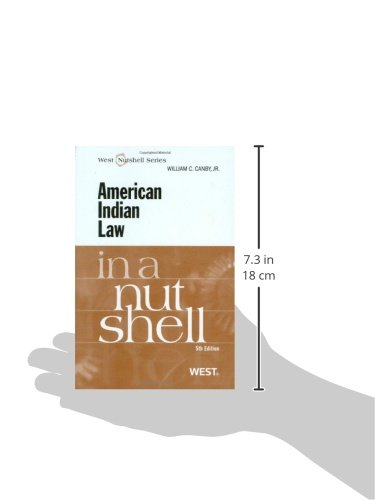
American Indian Law in a Nutshell by William C. Canby, Jr., the distinguished Senior Judge for the 9th Circuit Court of Appeals has now reached its 5th edition since its original publication in the early 1980's. I have lived with each edition since the second because of my involvement in Native American policy and governance since 1988.American Indian Law is a very specialized area of law and one does not enter into a solid understanding of its principles and practices easily. As Judge Canby himself notes, when you speak about American Indian Law, you are first talking about "Federal law about Indians". Such is the focus of Judge Canby's efforts: federal law about Indians.There is, of course a law of individual Indian nations known as Tribal law. Canby addresses the nature of Tribal law in the context of the rights of Tribes contrasted with the vast Congressional plenary authority over Indian affairs. Executive authority to make Federal Indian policy and carry out the laws is likewise considerable. Then too, with the passage of time Congress and the Federal courts have opened the door for States to have a greater role in Indian affairs because of situations like shared civil and criminal jurisdictin, dual roles in gaming and child welfare but to name just a few.How does one sort out and comprehend the multiple authorities and jurisdictions? Where can lawyers and policy experts turn to for an initial understanding of American Indian law outside of dense casebooks and advance treatises like Cohen's Handbook of Indian Law (2005)?The answer is a good primer and American Indian Law in a Nutshell has enjoyed pride of place for more than 30 years. Judge Canby who also use to teach Insian law at Arizona State University is a clear, concise and even-handed guide. He provides a solid historical overview of Federal Indian law and policy--something essential for any further understanding of Indian law; and a clear nderstanding about the scope of Indian law. Likewise, he clears up confusion that can quickly arise about who is an Indian and what is a tribe.With this foundational background in place, Canby discusses the special relationship between Tribes and the Federal government, the "trust relationship", what Indian tribal governments can do and the nature of Indian sovereignty and significance of Indian treaties. From here, Judge Canby moves forward to the complexities of civil and criminal jurisdiction in Indian Country with a seperate chapter on Public Law 280 granting full or partial civil and criminal jurisdiction to states. The status of Alaska Natives is a special case covered in Chapter XIII.Taxation, regulation and gaming are at the heart of many of the disputes between Indian tribes and the states wherein they reside as "nations within a nation". Land, fishing, hunting and water rights are also sources of conflict and dispute between tribes, states and the Federal government. The major issues are deliniated with leading case law covered.It must not be forgotten that Indians are state and Federal citizens while also being citizens of their respective tribes. It is also true that non-Indians also reside on our larger reservations or otherwise come into civil or criminal contact with Indian nations. The Indian Civil Rights Act and its applicability to Indians and non-Indians is discussed.In 15 broad chapters Judge Canby succeeds in doing what every good primer should do: He covers the essentials of every important topic in a fair and impartial manner. He does so in a manner that is refreshingly free of ideological cant that has crept into some of contemporary American Indian legal literature. Finally, there is another reason to buy Canby's book. Cost. It is just $30.00 compared with $150.00 for Cohen's Handbook and $100 for the American Indian Law Deskbook and another hundred or more for a casebook on Indian law.Even if you are a specialist in Indian law or policy, Canby's nutshell on Indian law is valuable even as one moves on to the bible of Indian law--Cohen's Handbook of Indian Law.
C**.
The Best Place to Start to Understand Indian Law
Although I understand the earlier reviewer's concern regarding anti-discrimination law and how miserable law school can be, I have found this book to be the best possible introduction to Indian Law. My law school offered no Indian Law class, and wanting to learn more after I read about the Cobell case, I needed a concise book. Canby has done a wonderful job. His historical introduction is a quick and engrossing read, and the other chapters in the book are equally clear and concise. I owe him much, given that I wrote two papers on Indian Law in law school and quoted extensively from him. Yes, Indian Law is a complex field where tribal sovereignty and the government's trust responsibility often collide and where concepts of jurisdiction and property are seriously muddled, but Canby gives you just what you need to get your legs under you, understand the basic concepts, and know where to begin to research from there.If the Indian Law bug bites you after reading this book, which it likely will, then you can move on to the 2005 edition of Felix Cohen's Handbook of Federal Indian Law or the 2005 Clinton, Goldberg and Tsosie American Indian Law manual - and spend the big bucks!
A**R
South Dakota bar prep tool
I used this to study for the South Dakota State Bar exam. I couldn't find a single test-specific study guide. But this worked out alright. I haven't used it for anything else. I'm not sure I did that well on the indian law question, but I passed the test. And this book has enough information to study for the test. I'm just not sure I actually studied enough for that question.
L**R
If you need it, get it.
It's a boring read, but if you have the right instructor it's interesting. I'm glad that it was something that I bought, considering I wouldn't be able to pass my class without it! It offered good explanations to most topics, however it makes many references to federal laws that leave you scratching your head and glazing over.
H**K
Easy to read and understand
I bought this for the South Dakota bar exam. I really like Nutshell books because they're succinct and get to the point. They're not written in legalese and they don't present case law, it's black letter law written in narrative form. It's easy to hop from chapter to chapter and easily learn areas of the law which might be tested. Fingers crossed for the February bar!
A**A
Excellent introduction to Indian Law
I am a retired lawyer from CA living in NV. I am looking for something new and different and Indian Law suddenly came to mind after a visit to the Acoma Pueblo in New Mexico. I am familiar with this series from law school. This is a terrific introduction to this area of law. Be sure to buy the most recent edition.
S**E
Excellent Summaries
This text is a terrific companion for any lawyer or student dealing with the interplay of the federal government, states, and Indians. Well written. Concise. Helpful citations.Can by brings the vast body of Indian law into clear focus.
N**N
Hand in Hand - Easy to Read
Straight and to the point. I love the easy to read format. You can find exactly what your looking for just by simply skimming through the titles. I'm using this and The Rights of Indians and Tribes by Stephen Pevar for an online course, and its like they were written together.
Trustpilot
2 weeks ago
1 week ago