Some deliveries may take a little longer than usual due to regional shipping conditions.

DOWNLOAD THE APP


Customer Services
Copyright © 2025 Desertcart Holdings Limited
DOWNLOAD THE APP
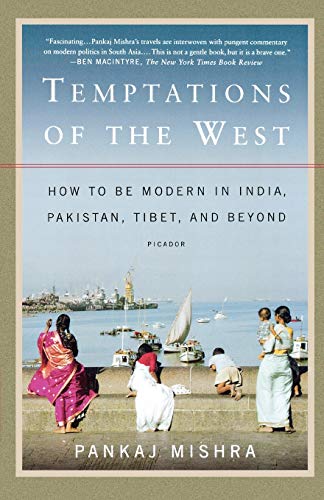
Temptations of the West: How to Be Modern in India, Pakistan, Tibet, and Beyond
D**I
Honest Reporting from Volatile Regions
The book contains treatises on the author's travels through India, Afghanistan, Pakistan, Nepal and Tibet. Pankaj Mishra provides honest, fearless reports from the areas he visits. The incidents and conditions that he reports are hardly covered or purposely censored in the mainstream media. Reports from Kashmir, Pakistan's play in Afghanistan and the political reasons on events and the governments responses, are well covered. He also mentions the threats he and his family have received due to his frank coverage.The book is recommended to anyone who wants a honest, on-the-ground view of things.
A**I
Great read but lacks coherence
Unlike his other books (e.g. "From the Ruins of Empire)", this book doesn't seem to remain committed to it's central theme. Some parts of it seem like they're a rather concise summary of how things have come to be whereas others (especially the one about Bollywood) seem like they're forcibly told in a manner that attempts to fit into the purported narrative. It's still a very engaging read, just that it doesn't fundamentally alter your perception of South Asia, something I've come to expect from his books.
J**K
Insight into a little known part of the world
In this book of essays, travel reports, and opinions, I'm not quite sure just what the word 'Modern' means in the sub-title. The places he visits and upon which he reports don't seem to fit my definition of 'modern.'India is, of course, a world of contrasts, just as is the rest of the world. The places he describes in this book are a long way from the high-tech world you talk to whenever you have a problem with your computer. It's much the same as comparing the fishermen in South Louisiana with down town Manhattan.Here we see India (and surrounding countries) as a place of dirt streets, mud houses, and a collection of hatreds between tribes and religions that go back centuries. At the same time, he reports on some progress as a middle class begins to emerge, but also a religious militancy with inter religious warfare. The pull of the material aspects of the west are matched by nationalism.Mostly I come away from this book knowing that I know less about that part of the world than I thought. That I will probably never have a good understanding, and a feeling of some dispair in looking towards the future.
S**U
The Effects of Globalization on the Indian Sub Continent Through the Eyes of a Brahmin Journalist.
Mishra is an Upper Caste Hindu Journalist who tries to show us the conditions of the States of the Indian Subcontinent as a result of Globalization and Modernization through his eyes and experiences. We follow him as he interacts with people in different castes, politics, Bollywood Entertainment, the Police, the Military, Militias, education, and simple peasants.We get a history of Indian/Pakistani Politics since 1948 from his experiences. We get a simple understanding of how India has florished while Pakistan has floundered. Of how the Congress party of Nehru and the Gandhi's have been overcome by the rise of Hindu Nationalist parties like the BJP.He visits the Kashmir and we can see how it became India's Northern Ireland with the exception that both sides are armed with nuclear weapons. The Troubles there are similar but the killing is magnified 10 fold as no human rights groups manitor the Indian nor the Pakistani armies for human rights violations.We get a glimpse of the Bollywood scene in Mumbai. How it is similar to the Holywood Studio system of the 40's(maybe the 30's as each film seems to have a song and dance number). We get an understanding of what is acceptable on film in that culture and why there was such a hue and cry recently over Richard Gere's kiss in public.Mishra's strength is that he lets his subjects tell the story of their lives and how the World has changed around them. His most compelling sections are where he relates his own life experiences. I recommend the book as an excellent glimpse into the cultures of South Central Asia.
R**E
temptation of the west
I just got the book and started reading it and it is very interesting.things that people go through in other countries and how they overcome it. This book is good
L**Y
Worth reading, its an eye-opener
Pankaj Mishra writes like he is having a long and detailed conversation with you. After spending a few weeks reading this book, I feel that he is a close member of my social circle. He is a true journalist - he does not preach, he allows you to draw your own conclusions. His facts will knock your socks off. This is stuff we never hear in our world of Fox News.
U**R
Title and contents don't match
If you don't care about the title, then this is a very readable book and, Mishra is a good writer. It informs you about the people and places that Mishra visits; albeit in a somewhat cynical way. The problem arises when you start dissecting the book. You wonder if Mishra really has any expertise to write about places like Nepal, Tibet, Afghanisthan, Pakistan etc. It seems that his expertise is really in the underdeveloped Hindi belt, and surroundings of North India, an area which is quite removed from the modern world. Then what is this title all about? To find real stories about the temptations of the West, shouldn't one be digging in South India?Coming back to the book, Mishra raises some soul searching issues about the failure of Democracy on one hand, and the tendency of the emerging Hindu middle classes to mutedly tolerate violence against minorities. Both of these issues are heavy topics that need to be covered thoroughly, with the one-on-one perspective that Mishra has.
F**Y
lively and in depth reportage
This travelogue/reportage is extremely well written with very deep analysis of the social forces that rule these places of geopolitical importance. Mishra has invoked the history in brief for each place to explain why the society there is turning the events in some particular way. He also explains how the hegemonic powers are causing tension in the lives of the people living there. However the title is a total misnomer, and does not convey the true value of this book. This book does not give a list of "what to do's" if you travel those places. It reports what the author saw happening in those places, tried to get interviews of some key players and explains the socio-historic background of the regions.
M**.
What the news never tells us
I picked this book because I was looking for something to tell me about the way life is changing on the Indian sub-continent. I was expecting a report about economic success and increasing materialism. What I got was much a deeper, darker, far more interesting but worrying political and economic report surrounding tales of everyday life.It's rare good fortune to stumble over a book that tells you things you never knew you didn't know; Pankaj Mishra explores and explains details about life in the East which are truly shocking to someone like me who thinks she's reasonably well-informed about world affairs. This book has entirely changed my views on India. We hear and read in the West about India's marvellous economic revolution and how we all ought to be doing business with the forward thinking, intelligent people there. Who wants to know about all the other people who aren't feeling the benefit, who are becoming poorer, deprived of even the basics for a bearable life, living in fear of violence?This is a book about individuals' lives, people that Mishra helps us to understand and like or dislike, in whom we become fascinated. Educated people who can't even dream of finding a job, corrupt politicians and their dedicated counterparts, aspiring film stars, bereaved families. It's a book about people and their backgrounds, the political and economic backdrops against which their difficult lives are played out. I wonder what has happened to them?I've been urging people to read this book, especially people who do business with India. This is not an easy nor a comfortable read, but it is a rewarding one.
M**Y
Pankaj Mishra is always worth reading (and re-reading!).
Factual reporting, informative, interesting and well written.
N**M
Mishra grows up
Before reading Temptations, I read Mishra’s Butter Chicken in Ludhiana where he seemed less mature and much more disdainful about expressions of modernity in recently-liberalised India. In this work, he seems more measured and compassionate, while retaining a critical distance from the subject matter of how the imposition of “modernity” has impacted the lives of millions in a belt stretching from Afghanistan to Tibet.In what seems to be a theme for Mishra, he focusses on the jarring nature of an imposed modernity on groups with limited exposure to it and almost no experience dealing with it. Having read his more recent work, Age of Anger, he seems particularly keen on understanding the disaffection or discomfort felt by provincial young men thrust into a world that they don’t have a ready way to navigate, where older, more set ways of interaction have been violently replaced, leading to bewilderment and confusion. I suspect this stems from his own upbringing in small-town India and the disorientation he experienced when he left home for university.Overall, a fascinating if slightly overwhelming book.
A**R
overrated
this book is simply overrated author is just describing his memories of living at different places in south Asia but he lacks sociological understanding as well depiction .very shallow
M**Y
Three Stars
Enjoyed reading this book.
Trustpilot
2 months ago
1 month ago