We remain fully operational. Our teams are working around the clock to ensure your deliveries continue safely.

DOWNLOAD THE APP


Customer Services
Copyright © 2025 Desertcart Holdings Limited
DOWNLOAD THE APP
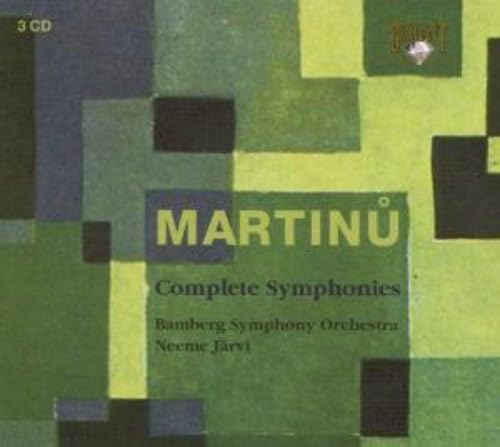
CD Review: Good intro to little-known symphony cycle - I didn't know Martinu well and bought this set to learn his symphonies. Among 20th century symphonies they are fairly easy to take and are not quite as "angular" as Shostakovich or Prokofiev. Järvi specializes in off standard repertoire so helps us discover these works with more than competent conducting and interpretation -- though he is rarely a "heart on sleeve" kinda guy. The Bamberger Symphoniker are favorites of mine since the Telefunken LP (aka Vinyl) days when I had some records of them conducted by Keilberth. While living in Germany in the '60's I also heard them live a couple of times. Review: Superb Service - Product was delivered exactly as advertised. The shipment packaging of the CDs was extraordinarily careful -- I'll go so far as to say lovingly -- with the clear intention to protect the multi-CD set from being damaged. The set arrived in mint condition. I'm extremely pleased and very impressed.
| ASIN | B0017HFRFI |
| Best Sellers Rank | #205,917 in CDs & Vinyl ( See Top 100 in CDs & Vinyl ) #5,234 in Symphonies (CDs & Vinyl) |
| Customer Reviews | 4.4 4.4 out of 5 stars (39) |
| Date First Available | June 17, 2008 |
| Is Discontinued By Manufacturer | No |
| Item model number | 1-1-24602-22 |
| Label | Brilliant |
| Manufacturer | Brilliant |
| Number of discs | 1 |
| Original Release Date | 2008 |
| Product Dimensions | 4.92 x 5.63 x 0.98 inches; 2.43 Pounds |
J**N
Good intro to little-known symphony cycle
I didn't know Martinu well and bought this set to learn his symphonies. Among 20th century symphonies they are fairly easy to take and are not quite as "angular" as Shostakovich or Prokofiev. Järvi specializes in off standard repertoire so helps us discover these works with more than competent conducting and interpretation -- though he is rarely a "heart on sleeve" kinda guy. The Bamberger Symphoniker are favorites of mine since the Telefunken LP (aka Vinyl) days when I had some records of them conducted by Keilberth. While living in Germany in the '60's I also heard them live a couple of times.
E**2
Superb Service
Product was delivered exactly as advertised. The shipment packaging of the CDs was extraordinarily careful -- I'll go so far as to say lovingly -- with the clear intention to protect the multi-CD set from being damaged. The set arrived in mint condition. I'm extremely pleased and very impressed.
B**0
Heard a cut on the radio
I heard Martinu on a classical station. I was intrigued by this composer I had not heard of before. Kinda Prokofiev with a touch of Stravinsky. When I got the set I listened to about half of it. The sound and orchestration is good, but some how the composition of all the pieces listened to just didn't quite cut it for me for some reason. After a while listening you realize that the pieces are weak on theme or arc. Kinda rambly and unfocused which tired me. The upside is that the composer is different from the regular pop classical fare, and parts of his stuff is off the wall and attention getting. It's sad when a composer comes up with some good bits, but can't seem to string them into one sturdy body of work. I'm no reviewer or academic, but I have listened to a serious amount of classical music in the past 45 years. Martinu is interesting but sad to say mediocre to my ears.
M**R
Very nice music -- unfortunately, neglected
Really, really nice symphonies -- unfortunately, quite unknown. Unfortunately, given Hitler's musical aesthetic during the 1930s and 1940s, this became all too common with many central European composers who have ended up being more or less forgotten.
P**G
It is a delight, and these are excellent performances caught in fine ...
Too many people do not know this music. It is a delight, and these are excellent performances caught in fine sound.
L**K
Great
It appears to have arrived in time. It was a gift so I don't know what they thought. I expect they liked it.
A**S
Martinu's Symphonic Cycle from Jarvi -- superb!
I discovered this Brilliant box of Martinu in Berlin on the way from the Friedrichstrasse Bahnhof to the Brecht-Weigel House on Chausseestrasse. An excellent bargain! Bohuslav Martinu (1890-1959) only began composing symphonies after fleeing the Nazis into American exile in 1941. He was of a generation that saw the symphony as passe -- Bartok was born in 1881 and Stravinsky in 1882, and Martinu was born in 1890 -- while Mahler was born in 1860, and Sibelius and Nielsen in 1865. Modernism entailed new forms and styles, and while Martinu was never a modernist he did inhabit a soundworld with a lighter touch full of dance rhythms, not heavy, four-square symphonies. But he received a commission from Koussevitsky and the Boston Symphony, so he wrote a symphony. And then another, and another... He ended up composing a symphony a year every year from 1942 to 1946, No.s 1 through 5, and later a Sixth, his most popular. They are graceful, full of dancing rhythms, and of classical proportions, ranging from 23 to 36 minutes in length. Symphonies 1, 2 and 4 are in the traditional four-movement form, while No.s 3, 5 and 6 each have three movements. The First, Third and Sixth were premiered by the Boston Symphony, the Second was premiered by the Cleveland Orchestra, the Fourth was premiered by the Philadelphia Orchestra, and the Fifth is unique in having been premiered by the Czech Philharmonic and Rafael Kubelik. Symphony No. 1 demonstrated that Martinu's gifts, previously applied to the concerto grosso form, all manner of chamber music, and opera, could be applied to great effect to the symphonic form, despite his misgivings. Its success spurred him on. Symphony No. 2 is shorter and uses Czech and Moravian folk melodies in the slow movement, his most Czech symphony, and features the use of several small groups of instruments. Symphony No. 3 stands out from the others in its dark and somber hue. While parts of the First and Second had reflected the war, the Third is clearly marked by it through and through. It is Martinu's only work that reminds me of Shostakovich in its gravity and tragic cast. It is a powerful work which ends without a triumphant resolution, despite Beethoven's Eroica being an inspiration and despite the D-Day landing at Normandy taking place shortly before Martinu completed it. Though atypical, I consider this to be one of the finest jewels in this string of six. The Fourth complements the Third perfectly as it celebrates victory. The second movement Allegro vivo reminds me of nothing so much as the scherzo to Beethoven's 9th, a propulsive dancing march rhythm. It has the forward momentum of the opening of Roussel's Third Symphony, but is lighter on its feet. And the Poco allegro finale is an ecstatic celebration, the triumph that was withheld at the conclusion of the Third. The Fifth is more questing and tentative after that burst of enthusiasm. It was first heard at the inaugural Prague Spring Festival in 1947. A head injury caused by a fall from an open second-floor terrace led to several years of expensive treatment and convalesence, but Martinu returned to composing at the peak of his powers. The Sixth was finished in 1953, and is the most broadly Romantic of his symphonies, sounding like Copland in parts with lush, sweeping melodies, and using the melody "Across the Wide Missouri," though I've never seen this mentioned anywhere. Listen for yourself and see. It remains one of Martinu's most popular works. This box, with Neemi Jarvi leading the Bamberg Symphony Orchestra, is now in direct competition with the Chandos box of Martinu symphonies with Bryden Thomson leading the Royal Scottish National Orchestra . (And it replaces the earlier BIS box .) They were recorded at about the same time -- Jarvi's cycle, originally on BIS, in 1987/1988, and Thomson's in 1989/1990. This set combines the works chronologically, with 1 & 2 on Disc One, 3 & 4 on Disc Two, and 5 & 6 on Disc Three. The Chandos box pairs 1 & 5, 2 & 6 and 3 & 4. I prefer the chronological ordering myself. The Chandos box is a "true box" with the discs in cardboard sleeves, while this Brilliant set is not actually a box, but rather a fold-out with three jewel-case inserts for the discs. Not as elegant, but it works. Some have reached the sweeping conclusion that the Thomson set is faster than the Jarvi set. This is not totally accurate. Comparing movement by movement, Jarvi is actually faster in 8, while Thomson is faster in 13. It is true that Jarvi takes the slow movements more slowly, but the overall timing does not dramatically differ between the two. And while both cycles are fine accomplishments, I would not be without Jarvi's Third, which I prefer decisively over Thomson's because the opening is *faster.* Overall Thomson excels in bringing out the dancing rhythms in Martinu, while Jarvi is better at accentuating the more classical, more Germanic, elements, but these differences are relatively minor. If you are a symphony lover, and/or someone interested in hearing great early 20th century classical music, you should definitely not miss the symphonies of Martinu! (verified purchase from a shop in Berlin near the Brecht-Weigel House)
S**Y
This is the definitive Martinu cycle in demonstration sound and it's at budget price and well packaged. What are you waiting for?
M**N
あまり知られていない作曲家の素晴らしい曲を聴く事ができました。
F**L
Fenomenal trabajo de la orquesta y del director. Por otra parte las sinfonías de Martinú me han sorprendido para bien. Imponentes y con mucho trabajo de percusión . Interesantes y sorprendentes. El precio: una ganga...
B**A
Très bons enregistrements, rares, 3 disques qui couvrent la musique symphonique de ce musicien peu joué en France. Je recommande.
R**L
Martinu ist für mich DIE Entdeckung der letzten Jahre. (Nicht nur seine Sinfonien) Rhythmisch, einfallsreich, lebendig. Eine unwiderstehliche Mischung mit, ich denk für ihn typischen, Dur/Moll und Harmonie/Disharmonie-Wechseln, und immer wieder folkloristische Elemente.
Trustpilot
5 days ago
2 weeks ago