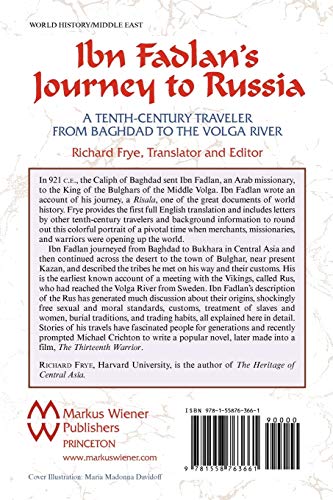


Buy Ibn Fadlan's Journey to Russia: A Tenth-century Traveler from Baghdad to the Volga River illustrated by Frye, Richard, Frye, Richard (ISBN: 9781558763661) from desertcart's Book Store. Everyday low prices and free delivery on eligible orders. Review: fantastic - About the best known and the first eye witness account of the vikings and Northern Russia. A fantastic source piece. I do wish though that we had more source work from this period from non Byzantine sources. Highly recommend this book and wish more writings from this period had survived and indeed more people had recorded the era in this part of the world Review: Awesome - A must for any heathen, it is an outsiders observations of different folk, there customs rituals and belief structures. This translation into english is an excellent addition to any personnel library, the chapter on the Rus my particular favourite.
| Best Sellers Rank | 1,539,078 in Books ( See Top 100 in Books ) 9,073 in Travel Writing (Books) 32,379 in World History (Books) |
| Customer reviews | 4.8 4.8 out of 5 stars (39) |
| Dimensions | 14.61 x 1.27 x 21.59 cm |
| Edition | illustrated |
| ISBN-10 | 155876366X |
| ISBN-13 | 978-1558763661 |
| Item weight | 281 g |
| Language | English |
| Print length | 158 pages |
| Publication date | 1 Dec. 2009 |
| Publisher | Markus Wiener Publishers |
M**R
fantastic
About the best known and the first eye witness account of the vikings and Northern Russia. A fantastic source piece. I do wish though that we had more source work from this period from non Byzantine sources. Highly recommend this book and wish more writings from this period had survived and indeed more people had recorded the era in this part of the world
A**Y
Awesome
A must for any heathen, it is an outsiders observations of different folk, there customs rituals and belief structures. This translation into english is an excellent addition to any personnel library, the chapter on the Rus my particular favourite.
J**N
Ibn Fadlans's Journey through Russia
What a debt of gratitude we owe to those Arabic scribes who gave an impartial eye witness account of Vikings, unlike our Anglo Saxon scribes who had good cause to be bias. This book makes for compelling reading. A true window to the past and such detail for the time it was written. Brilliant!
B**S
Me fascina la temática sobre este viajero musulmán y todo lo que envuelve a las diferentes descripciones que se encuentran en su libro. La Edad Media se presenta como una época poco conocida, en la que aún se tiene mucho que descubrir.
D**Y
I understand that Michael Crichton based his book, "The Eaters of the Dead", on Ibn Fadlan's account of his journey to Russia--and the movie "The 13th Warrior" was based on Crichton's book. I've not read Crichton's book, but, being a huge fan of Medieval Norse myth and culture, I have seen the movie. (It was something of a disappointment, but that's Hollywood for you...) It may surprise some people to discover that Ibn Fadlan was a real person, who was indeed sent on a journey to Russia, and who indeed meet the Rus (who were probably in large part Swedish Vikings), among many other peoples besides. I can't say anything about Crichton's book, but the only part of the movie with any basis whatsoever in reality was the beginning. (Yes, Ibn Fadlan even records the Russ washing and blowing their noses in a communal bowl--although Ibn never mentions this water being drunk afterward, as I believe happens in the movie.) Everything having to do with Ibn Fadlan as a "13th warrior" is pure fiction, and based, as I understand it, on the English poem Beowulf. (Perhaps that basis is largely lost in the movie, because, although I'm no scholar, I don't see much resemblance between the two.) The reason I bought and read this book had nothing to do with Crichton or the movie; rather Ibn Fadlan's section on the Russ is very often quoted and/or referred to in other works about Viking culture, and I wanted to read the entire account for myself. Ibn Fadlan's most vivid account of the Russ is that of the funeral of one of their cheiftans, which Ibn happened to witness. This is touched upon in the beginning of the movie, when the slave-girl is being hoisted repeatedly over the door-frame-like structure and reports seeing her master in the other world. I believe the movie leaves out the fact that this slave-girl volunteered to be sacrificed and accompany her master to the other world; the scene in which she appears directly precedes her being ritualistically killed by the "Angel of Death", who is I think also mentioned in the movie, albeit in a different context. An often-quoted scene in this account is as follows: "A man of the Rusiya was standing besides me [Ibn Fadlan] and I heard him talking to the interpreter, and I asked what the Rus had said to him. The interpreter answered that he said: 'They, the Arab communities, are stupid.' So I asked: 'Why?' He said: 'You go and cast into the earth the people whom you both love and honor most among men. Then the earth, creeping things, and worms devour them. We, however, let them burn for an instant, and accordingly he enters paradise at once in that very hour,' and he burst into immoderate laughter. "He said: 'His Lord sent the wind for love of him, so that he may be snatched away in the course of an hour.' In fact an hour had not passed when boat, wood, maiden, and lord had turned to ashes and dust of ashes..." But Ibn Fadlan encountered many peoples other than the Rus, and he writes about them all, including his interactions and (mis)adventures with them. His chapter on the Rus constitutes just a small section of his work, and this translation, by Richard Frye, contains at least as much introduction and commentary as it does actual text by Ibn Fadlan. There's a wealth of information regarding the world and circumstances in which Ibn Fadlan set out on his journey, and it sheds much light on the original text. Many people would probably consider this a dry read--but if you're not interested in the time, places and peoples that Ibn Fadlan describes, you probably have no reason to be reading the book in the first place. If, on the other hand, you ARE interested in such things, it's an entertaining and enlightening read.
H**T
Very interesting read, but the part related to Russia and Vikings specifically is only 11 pages long. Larger part of the book is description of the travel to Volga region by Ibn Fadlan, and all the wacky NSFW traditions he observes along the way. This, and the Viking part, together probably take 50-60% of the book. The rest is fluff by the author and stuff by other travelers. Overall worth the $25 as a nice conversation piece.
B**A
One of the best book I had read in my life.
C**A
Google Vikings and the middle east and you'll likely run across Ibn Fadlan's account, as it is one of the few surviving documents that record interaction between the Vikings and Muslims. While parts are particularly interesting, namely the funeral, Fadlan's report leaves one with more questions than answers that are open to interpretation. The largest one in my mind was how much was first hand account and how much was hearsay? For example, he describes the funeral procession as a normal spectator would at a distance, but then he is in the presence of the human sacrifice as it happens. How likely is it that the Vikings would have him in such a confined space as an alien observer during their performance of a (horrific, in my opinion, but) sacred act? Also, what nationality were these 'Rus' and how long had they been in the Russian area? Where they Slavs, Slav-Swedish mixes or an entirely different race altogether? Neither the text nor Frye's assumptions are clear. Which is to say Fadlan's Embassy mission MAY have had contact with the Vikings but there is no way to be certain. Frye concedes the difficulty in differentiating Varangian, Rus and Viking peoples with the limited Archeological finds and documentation. Another thing that struck me about Fadlan's account is how short it is, or how complete some sources list it. Although my interest was initially for the Muslim-Viking interaction as part of research I was fascinated by the Muslim-Bulghar-Khazar interactions. Frye paints an interesting picture of the relationships between Persia and the Byzantines amidst competing emerging religions. Fadlan's account gives us a good sense of the difficulty of simply getting from one place to the next in an uncertain and dangerous landscape. What it also touches is the long-forgotten Sassanian (currently Iranian) empire that gives shape and color to many things we naturally assume to be 'Muslim', but were borrowed by people of that new faith. Fadlan's account was a little disappointing due to my own high expectations but Frye's work and the publishing project (i.e. editing, pictures, maps) is exceptional all around.
Trustpilot
3 days ago
2 months ago