Some deliveries may take a little longer than usual due to regional shipping conditions.

DOWNLOAD THE APP


Customer Services
Copyright © 2025 Desertcart Holdings Limited
DOWNLOAD THE APP
Full description not available
A**S
How Death Has Changed, And What This Means For Patients
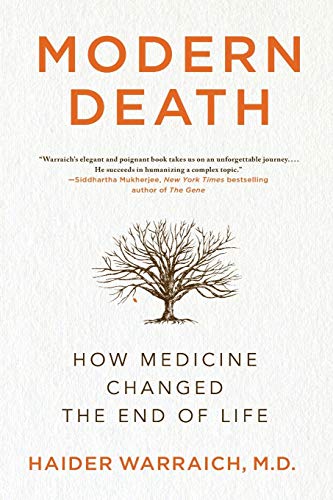
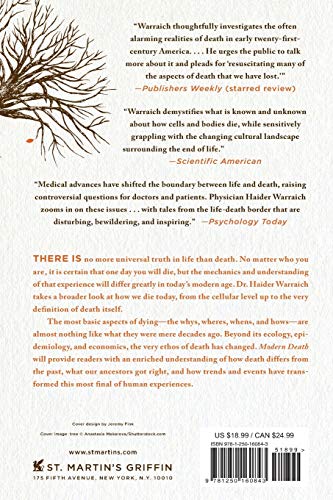
In this very valuable book, Dr. Warraich examines how death has changed, and discussing the implications of those changes for all of us. We will all die, and most of us will be involved in the deaths of others. But the way most of us die has changed drastically over the past century. Before then, death usually came quickly, at home, and was usually definitive -- the heart stopped, and so did life. But now death tends to be gradual, and to happen in the arms of the medical industrial complex of hospitals, nursing homes, and hospices. It is also, oftentimes, much harder to define - is someone dead when brain function cannot be detected, even if the heart continues to beat and the lungs to breathe? These changes pose problems for patients and care-givers, problems that all too often are not anticipated in advance. Dr. Warraich recommends over and over that people discuss and think about the way they want their lives to end before the crisis comes, and this book provides an enormous amount of information. It that sense, it can be liberating -- I did not find the book at all depressing (though it is painfully sad in some places). Dr. Warraich relies on extensive research and on his experience as a physician to make his points, a deeply satisfying combination.
K**R
Informative, Realistic, and Uplifting
Modern Death is a chapter by chapter exploration of how the medical profession, scientific advances in understanding, and twentieth to twenty-first century culture have changed what death is and how we die. I liked the format of the chapters; each exploring a different facet from the context of its own scientific, cultural, and political history as well its reality in modern death. I also liked the thorough, candid and realistic approach to death and all its adjacents in this book. The book was very informative and ultimately uplifting. I'm happy to have read it and will recommend it.
E**R
Dying in America -- probably not what you have in mind
I am a chaplain in a hospital. Dr. Warraich's well-researched and beautifully written treatise on how modern medicine has changed the way we die closely describes the reality I observe on a daily basis. In attempting to extend life, very often aggressive interventions seem to prolong a painful and confusing dying process that almost no one would elect if they and their families really knew the price they would ultimately pay. Sometimes the "hope" that medicine proffers can feel, in retrospect, more like denial, fear, and miscommunication. I greatly appreciated how Dr Warraich wrote about so many aspects of hospitalization, especially in the ICU -- a space that can be particularly fraught with mystery for patients and families.I am grateful to Dr Haider for articulating from a physician's perspective how we got where we are, and for his compassionate suggestions about how we might change the system to balance curative, palliative, and comfort treatments. Let us always remember that even in medicine, it's not just numbers and labs and cell counts that need to be looked at, and protocols that need to be followed, but that a human being is central to every single case. I look forward to reading more from this physician author.
N**A
Thought-Provoking Questions about Modern Death
Where do you want to die? At home? Well, good luck. According to Dr. Warraich’s well-researched statistics, it’s likely to be at a hospital or care facility. Do you have an Advance Directive? It may not have been in-putted into your care provider’s computer because it’s almost expected you’ll change your mind; after all, your illness and its complexities and your thought processes are likely to have changed from one hospital or doctor visit to the next. Has modern technology prolonged life or prolonged death? What is the definition of death, and how has it changed over time? How has Karen Ann Quinlan, Terry Schiavo, Jack Kevorkian and Alex Hardy changed the conversation about how we die? What is terminal sedation, and is it legal? These and many other questions about the modern way we die are answered—or not—in Dr. Haider Warraich’s thought-provoking and gentle treatment of a difficult subject. And he does so through poignant personal stories, statistics, history, definitions and court cases written in an easy-to-read-and-understand style. Doctors, patients, friends and families should read this book to begin the necessary conversation on modern death.
M**.
Writing that's dense and difficult to swallow
I pre-ordered this book immediately after hearing Dr. Warraich's interview on NPR's Fresh Air. The interview brought me to tears. Dr. Warraich's compassion for his patients, family, and colleagues was so inspiring to me as a new physician.As an intern (first-year doctor), I've been struggling with what we call "code conversations". Whenever I admit a patient to the hospital, I'm tasked with discerning the patient's wishes, should their heart or lungs stop working. It's a conversation that usually takes seconds, when I think it should take hours. There's a huge discrepancy between the "layman" and the medical professional when it comes to CPR and intubation. More often than not, the layman wants both (Full Code) and the medical professional wants neither (Do Note Resuscitate). The truth of the matter is that patients who get CPR do not do well in the long run. One NEJM study showed that among elderly patients who survived in-hospital cardiac arrest, only 60% we're alive at 1 year. I was hoping to gain some insight from Dr. Warraich on how to have these difficult conversations with patients.Unfortunately, I wholly agree with another reviewer who said this book is like a college term paper. I couldn't read it. The writing is dense and the prose leaves something to be desired. The patient anecdotes are compelling, but they are few and far between. I even bought the audio book in an attempt to power through it, but even that was hard to listen to.I don't recommend the book, but please listen to the Fresh Air interview if you haven't already.
M**T
Lots of medical talk but a very interesting and well ...
Lots of medical talk but a very interesting and well written book. It covers the many different perspectives and ideas surround individual rights versus medical practices. Anyone who knows anyone who ever may get seriously ill or grow old should probably read this book.
L**Y
At last an honest guide to death today
This is a remarkable path-finding book that clearly explains the process of breakdown leading to death. a subject that is unfortunately all too often ignored by most of us. The author, a doctor with much experience in dealing with patients in intensive care and patients who are terminally ill, addresses the issue of how we define death (and indeed life) at an age when progress in medical science keeps people alive longer than ever before until in some instances it is hard to know when death is completed. The paradox is that although we live longer now, the drawn-out experience of death is in many respects much worse than it used to be and whereas in the past, not all that long ago, many people died at home surrounded by family and friends, now death happens on impersonal hospital wards when one is alone. Having cared for my wife for five years before she died this book helps me to understand that whole trauma far more clearly and I think this will help you, too.
P**S
There is a good book to be written on Modern Death. This isn’t it
There are too many Americanisms, “pass “for “pass away”, “an attending” for “an attending doctor”.Much of the language is poor, Medical terms are used without definition or a glossary.
M**H
It's well written and easy to read and I thoroughly recommend it
This is such an interesting and thought provoking book. It's well written and easy to read and I thoroughly recommend it.
F**R
On time and good condition
n/a
R**Y
Modern Death
Most modern death occurs in Hospitals away from Home,families,loved ones in midest of i.v lines and ventilators and cpr procedures.but what most matters is death surrounded by family,loved ones,friends.explained is cardiopulmonary ressuciation,DO NOT RESSUCIATE(DNR),brain dead by giving real cases in hospitals.Good book on Death.
Trustpilot
1 week ago
3 weeks ago