

Desert Online General Trading LLC
Dubai, United Arab Emirates
Desert Online General Trading LLC
Dubai, United Arab Emirates

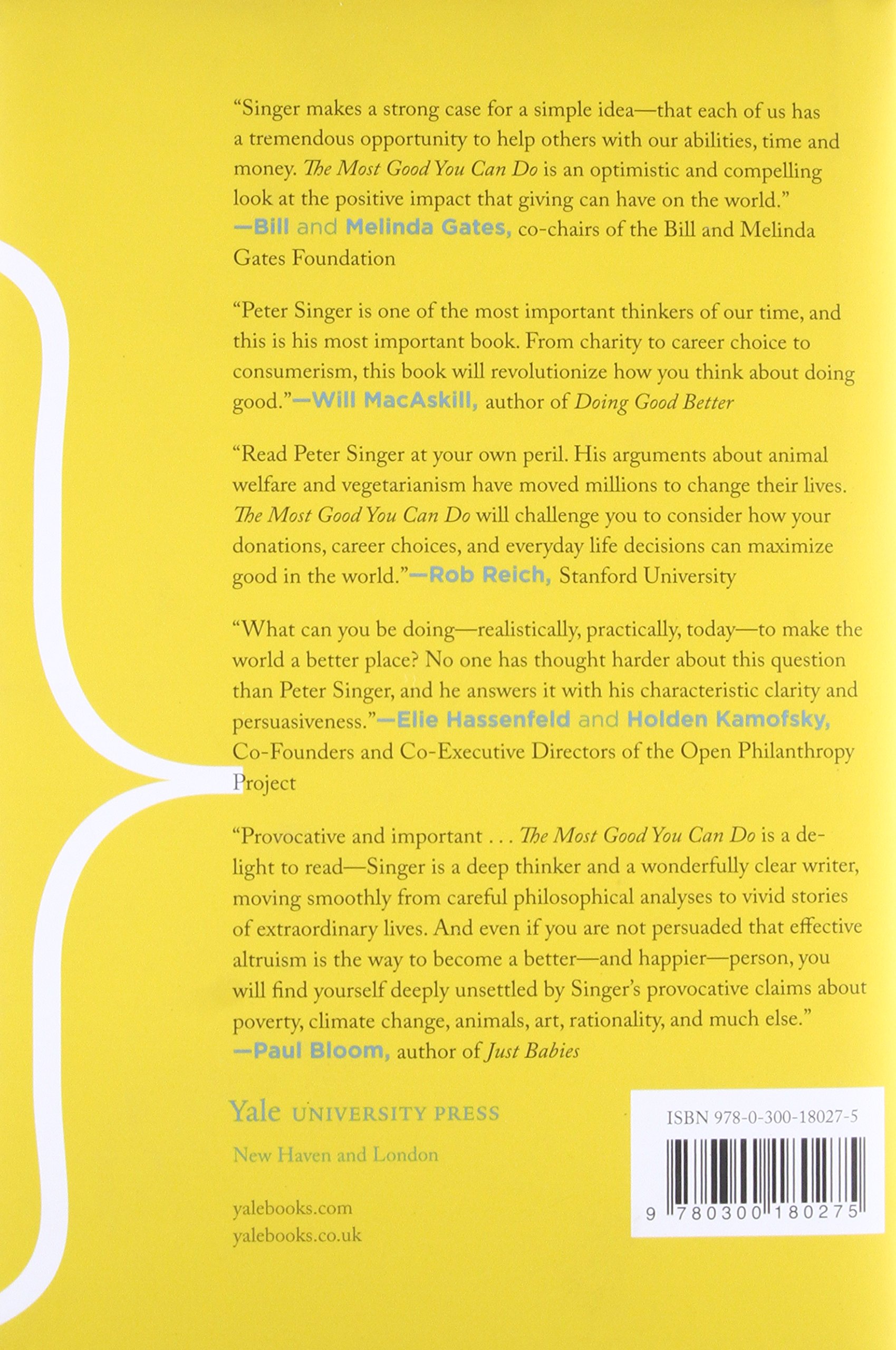
Full description not available
B**N
Life-changing
Seven years ago, Professor Singer came to my high school to give a talk about his previous book, The Life You Can Save. He exhorted me and my classmates to give to charities across the world as readily as we would leap into a pond to save a drowning child nearby. Of course I decided he was crazy and had no idea what he was talking about. (After all, if he really believed what he was saying, surely he'd live in a cardboard box so that he could donate more money to Oxfam! But he didn't, and he even told other people not to either.)Still, I couldn't get his arguments out of my head. They were a little scary, and yet compelling. What if I really could save so many lives simply by donating money that I had no real need for anyway? I should be lucky to have the chance!Seven years on, after mulling it over a lot, I've largely come around to Singer's point of view. I'm excited by the huge amount of impact I'm able to make simply by the luck of being born in a first-world country. I think of the idea of effective altruism as a challenge to rise to, not a burden to bear.Meanwhile, the effective altruism movement has matured and grown a thousandfold, and Professor Singer has wonderfully distilled its essence into a new book, The Most Good You Can Do. He still doesn't recommend living in a cardboard box--you can read why for yourself in chapter 3--but he does present a wealth of other knowledge about how to do a huge amount of good in the world.For readers new to effective altruism, here are my favorite chapters:- Chapter 3, in which Prof. Singer describes principally how one couple lives fully and happily on a small fraction over income, and donates over 50% to charity.- Chapter 5, which describes a lot of other people who have done incredible amounts of good with their careers.- Chapter 9, on the surprising fact that these people, who give away so much, do not seem to feel that it's a burden, but rather, that it makes them happier and more fulfilled.- Chapters 10, 11, and 14, on how to find the charities and causes that will do the most good with your donation. (Including one of my favorite thought experiments, the "demon-haunted art museum." Prof. Singer really has a knack for thought experiments!)Overall, the book was very readable--unlike most philosophers, Prof. Singer writes simply, lucidly and to-the-point. It's also fairly short, clocking in at about 175 smallish pages. But The Most Good You Can Do punches well above its weight; you'll find every page interesting and thought-provoking. Happy reading! You're in for a treat.
N**M
Must read for every philanthropist, however, he fails to provide enough credit to those working in the nonprofit sector
Singer's book, "The Most Good You Can Do," is a long overdue manifesto that the nonprofit community and philanthropists have been longing for. As a nonprofit professional, I found this book to offer a powerful plan for helping individuals achieve the greatest impact. Although I appreciate Singer's profiles of individuals who have decided to work for hedge funds and Fortune 500 companies, I do think he underestimates the ability to exert change from within the nonprofit sector. In fact, I think nonprofits would be negatively impacted if every bright mind went and worked for a for-profit rather than considering a career with a social enterprise/nonprofit organization. Singer's argument almost appears to come down to -- "well anyone can be aid worker" -- however, the reality is that it takes an innovative and creative mind in the field to recognize the opportunity for the next great breakthrough in combating poverty, etc.Although I put forward this humble critique of Singer's thesis, I do think that overall he presents a powerful argument regarding how best those with "means" can be agents of change with how they distribute their philanthropic giving. After reading Singer's book, I reviewed my own philanthropic giving, pooled the funds I was distributing to about a dozen charities each year, and used the tools presented in Singer's book to identify two high-impact global charities (Against Malaria Foundation and Mercy for Animals) as well as two U.S.-based charities to support. With the international charities in particular, I've found that the impact of my contributions is very easy to assess and understand whereas my gifts to U.S. charities tend to be more difficult largely because they are multifaceted and multi-service oriented (by practice, I no longer support "think tanks" or cultural institutions as I share Singer's concern that they fail to address the big problems of our time).If you're looking to make a difference then this book should be on your shelf and in your hands.
A**N
Empowering
I loved this book! It made me rethink a lot of my habits, as I realized there were so many more ways I could help others. Singer explains that effective altruists are people who aim to maximize their positive impact. He gives good examples of which nonprofits are most effective (usually ones addressing the global poor or farm animal welfare) and people who are effective altruists. Most of the effective altruists he mentioned gave 10% of their income to charity, with students and lower-middle class altruists tending to give around 5% and one particularly wealthy altruist donating 95% of his income. Each effective altruist budgeted to still have enough money to cover necessary expenses, hobbies, and take care of family, so they did not see donating such large percentages as sacrifices. Singer used reasoned calculations to explain potential budgets and how some organizations are significantly more effective at helping per dollar donated than other organizations. I have bought additional copies to give to others, since it was so empowering to see how even someone on a modest income can make such a big difference. Highly recommended!
Trustpilot
3 weeks ago
3 weeks ago