Some deliveries may take a little longer than usual due to regional shipping conditions.

DOWNLOAD THE APP


Customer Services
Copyright © 2025 Desertcart Holdings Limited
DOWNLOAD THE APP
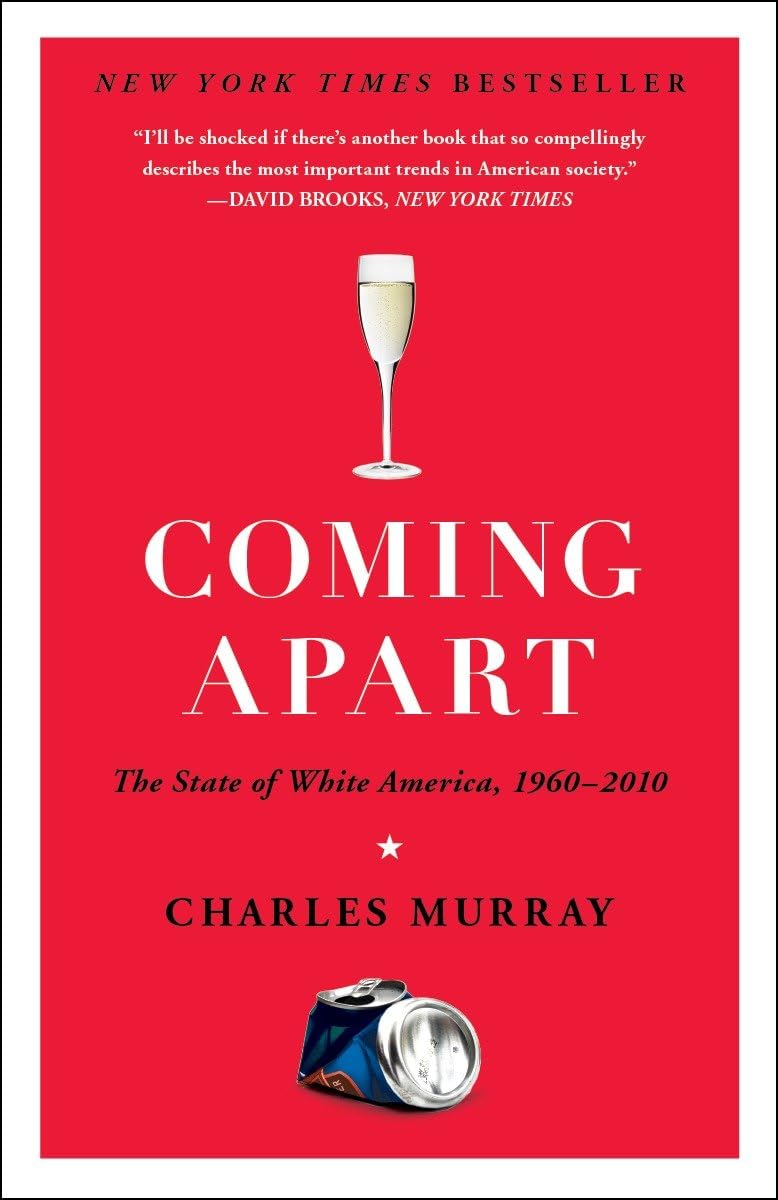
Coming Apart: The State of White America, 1960-2010 [Murray, Charles] on desertcart.com. *FREE* shipping on qualifying offers. Coming Apart: The State of White America, 1960-2010 Review: A Very Important Book - As many have argued, this is a very important book, perhaps the most important this year. The argument can be briefly summarized: the founding of our country was premised on the notion of virtuous behavior. Absent such behavior, the exceptional degree of personal freedom accorded by the Constitution would lead to failure rather than success. This virtuous behavior can also be correlated with individual happiness. The nexi for the relevant behaviors are: work, faith, community and family. Industriousness can lead to wealth. More importantly, it leads to self-esteem based on accomplishment. Our desire to pursue a meaningful vocation bears on our personal happiness. The regular practice of faith has characterized the American project and can be shown as well to contribute to personal happiness. This is true as well for civic participation, neighborliness and philanthropy. Finally, the nuclear family with married biological parents contributes to both financial wellbeing and personal happiness. In the 1950's there was considerable commonality across American society. Although there were differences in income there was much less cultural differentiation. Far more Americans watched The Beverly Hillbillies than now watch American Idol. Diets were similar; we drove American cars and there was a greater sense that `we all are members of the middle class'. That commonality has now been lost. We have a society bifurcated by class (not, it should be noted, ethnicity). The successful, the `cognitive elite,' David Brooks's `bobos in paradise' live in a very different way than the poor. They eat radically different foods; they marry later; they watch far less television; they don't smoke; they drive foreign cars, and so on. Most important, they attend church far more regularly; they contribute to their communities; they work very, very hard and they have children within wedlock. In short, the elites practice the virtues urged by the founders and confirmed by modern social science as having positive results. They do not, however, preach what they practice. They are studiously nonjudgmental. This is usually seen as `tolerance', though it could be viewed, conspiratorially, as their `keeping the secret to themselves' in order to sustain their elite position. I would put it this way: the elites have been enjoined never to discriminate with regard to race, class, gender, and so on, but they have neglected to notice that the word `discriminate' also is defined as `to use good judgment'. The former is important, but the latter is equally important. Elites should not remain silent for fear of offending if their silence contributes materially to human suffering. Murray describes these two groups in terms of imaginary communities: `Belmont' and `Fishtown' and traces their attitudes and behaviors, their successes and their dysfunctionality. The discussion is confined to whites, but when minorities are brought into the equation the results (behavior > success/dysfunctionality) remain essentially the same. While fearing the growth of dysfunctionality and the destruction of the American project, Murray holds out hope for other alternatives--first, that the elites will share their `secret' and speak up on behalf of virtuous behavior; second, that modern genetics, neuroscience and social science will demonstrate that the views of human nature that undergird the European welfare states will simply be proved to have been wrong and the ongoing implosion of those states will foster a reinforcement of American exceptionalism. Needless to say, this is fiery material that will evoke passionate responses. The beauty of the book lies in the clarity of its argument, the use of a breadth of materials, from popular culture to Aristotelian notions of happiness, to modern survey research and the rigor with which it is presented. This is not a screed; it is an elegiac expression of hope that is deserving of wide and serious attention. Review: The Problem is Clear; the Solution More Elusive - In "Coming Apart", social scientist Charles Murray explores class divide in modern United States. The book's subtitle, "The State of White America", and the limit in scope of Mr. Murray's investigation it highlights, is an unfortunate limitation for this, and any, book about class divide. Murray said the reason for this focus on just "White America" was because he wanted to eliminate the race variable from the equation. Murray warns readers to not "kid yourselves that we are looking at stresses that can be remedied by attacking the legacy of racism or restricting immigration." The focus on just one race of people in the book, Murray argues, is to make the point that not race, but class, is the important reference point around which any debate on what ails America should hinge. The unfortunate aspect of this choice, which I cannot wrap my head around, is that if Murray wanted to demonstrate that class is the dividing factor in society, so shouldn't he have tried to show that these class divisions exist, even when controlling for the race variable (rather than merely eliminating it as a variable for consideration)? The problem is, that if this book only addresses a divide that exists within one racial subset of America, than we are not in a position to extrapolate any of its findings to society as a whole. Nonetheless, Mr. Murray presses on with this more limited approach, injecting a palatable narrative into a broad set of sociological findings, ones that cannot be quickly dismissed merely on account of their shortcomings. To make his findings easier to digest, Mr. Murray creates two prototypical American towns: Belmont and Fishtown. These towns are meant to represent the new upper class (Belmont) and everyone else (Fishtown). The one and ninety-nine percent, if you will. With these two prototypical towns, Murray, in rather thorough and compelling detail (within the most memorable portion of the book) lays out rich data that outlines the differences in financial and education status between haves and haves-nots in America. Murray demonstrates how members of Belmont live in what he coins "SuperZips" or clusters of elite Zip Codes usually located around major metropolitan areas (towns like Berkeley, Bethesda, Greenwich, et al). He shows how members of Belmont are far more likely to have gone to a very particular set of elite schools, to have higher IQs, to have married other people with higher IQs, to attend church and religious organizations, to work longer hours, to vote, and to have certain jobs. One of the more surprising findings of Mr. Murray's analysis is the way he details the various substratum of Belmont. Not all the 1% is created equal, in other words. Mr. Murray breaks down Belmont into centiles, for example, and demonstrates how more members of the top centiles went to the elite schools, or have higher IQs, etc. than those in the lower centiles. The qualities that allow members entry into the SuperZips, it appears, also disperse themselves in a rather tiered, orderly fashion within the SuperZips. The narrative which Murray lays out, and which his data clearly shows, is that the United States is indeed "Coming Apart" at the seams, in that the living patterns of its citizens is one characterized by the clustering of a "cognitive elite" subset. These elites are the leaders in the information economy. They live and work in a very predictable fashion, and in certain areas, demonstrating certain behaviors and values, and earning (and perhaps creating) a disproportionate part of the country's economic wealth. While Mr. Murray does present, in the first two-thirds of the book, a compelling array of data and trends, Murray imposes a narrative on top of his findings that cannot be fully supported by his data set. The "coming apart" that is happening today in our society, thanks to the work of Murray and others like him (David Brooks, Richard Florida, etc.), is clear. But why it is happening, or what the ideal solutions to the problems are exactly, are not any more certain to me after having read this book. Would Fishtown benefit from the very values that Murray highlights they are missing? Surely. But the more perplexing, and perhaps not easily answered, questions are- what caused the decline in marriage, faith, employment, and sense of civic duty in Fishtown in the first place? And what can be done to fix it? The only answer that Murray offers to the first question is the same conclusion, he admits, which he came to in his previous books. For Murray, the conclusions of "Coming Apart" are nothing more then a peroration of his earlier works. Murray believes it is the advent of social engineering programs, like welfare, that caused people in Fishtown to increasingly depend on these programs, rather than on self-reliance. With the safety net of welfare, Mr. Murray argues, came an increase in expectations and a decline in work. And Murray's prescriptions to solve this problem seem oversimplified. But it does seem safe to say- from the very evidence that Murray provides- that Fishtown is not in a position to adequately invest current welfare benefits given to them, in an effort to better secure their futures. It is perhaps only in the empowerment and the education of Fishtown- teaching them how to adapt and invest in their own knowledge and future within the context of an information economy- that a potential solution exists. All of Murray's conclusions in this book, not just those of his that have to do with welfare programs, fly far from any grounding in the data before him. They are polemical and opinionated. Murray's prescriptions for "the new upper class" are odd. He argues that this elite class "still does a good job of practicing some of the virtues, but it no longer preaches them." Murray goes on to argue that Belmont needs to have greater self-confidence in those values (faith, industriousness, community) that Murray's data indicates that it possesses more of than does Fishtown. In what he refers to as the "dominant minority", Murray argues the prevailing code of conduct is one that is a "set of mushy injunctions to be nice." Is a preachy elite really what this nation needs right now? Surely not. Murray attributes Belmont's silence to its "keeping the good stuff to itself" and to knowing the "secret to maximizing the chances of leading a happy life" while "refusing to let anyone else in on the secret". This denies a myriad of other plausible explanations: society is more litigious and intolerant towards those that cast strong opinions towards others, the younger generations in our society whose parents grew up in an era of racial segregation and terrible intolerance have been taught to and decided to embrace a more tolerant approach towards other members of society and their ways of living. Preaching hardly seems to be the answer. A more plausible way forward is perhaps for society to work to create a social framework within which each member has an equal chance to succeed in the information economy (not outcome, but equal chance). This would require an improved education system, one that is more practical and skill-based and cheaper to execute and provide. Merely hoping a disconnected subset of the population will reconnect with America's founding values and join the knowledge economy by remembering those values that our Founding Fathers espoused, as Mr. Murray suggests, without a framework within which they can do so quickly and lastingly, is no solution at all. A welfare state is surely not the framework. And I am not sure what is. But Murray does not seem to fully know either. The problem is clear; the solution is yet more elusive. I am as certain of that now after reading this book as I ever was.


| Best Sellers Rank | #101,793 in Books ( See Top 100 in Books ) #37 in Sociology of Class #197 in Cultural & Ethnic Studies #645 in Sociology Reference |
| Customer Reviews | 4.4 4.4 out of 5 stars (1,744) |
| Dimensions | 5.15 x 0.9 x 7.99 inches |
| Edition | Reprint |
| ISBN-10 | 030745343X |
| ISBN-13 | 978-0307453433 |
| Item Weight | 10.8 ounces |
| Language | English |
| Print length | 432 pages |
| Publication date | January 29, 2013 |
| Publisher | Forum Books |
R**Z
A Very Important Book
As many have argued, this is a very important book, perhaps the most important this year. The argument can be briefly summarized: the founding of our country was premised on the notion of virtuous behavior. Absent such behavior, the exceptional degree of personal freedom accorded by the Constitution would lead to failure rather than success. This virtuous behavior can also be correlated with individual happiness. The nexi for the relevant behaviors are: work, faith, community and family. Industriousness can lead to wealth. More importantly, it leads to self-esteem based on accomplishment. Our desire to pursue a meaningful vocation bears on our personal happiness. The regular practice of faith has characterized the American project and can be shown as well to contribute to personal happiness. This is true as well for civic participation, neighborliness and philanthropy. Finally, the nuclear family with married biological parents contributes to both financial wellbeing and personal happiness. In the 1950's there was considerable commonality across American society. Although there were differences in income there was much less cultural differentiation. Far more Americans watched The Beverly Hillbillies than now watch American Idol. Diets were similar; we drove American cars and there was a greater sense that `we all are members of the middle class'. That commonality has now been lost. We have a society bifurcated by class (not, it should be noted, ethnicity). The successful, the `cognitive elite,' David Brooks's `bobos in paradise' live in a very different way than the poor. They eat radically different foods; they marry later; they watch far less television; they don't smoke; they drive foreign cars, and so on. Most important, they attend church far more regularly; they contribute to their communities; they work very, very hard and they have children within wedlock. In short, the elites practice the virtues urged by the founders and confirmed by modern social science as having positive results. They do not, however, preach what they practice. They are studiously nonjudgmental. This is usually seen as `tolerance', though it could be viewed, conspiratorially, as their `keeping the secret to themselves' in order to sustain their elite position. I would put it this way: the elites have been enjoined never to discriminate with regard to race, class, gender, and so on, but they have neglected to notice that the word `discriminate' also is defined as `to use good judgment'. The former is important, but the latter is equally important. Elites should not remain silent for fear of offending if their silence contributes materially to human suffering. Murray describes these two groups in terms of imaginary communities: `Belmont' and `Fishtown' and traces their attitudes and behaviors, their successes and their dysfunctionality. The discussion is confined to whites, but when minorities are brought into the equation the results (behavior > success/dysfunctionality) remain essentially the same. While fearing the growth of dysfunctionality and the destruction of the American project, Murray holds out hope for other alternatives--first, that the elites will share their `secret' and speak up on behalf of virtuous behavior; second, that modern genetics, neuroscience and social science will demonstrate that the views of human nature that undergird the European welfare states will simply be proved to have been wrong and the ongoing implosion of those states will foster a reinforcement of American exceptionalism. Needless to say, this is fiery material that will evoke passionate responses. The beauty of the book lies in the clarity of its argument, the use of a breadth of materials, from popular culture to Aristotelian notions of happiness, to modern survey research and the rigor with which it is presented. This is not a screed; it is an elegiac expression of hope that is deserving of wide and serious attention.
F**N
The Problem is Clear; the Solution More Elusive
In "Coming Apart", social scientist Charles Murray explores class divide in modern United States. The book's subtitle, "The State of White America", and the limit in scope of Mr. Murray's investigation it highlights, is an unfortunate limitation for this, and any, book about class divide. Murray said the reason for this focus on just "White America" was because he wanted to eliminate the race variable from the equation. Murray warns readers to not "kid yourselves that we are looking at stresses that can be remedied by attacking the legacy of racism or restricting immigration." The focus on just one race of people in the book, Murray argues, is to make the point that not race, but class, is the important reference point around which any debate on what ails America should hinge. The unfortunate aspect of this choice, which I cannot wrap my head around, is that if Murray wanted to demonstrate that class is the dividing factor in society, so shouldn't he have tried to show that these class divisions exist, even when controlling for the race variable (rather than merely eliminating it as a variable for consideration)? The problem is, that if this book only addresses a divide that exists within one racial subset of America, than we are not in a position to extrapolate any of its findings to society as a whole. Nonetheless, Mr. Murray presses on with this more limited approach, injecting a palatable narrative into a broad set of sociological findings, ones that cannot be quickly dismissed merely on account of their shortcomings. To make his findings easier to digest, Mr. Murray creates two prototypical American towns: Belmont and Fishtown. These towns are meant to represent the new upper class (Belmont) and everyone else (Fishtown). The one and ninety-nine percent, if you will. With these two prototypical towns, Murray, in rather thorough and compelling detail (within the most memorable portion of the book) lays out rich data that outlines the differences in financial and education status between haves and haves-nots in America. Murray demonstrates how members of Belmont live in what he coins "SuperZips" or clusters of elite Zip Codes usually located around major metropolitan areas (towns like Berkeley, Bethesda, Greenwich, et al). He shows how members of Belmont are far more likely to have gone to a very particular set of elite schools, to have higher IQs, to have married other people with higher IQs, to attend church and religious organizations, to work longer hours, to vote, and to have certain jobs. One of the more surprising findings of Mr. Murray's analysis is the way he details the various substratum of Belmont. Not all the 1% is created equal, in other words. Mr. Murray breaks down Belmont into centiles, for example, and demonstrates how more members of the top centiles went to the elite schools, or have higher IQs, etc. than those in the lower centiles. The qualities that allow members entry into the SuperZips, it appears, also disperse themselves in a rather tiered, orderly fashion within the SuperZips. The narrative which Murray lays out, and which his data clearly shows, is that the United States is indeed "Coming Apart" at the seams, in that the living patterns of its citizens is one characterized by the clustering of a "cognitive elite" subset. These elites are the leaders in the information economy. They live and work in a very predictable fashion, and in certain areas, demonstrating certain behaviors and values, and earning (and perhaps creating) a disproportionate part of the country's economic wealth. While Mr. Murray does present, in the first two-thirds of the book, a compelling array of data and trends, Murray imposes a narrative on top of his findings that cannot be fully supported by his data set. The "coming apart" that is happening today in our society, thanks to the work of Murray and others like him (David Brooks, Richard Florida, etc.), is clear. But why it is happening, or what the ideal solutions to the problems are exactly, are not any more certain to me after having read this book. Would Fishtown benefit from the very values that Murray highlights they are missing? Surely. But the more perplexing, and perhaps not easily answered, questions are- what caused the decline in marriage, faith, employment, and sense of civic duty in Fishtown in the first place? And what can be done to fix it? The only answer that Murray offers to the first question is the same conclusion, he admits, which he came to in his previous books. For Murray, the conclusions of "Coming Apart" are nothing more then a peroration of his earlier works. Murray believes it is the advent of social engineering programs, like welfare, that caused people in Fishtown to increasingly depend on these programs, rather than on self-reliance. With the safety net of welfare, Mr. Murray argues, came an increase in expectations and a decline in work. And Murray's prescriptions to solve this problem seem oversimplified. But it does seem safe to say- from the very evidence that Murray provides- that Fishtown is not in a position to adequately invest current welfare benefits given to them, in an effort to better secure their futures. It is perhaps only in the empowerment and the education of Fishtown- teaching them how to adapt and invest in their own knowledge and future within the context of an information economy- that a potential solution exists. All of Murray's conclusions in this book, not just those of his that have to do with welfare programs, fly far from any grounding in the data before him. They are polemical and opinionated. Murray's prescriptions for "the new upper class" are odd. He argues that this elite class "still does a good job of practicing some of the virtues, but it no longer preaches them." Murray goes on to argue that Belmont needs to have greater self-confidence in those values (faith, industriousness, community) that Murray's data indicates that it possesses more of than does Fishtown. In what he refers to as the "dominant minority", Murray argues the prevailing code of conduct is one that is a "set of mushy injunctions to be nice." Is a preachy elite really what this nation needs right now? Surely not. Murray attributes Belmont's silence to its "keeping the good stuff to itself" and to knowing the "secret to maximizing the chances of leading a happy life" while "refusing to let anyone else in on the secret". This denies a myriad of other plausible explanations: society is more litigious and intolerant towards those that cast strong opinions towards others, the younger generations in our society whose parents grew up in an era of racial segregation and terrible intolerance have been taught to and decided to embrace a more tolerant approach towards other members of society and their ways of living. Preaching hardly seems to be the answer. A more plausible way forward is perhaps for society to work to create a social framework within which each member has an equal chance to succeed in the information economy (not outcome, but equal chance). This would require an improved education system, one that is more practical and skill-based and cheaper to execute and provide. Merely hoping a disconnected subset of the population will reconnect with America's founding values and join the knowledge economy by remembering those values that our Founding Fathers espoused, as Mr. Murray suggests, without a framework within which they can do so quickly and lastingly, is no solution at all. A welfare state is surely not the framework. And I am not sure what is. But Murray does not seem to fully know either. The problem is clear; the solution is yet more elusive. I am as certain of that now after reading this book as I ever was.
A**K
Thoroughly researched and well presented
I keep using thought-provoking as a description, but I just can't help it when it really is the case, as is with Coming Apart. I also appreciate and share author's tendencies towards libertarian types of possible solutions vs. top down government led approaches. Both have their place, but we should not be so eager to think first about outsourcing our communal and societal responsibilities to amorphous entities instead of relying first and foremost on exercising our individual responsibilities. Anyway, a great book that brought up some very unexpected points for me and some tendencies that I have been observing myself for many years. Definitely a worthy read, even if at times not an easy one.
A**N
In Coming Apart, Charles Murray presents, and defends through an amazing amount of statistics, that America is coming apart at the seams. We are coming apart because "the American project has been historically based on industriousness, honesty, marriage, and religiosity" and the united culture in which the American project began is now a divided culture. Murray questions whether or not the American project can exist much longer in such a divided culture. Coming Apart isolates the white culture of America to avoid the impact of race on the formation of values. Murray compares the culture of the 1960s to the culture of 2010 using a wide array of studies. At times, the amount of information is almost too much to take in. But the implications are hard to miss. To make it easier on the reader, Murray created two fictional communities, Fishtown and Belmont. Fishtown represents those without a college education and who works in a blue collar jobw or low level white collar jobw. Belmont represents those withe a college degree and who work in high-prestige professions or management. These two fictional neighborhoods represent the top 20% of education and income (Belmont) and the bottom 30% of education and income (Fishtown). And the differences between the two are staggering. On all four values of hard work, honesty, marriage, and religiosity, Belmont and Fishtown are night and day apart. Marriage is still a practiced value in Belmont, but not so much in Fishtown. A large number of children are born to single mothers in Fishtown, but not in Belmont. Unemployment is through the roof in Fishtown.Etc., etc., etc. Murray's point is not that the two extremes are, well, the two extremes, but that they are the two extremes based upon the values they embrace. Because Belmont still values hard work and marriage, they are in the top 20%. Because Fishtown has abandoned the same, they are in the bottom 30%. His larger point is that the divide between these two "cultures" is getting worse and problematic. The Belmonts of America are increasingly self-isolating from the Fishtowns, to the point that most Belmontians have no idea what life in Fishtown is like. And since the Belmontians are the influencers and decision makers of America, they have lost touch with the reality that most of Americans experience. His analysis of "super ZIPS," where these Belmont clusters have isolated from the rest of America is worth the price of the book alone. Murray is careful not to say that Belmont is higher and mightier than Fishtown per say. In fact, Belmont is in real danger. Belmont itself is forsaking the convictions that what made Belmont is the values of hard work, marriage, and religion. If Belmont thinks it can reach the same end on a different path than the values that brought it there, Belmont may end up like Fishtown. Coming Apart will make you think, and leave you thinking with a whole lot of "what do we do with this" kind of thoughts. But a good book is supposed to do that. But you will come away convinced that America is indeed, coming apart.
M**A
E' un libro veramente affascinante. Apre prospettive nuove. Ricco di dati e di provocazioni che fanno pensare. Perchè non tradurlo in italiano per dargli una maggiore diffusione nel nostro Paese?
P**B
.
M**A
O papel e impressão do livro são muito ruins
F**O
Excellent
Trustpilot
2 weeks ago
1 month ago