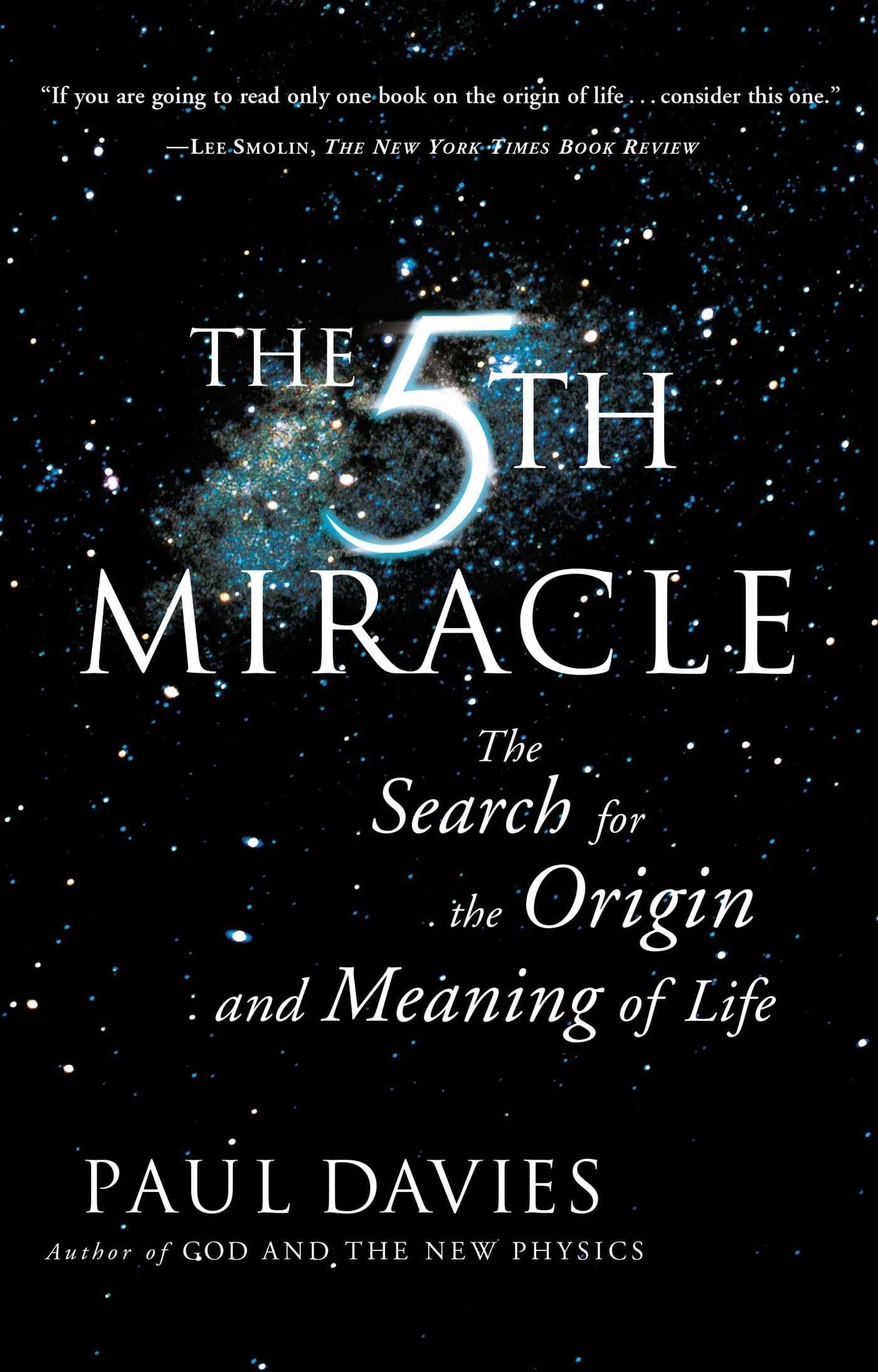
Buy The FIFTH MIRACLE: The Search for the Origin and Meaning of Life on desertcart.com ✓ FREE SHIPPING on qualified orders Review: 15 Years later: Still Very Intriguing - BEGINNING After reading several books about astrobiology finally I started to read 'The 5th Miracle' from Paul Davies. In the past the words 'The 5.th Miracle' have been very deceptive for me, because these words somehow hided the real content ' The Search for the Origin and Meaning of Life'. But luckily I got around these words and could dig into the text. SUMMARY I will not talk about all the rich content of this book here, but only about my personal resume at the end of the book. STILL VERY INTRIGUING Although the scientific discussions have clarified some of the details in chemistry, biochemistry etc. during the years, the 'bigger picture' which Davies offers the reader is still breathtaking and somehow unique. Beyond the many details in the field of astrobiology Davies introduces many theoretic concepts like 'information', 'self-organization', 'autocatalysis', 'complexity theory', 'algorithmic computability', 'quantum theory', 'gravity theory', 'thermodynamic' (and more), which on their own are not really new but in this context of the emergence of life they shed some new light on the whole scene. You see some new possibilities how to look at the phenomena but at the same time Davies stays critical and points to the still open questions. HOW TO PROCEED FURTHER? Davies himself is unclear at the end of the book how to proceed further. The final impression is, that there are several important concepts in the air which altogether are true, but what is missing is the 'key' to make them 'interacting' in the right way. This is intriguing, challenging. Personally I think that the observation of Davies, that the emerging structures beyond the parts reveal a logical structure, a kind of information, is fundamental. Additionally we have the fact that the information stored in DNA/ RNA molecules has the format of a 'random' structure although it works 'against' randomness. Both things have to be brought together. This leads to the assumption, that the structure of matter has to be re-thinked. Something we probably have 'overseen'. As I see, Davies has published meanwhile two more books with exactly these themes. Perhaps there we can find some more answers which will produce further questions. I have not yet read tem. Review: How did life begin and what was the nature of the earliest life? - This is a book about the origin of life. Paul Davies is a physicist but his interests are wide and one of those interests happens to be the question of life's beginning. Dr. Davies begins by noting that the probability of the self-assembly, by sheer random accident, of even the most primitive life found on Earth today (what biologists now call Archaea) is vanishingly small. So how did life begin? He explores the possibility of life originating on other worlds and being carried to Earth in meteorites. He notes that Mars was probably much more Earth-like some billions of years ago, and we also know that Martian rocks have fallen to Earth. Some of those rocks even have fossil like structures within them, but that they are actually fossils is debatable. He also looks into speculation that there may be other mechanisms by which life might physically distribute itself about the galaxy, a hypothesis called 'Panspermia'. But while these possibilities remain open questions Davies notes that they don't answer the fundamental question. Even if life came from somewhere else, how did the original life get going? So he next explores the possibility of some "life friendly" forces being built into physics. That is, what look (to us) like purely contingent (random) events throughout the history of the universe are, by some as yet undetected mechanism, not entirely random, but are rather pushed toward life assembly whereever physical conditions (presumably contingent) condusive to it appear in the universe. He leaves this possibility open while admitting that nothing in physics or cosmology today suggests that this sort of pressure, distorting contingency towards life, has ever been found in physics. Besides, such a notion entails some teleology (purpose) in physical mechanisms, something strongly resisted (right or wrong) by today's scientists. He ends his review with a middle-of-the-road possibility. First that chaotic physical systems, quantum phenomena, or both together might have intrinsic properties that raise the likelihood of life's self assembly. Second, that the first self-assembled life might have been considerably simpler than even the primitive Archaea on Earth today. The upshot, in combination, might have resulted in the self-assembly of such ultra-primitive life that the vanishingly small probably of self-assembly becomes a little less improbable. What is left out of the account is what such ultra-primitive life might look like? Neither biology or philosophy has determined how simple something can be and yet be alive and therefore subject to Darwinian selection. Although I understand this it leaves the author's speculation at just that. Both the nature of such ultra-primitive life or the likelihood of its self-assembly are assessable. So we are left there, a nice review of the possibilities, but little purchase on evaluating them.
| Best Sellers Rank | #1,316,230 in Books ( See Top 100 in Books ) #596 in Cosmology (Books) #1,492 in Philosophy Metaphysics #3,428 in History & Philosophy of Science (Books) |
| Customer Reviews | 4.4 4.4 out of 5 stars (140) |
| Dimensions | 5.5 x 0.76 x 8.44 inches |
| Edition | 1st Edition/ 1st Printing |
| ISBN-10 | 068486309X |
| ISBN-13 | 978-0684863092 |
| Item Weight | 9.6 ounces |
| Language | English |
| Print length | 304 pages |
| Publication date | March 16, 2000 |
| Publisher | Simon & Schuster |
D**H
15 Years later: Still Very Intriguing
BEGINNING After reading several books about astrobiology finally I started to read 'The 5th Miracle' from Paul Davies. In the past the words 'The 5.th Miracle' have been very deceptive for me, because these words somehow hided the real content ' The Search for the Origin and Meaning of Life'. But luckily I got around these words and could dig into the text. SUMMARY I will not talk about all the rich content of this book here, but only about my personal resume at the end of the book. STILL VERY INTRIGUING Although the scientific discussions have clarified some of the details in chemistry, biochemistry etc. during the years, the 'bigger picture' which Davies offers the reader is still breathtaking and somehow unique. Beyond the many details in the field of astrobiology Davies introduces many theoretic concepts like 'information', 'self-organization', 'autocatalysis', 'complexity theory', 'algorithmic computability', 'quantum theory', 'gravity theory', 'thermodynamic' (and more), which on their own are not really new but in this context of the emergence of life they shed some new light on the whole scene. You see some new possibilities how to look at the phenomena but at the same time Davies stays critical and points to the still open questions. HOW TO PROCEED FURTHER? Davies himself is unclear at the end of the book how to proceed further. The final impression is, that there are several important concepts in the air which altogether are true, but what is missing is the 'key' to make them 'interacting' in the right way. This is intriguing, challenging. Personally I think that the observation of Davies, that the emerging structures beyond the parts reveal a logical structure, a kind of information, is fundamental. Additionally we have the fact that the information stored in DNA/ RNA molecules has the format of a 'random' structure although it works 'against' randomness. Both things have to be brought together. This leads to the assumption, that the structure of matter has to be re-thinked. Something we probably have 'overseen'. As I see, Davies has published meanwhile two more books with exactly these themes. Perhaps there we can find some more answers which will produce further questions. I have not yet read tem.
M**T
How did life begin and what was the nature of the earliest life?
This is a book about the origin of life. Paul Davies is a physicist but his interests are wide and one of those interests happens to be the question of life's beginning. Dr. Davies begins by noting that the probability of the self-assembly, by sheer random accident, of even the most primitive life found on Earth today (what biologists now call Archaea) is vanishingly small. So how did life begin? He explores the possibility of life originating on other worlds and being carried to Earth in meteorites. He notes that Mars was probably much more Earth-like some billions of years ago, and we also know that Martian rocks have fallen to Earth. Some of those rocks even have fossil like structures within them, but that they are actually fossils is debatable. He also looks into speculation that there may be other mechanisms by which life might physically distribute itself about the galaxy, a hypothesis called 'Panspermia'. But while these possibilities remain open questions Davies notes that they don't answer the fundamental question. Even if life came from somewhere else, how did the original life get going? So he next explores the possibility of some "life friendly" forces being built into physics. That is, what look (to us) like purely contingent (random) events throughout the history of the universe are, by some as yet undetected mechanism, not entirely random, but are rather pushed toward life assembly whereever physical conditions (presumably contingent) condusive to it appear in the universe. He leaves this possibility open while admitting that nothing in physics or cosmology today suggests that this sort of pressure, distorting contingency towards life, has ever been found in physics. Besides, such a notion entails some teleology (purpose) in physical mechanisms, something strongly resisted (right or wrong) by today's scientists. He ends his review with a middle-of-the-road possibility. First that chaotic physical systems, quantum phenomena, or both together might have intrinsic properties that raise the likelihood of life's self assembly. Second, that the first self-assembled life might have been considerably simpler than even the primitive Archaea on Earth today. The upshot, in combination, might have resulted in the self-assembly of such ultra-primitive life that the vanishingly small probably of self-assembly becomes a little less improbable. What is left out of the account is what such ultra-primitive life might look like? Neither biology or philosophy has determined how simple something can be and yet be alive and therefore subject to Darwinian selection. Although I understand this it leaves the author's speculation at just that. Both the nature of such ultra-primitive life or the likelihood of its self-assembly are assessable. So we are left there, a nice review of the possibilities, but little purchase on evaluating them.
R**J
A lot of intelligent, interesting and profound ideas. The best is the role of intelligence itself in shaping the future of the cosmos, not necessarily an all embracing intelligence on a "god" scale but rather each and every intelligent being is capable of affecting the future for good or bad. Of course he assumes that "intelligence! involves "free will": I agree with that but that part is not explored thoroughly.
O**Y
This is very informative book. One must also read "The Origin of Life" from Paul Davies.
F**R
C'est à la fois passionnant et très prenant de suivre l'auteur dans sa recherche de l'origine et l'émergence de la vie. Beaucoup de questions, point de réponses. En cours de route, on découvre ou redécouvre la deuxième loi de thermodynamique et la théorie de l'information de Shannon.
Trustpilot
2 days ago
3 days ago