We remain fully operational. Our teams are working around the clock to ensure your deliveries continue safely.

DOWNLOAD THE APP


Customer Services
Copyright © 2025 Desertcart Holdings Limited
DOWNLOAD THE APP
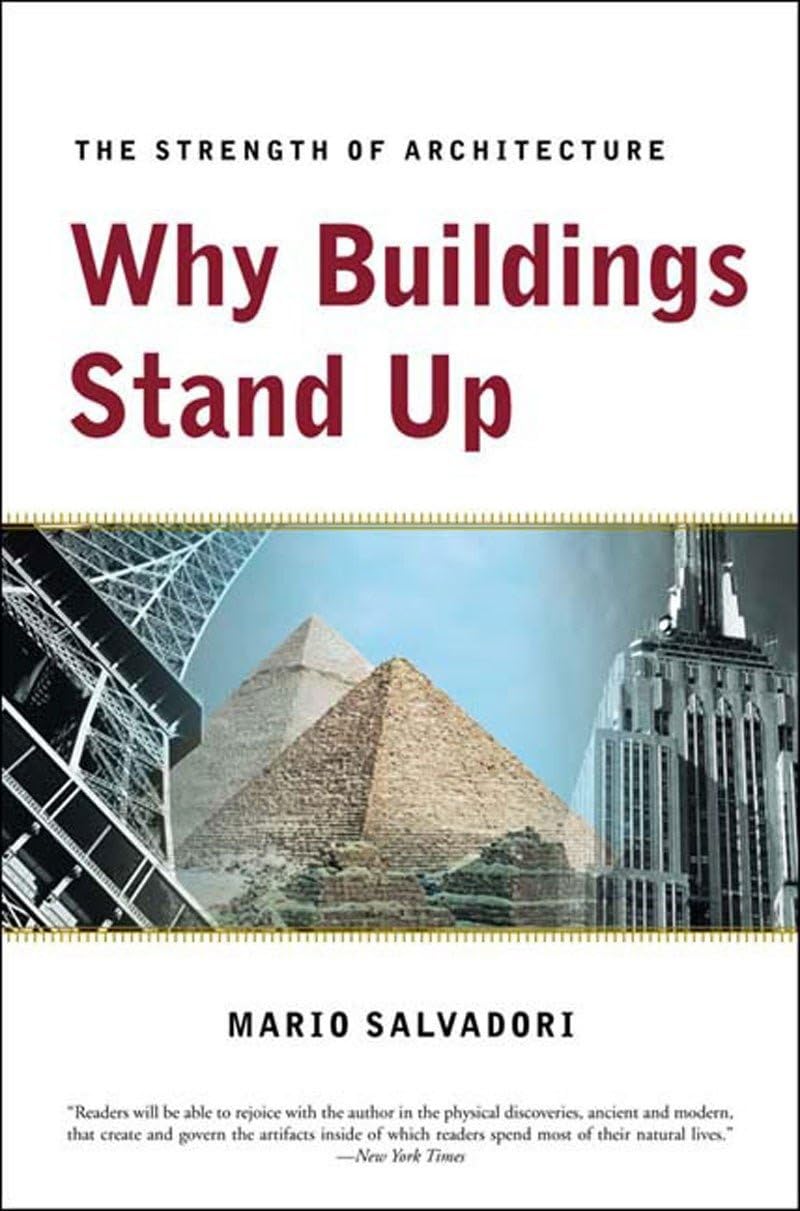
Why Buildings Stand Up: The Strength of Architecture [Salvadori, Mario] on desertcart.com. *FREE* shipping on qualifying offers. Why Buildings Stand Up: The Strength of Architecture Review: It's an interesting history book, if you nerd out on construction it's a good read. - In a sentence: There's great beauty in our desire to create grand and amazing structures and it's worth pausing to reflect on the accomplishments of man from time to time. Who should read it: Anyone who has ever built anything or enjoyed viewing great works. The book is an interesting narrative of the how some of the most famous structures were built. No math here just some basic understanding of forces. I won't regale you with details from the book but just know it's an entertaining read with interesting 'today I learned' and it's well written and worth reading if you find general history and architecture interesting. It's not that old, maybe 40 years? But old enough it will give the reader a bit of a time travel into the eyes of someone in the past. I particularly like the section on 'electromagnetic floating buildings of the future' And plastics of course. Once a miracle invention we thought would be used everywhere. Review: this is a good place to start - If you're interested in architecture, this is a good place to start. Architecture hath three qualities, firmness, commodity and delight, so it covers at least 1/3 of what's important about architecture in a delightful way. It is written by a real teacher who can explain complicated subjects simply. It is a wonderful base understanding of structures that should not be missed.
| Best Sellers Rank | #242,870 in Books ( See Top 100 in Books ) #16 in Architecture Study & Teaching (Books) #28 in Structural Engineering #1,239 in Architecture (Books) |
| Customer Reviews | 4.6 4.6 out of 5 stars (202) |
| Dimensions | 6.1 x 0.9 x 9.2 inches |
| Edition | Reissue |
| ISBN-10 | 0393306763 |
| ISBN-13 | 978-0393306767 |
| Item Weight | 1.1 pounds |
| Language | English |
| Print length | 320 pages |
| Publication date | February 17, 2002 |
| Publisher | W. W. Norton & Company |
R**N
It's an interesting history book, if you nerd out on construction it's a good read.
In a sentence: There's great beauty in our desire to create grand and amazing structures and it's worth pausing to reflect on the accomplishments of man from time to time. Who should read it: Anyone who has ever built anything or enjoyed viewing great works. The book is an interesting narrative of the how some of the most famous structures were built. No math here just some basic understanding of forces. I won't regale you with details from the book but just know it's an entertaining read with interesting 'today I learned' and it's well written and worth reading if you find general history and architecture interesting. It's not that old, maybe 40 years? But old enough it will give the reader a bit of a time travel into the eyes of someone in the past. I particularly like the section on 'electromagnetic floating buildings of the future' And plastics of course. Once a miracle invention we thought would be used everywhere.
P**N
this is a good place to start
If you're interested in architecture, this is a good place to start. Architecture hath three qualities, firmness, commodity and delight, so it covers at least 1/3 of what's important about architecture in a delightful way. It is written by a real teacher who can explain complicated subjects simply. It is a wonderful base understanding of structures that should not be missed.
H**5
Great for architecture school and the ARE
Recommended as additional reading for the ARE exam by Thaddeus. This is a great book, I wish I had read it while still in architecture school. This would be a great read between your first and second year of structures or just for the exam. "Why Buildings Fall Down" is also great, they will not only help you understand structures, but it's really helpful for architecture history. Definitely worth having in your library.
B**Y
Great study source for architects... and for some others.
This book was very helpful to me when I was studying for the architecture registration exams some years ago. Along with its companion book "Why Buildings Fall Down" it covered a significant swath of the multiple choice material that I encountered on the exams, with an appropriate level of specificity, or lack thereof. I've also recommended this book often to architecture students, because it is full of real-world examples of the principles that are studied in statics courses, and it is more engaging reading than the formula-filled textbooks that are required reading in a lot of those courses. That said, this book may not appeal to or be useful for some. I suspect it would annoy some engineers I know, with its fairly basic principles and lack of fine detail, and because it contains some over-simplifications that would matter if one were trying to use it as an instruction book to build another Pantheon. I do think this book would be appropriate for some non-architects, as the buildings discussed are mostly widely recognizable icons, and the stories behind them are lively and engaging. But it is also possible the book could be a little intimidating for someone who doesn't yet have an architectural vocabulary. Perhaps if I was giving this book to someone like a high school student interested in architecture, or someone without much past reading on the subject, then I might also give them something like Ching's "A Visual Dictionary of Architecture" at the same time, so that the reader could look up any unfamiliar terms.
F**1
Great book
Great book
I**S
Great Intro to Structures
As a structures primer, there is no better read. Why Buildings Stand Up covers the breadth of historical presidents intermingled with well presented, clearly written structural techniques. Certainly not an exhaustive textbook, it does however generate momentum for further study and will definitely lay a solid foundation of structural understanding. An absolute essential for young architects and a great read for anyone interested in some construction fundamentals. If you're more interested in the "what went wrong" kind of structural failure documentary as opposed to this more technical piece, see Why Buildings Fall Down also by Salvadori.
Z**B
Still interesting after all these years
This book was a textbook for one of my classes in architecture school in the 80s. My old, dog-eared copy is still on my bookshelf. I bought this copy for an 11-year-old friend who is super smart, and who wants to be an architect and build skyscrapers someday. I don't know if most 11-year-olds could comprehend the concepts, but my friend's mom assures me that he will have no problem understanding the book.
Q**I
Damaged
Book arrived damaged
A**N
My architecture teacher suggested it, there is also Japanese translate. I think it is an interesting book for people who likes architecture&construction.
L**B
Studying Civil Engineering at University and this was on one of the extra reading lists. Looked interesting and had good reviews so thought I would give it a read. Wasn't disappointed. Very informative but also interesting. Was quite an enjoyable read considering it is degree related. Goes very well with the other book Why Buildings Fall Down. I read them both.
D**O
I like the explanations of what actually happened!
N**0
Tardo mucho en llegar y llegó muy maltratado
A**R
Product was exactly as described, and very cheap.
Trustpilot
2 weeks ago
2 days ago