



🔧 Seal smarter, save energy, and stay ahead of the curve!
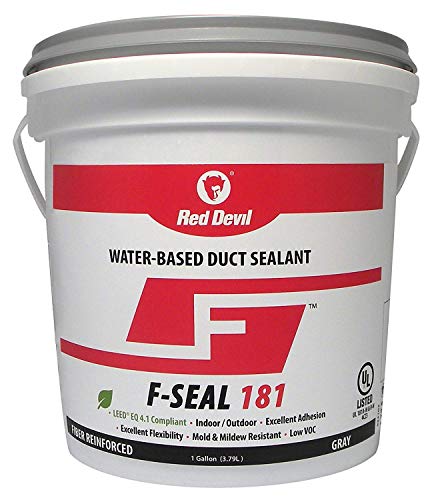
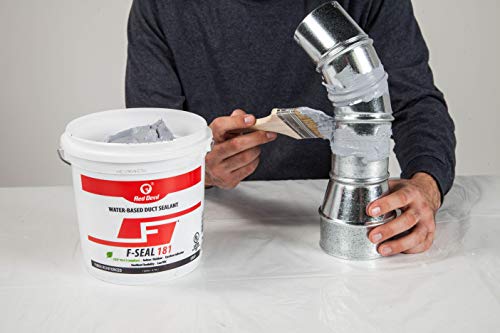
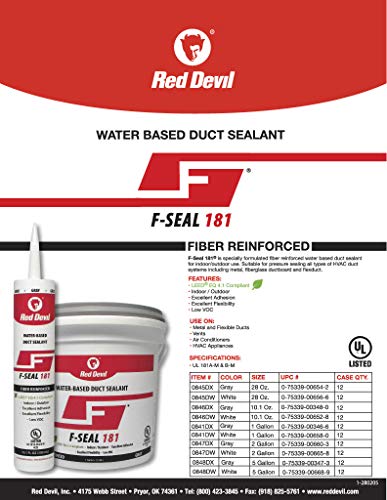
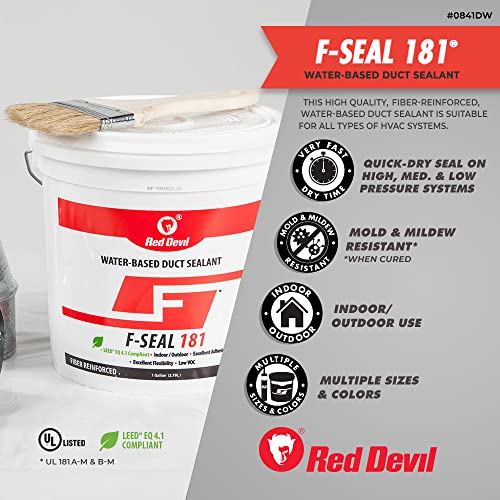
Red Devil F-Seal 181 is a premium, fiber-reinforced, water-based duct sealant designed for superior HVAC sealing. UL 181 A-M & B-M certified, it works on metal, fiberglass, and flexible ducts. Its fast-drying, low VOC formula ensures safe, efficient application, while its weather-resistant properties make it ideal for both indoor and outdoor use. Exceeding all SMACNA Pressure and Sealing Classes, this USA-made sealant delivers durable, mold- and UV-resistant performance that enhances energy efficiency and meets stringent environmental standards.

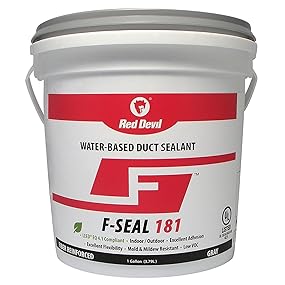








| ASIN | B01I7JVUO0 |
| Batteries | 1 Unknown batteries required. |
| Batteries Included? | No |
| Batteries Required? | No |
| Best Sellers Rank | #13,654 in Tools & Home Improvement ( See Top 100 in Tools & Home Improvement ) #35 in Hardware Sealers |
| Brand | Red Devil |
| Color | Gray |
| Customer Reviews | 4.4 4.4 out of 5 stars (1,495) |
| Date First Available | July 10, 2016 |
| Finish | Brushed |
| Global Trade Identification Number | 00075339003466 |
| Included Components | Duct Sealant |
| Item Form | Paste |
| Item Package Quantity | 1 |
| Item Weight | 1 pounds |
| Item dimensions L x W x H | 7 x 7 x 8 inches |
| Item model number | 0841DX |
| Manufacturer | Red Devil |
| Material | Acrylic |
| Number of Items | 1 |
| Part Number | 0841DX |
| Pattern | Sealant |
| Power Source | Hand_powered |
| Product Dimensions | 7 x 7 x 8 inches |
| Shape | Rectangular |
| Size | 1 Gallon |
| Style | 1 - Pack |
| Surface Recommendation | Metal |
| UPC | 075339003466 |
| Unit Count | 128.0 Fluid Ounces |
| Water Resistance Level | Water Resistant |
S**R
Thick and goes a long way
Used this to seal various parts of my air conditioning system. I applied to seams and screws on the air handler in the attic and also to all connections of the flex duct from the sheet metal plenum. The goal was to reduce as much air loss as possible. I removed the flex duct that was held on with duct tape and a screw. It was all installed around 35 years ago and I found old instructions that said to use duct tape which of course today you are not supposed to use duct tape for anything HVAC anymore. I used an old 2" paint brush. You really want one with stiff bristles because this stuff is thick maybe closer to joint compound consistency. I spread everywhere around each start collar really pushing the sealant into the cracks and leaving a thick layer. I put a liberal glob over any screwheads and spread across any places air might pass through such as seams. It was dry enough within an hour to not be pliable anymore but full cure says 24-48 hrs. For me, I was able to do the second coat for most except the thicker spots. I poured a little water into the jug which thinned it so I could get a better spread over the thicker parts and feather out the product. I was working in a hot attic and I found having a separate container with just water helped a lot since leaving the lid off obviously dries it out. Adding water back in seemed to restore even the drier bits along the sides of the jug. I used a putty knife to scrape it back in and it mixed back in to the rest of it easily. I assume after a full cure it no longer accepts water and creates a permanent moisture proof barrier. Otherwise what's the point. I also spread some on the neck of the start collar and then inside the duct so that when I slid the flex duct back over there would be a seal. This is what you're supposed to do. I then put a screw back in to secure the two together. You're not supposed to do that though, you're supposed to use a zip tie and tensioning tool but I didn't feel like spending the money on those things was necessary since the screws held fine all this time. I used paper backed, pressure sealing foil tape to wrap the flex duct and seal it to the collar. Using pressure you get a great seal so no air can get in or out. Another coating of this mastic over the taped edges and I was set. Simply pull the fiberglass back over the collar and against the plenum then pull the outer vapor layer over the insulation to the plenum and I was done. I also redid a bunch of the flex connections to the boots. The boots had riveted edges which could easily pass air through so I spread over all corners inside or out. I have a 5 ton system and with everything I did there is still half of the container left. I liked the white color because I was able to use it on the ceiling diffusers to seal any cracks without worry about the color. I don't know what else this stuff can be used on but I'm going to find out.
P**L
Nice thick sealant easily applied with brush and easy to clean up since water based.
I needed a duct sealant for the A/C intake air box. The edges of the air box had separated and were in need of repair to keep contamination out. I initially had some flexible strips to close the crack and then sealed it thoroughly with the duct sealant. Nice and think, but still easily applied with a paint brush. Since it is water based, I was able to clean the brush (and myself!) with just water.
O**D
Worked great for me
Background, my attic was a horror show. Duct insulation that had been pinned on with 4" nails by some insane attic seamstress. Vents were uninsulated. Bare ductwork metal in too many places to count. I could go on at length, but you'll have to wait for the book. Bucket arrived in good shape. Shipping was good, then it was delayed, then it was delivered. Some of the other items in the box had a little mastic on them but the bucket I got looked pristine, unleaked, and had 2 lengths of sturdy tape holding the lid on. Mastic inside was not dried or disturbed. I have to wonder if their initial try showed the folly of shipping buckets rattling around in a box. But I digress! Simply put my order of grey goop arrived in great shape. I had ordered a box of 10 or 12 cheap 'chip' brushes so I could use one for the day and just ditch it. I would tear off old poorly applied duct insulation, mastic all seams and screws of the ductwork on my list for the day, and retreat to places more hospitable to humans until the next day. I would leave the bucket fully resealed in the attic: the handle came off on day one and I couldn't get it back on. Easier to leave it where I'm going to use it next rather than lugging it back and forth. It's springtime in Texas, I have a remote thermometer in the attic, and it hit 140° up there the other day. So yeah, I just let it dry till the sun comes up again, then use duct wrap and sleeves with high quality tape. In my attic that's as dry as it's ever going to be. The temperature had no effect on the mastic still sealed in the bucket. Spreads well, seals well, dries well. I intend to eventually go back deep in the attic and mastic at least the edges of all my tape, working my way back to civilization and the attic stairs. I trust the mastic to secure the tape more than I trust the tape not to curl over the years. I wear cheap painter's coveralls and surgical gloves as the mastic, and everything else, tends to get quite snuggly with me. My roof comes down to the soffit on all sides so I'm an old man crawling across the joists and some places can sit up. I still come down looking like a coal miner after a double shift but at least most of the mastic is on the ductwork instead of me. It's brutal up there, so I pick my work for the day, let the mastic start drying, and get out while I still can. Oh yes, don't let the AC or heat come on while your mastic is still drying. Don't want to take a chance on displacing the mastic after all your hard work. I have a little over a month until my youngest son visits and we blow in insulation. I'm going to bury everything up there to the extent I won't be able to get in there to do anything. So, everything I'm going to fix had better be done before then. I'm trusting this mastic to last half of forever because I'm going to make it all but inaccessible in June (God help me). My end game is to stop making the electric company rich, and never go in the attic again.
D**K
Seals great, dries quick
Worked like a charm and at a fraction of the price of retail suppliers. It dried quick and sealed my duct very well. I painted it onto the supply and return plenum with an old brush.
B**O
It's RUBBERY when it dries.
This sealant is great at sealing gaps. The only issue I had is it dried to a rubbery finish, so the foam insulation I was covering it with wouldn't stick to it. I ended up spraying the affected areas with an adhesive so the foam would stick. Didn't have this issue with other sealants, which were like a papier-mache texture. Because this product is rubbery, there is a flex to it that the others don't have.
K**E
Whistle free
Easy to apply and does the job, no air leaks
A**S
Sold a new product and received used.
Good product but I payed for new and was sent one that was obviously used. Had some material scooped out and spilled around the lid of the container.
Y**.
Great duct seal
Seals ducts and covers tape and joints well. Spreads nicely using paintbrush or gloved finger. Used while running the AC and surprisingly didn't get any bad odor. Once dried seems very durable and ended up touching up areas that didn't seal the first round and can see how well it seals once hardens. I think one bucket will be more than enough for a system in a home. Very pleased.
G**B
I purchased this mastic in order to seal all of the joints in my heating and return ducts that were accessible in my basement ceiling. It was exceptionally easy to apply…much like spreading toothpaste with a paint brush. It goes a long way! The mastic did not have an odor, and it dried very quickly after application. This job took me a few days to complete, and I used a new brush each day. I also put a layer of plastic wrap on top of the mastic before closing the lid with a rubber mallet each day, and this kept the mastic from drying out. Because the majority of the duct work in my basement is up in the ceiling between the joists, and close to the plywood of the flooring above, I adapted some cheap 2-inch paint brushes so that I could actually brush the mastic on top of the joints. I bought cheap paint brushes that have wooden handles, and I trimmed the bristles quite short. Then, I cut off about half the length of the wooden handles with a hacksaw, which made little “stubbie” brushes. These shorter brushes allowed me to apply the mastic at the top of the duct work, and they made the application easier and more affordable. I do recommend that you wash the joints of the duct work before applying the mastic so that the mastic adheres well. I actually washed all of the outer surfaces of my duct work before starting this job, and I was stunned at the 38-years of dirt and dust that I was able to wash off. I also wore disposable vinyl gloves when applying the mastic, as doing this job was quite messy. It was, however, easy for me to rub the dried mastic off of my skin with hot, soapy water. After the whole job was finished, my husband and I definitely noticed an improvement in the heat flow in our home. No more cold spots upstairs in the bedrooms, and no more hot spots in the basement due to leaky ducts. I hope we also notice a change when the air-conditioning is turned on this summer!
J**Y
I'm not sure why this is impossible to find at DIY stores in Canada, but I will NEVER use tape again... if I can help it. This goes on like pancake batter and dries to a firm rubber consistency. If you embed fiberglass mesh tape in this mastic (I used fibaFuse mesh tape, found in the drywall section) this makes for incredibly strong and completely air-proof joints. It's messy as heck, but worth it!
K**R
Easy to use but can be a bit messy on arms and hands if not careful. Seals duct work seams for better air flow and leakage thru out the house.
T**C
Used to have duct tape on my duct work. It's all shriveled up and not doing mush help. Removed it, and used the Fiberglass Mastic. Used a paint brush, and it went on like butter, literally, but of course it didn't melt. Completed the vent side, Will complete the return side. Well worth the money, Initially started using Aluminum tape, but felt it was too much work. This Mastic is a must.
R**D
I am not sure what the shelf life is supposed to be, but due to unforeseen circumstances I as not able to use this right away as the reno took a COVID pause. I had never opened it until tonight and it is almost dried, not the paste it should be. I tried adding some water to a small amount but that did not appear to work. I realize that I didn't use this for 8 months, but I would expect it to be sealed and not dry out considering it was never opened. Neither the bucket nor the company's website give details as to shelf life so I am not sure if I am being fair in my review or not, but i thought it would have lasted this long.
Trustpilot
2 months ago
2 days ago