
DOWNLOAD THE APP


Customer Services
Copyright © 2025 Desertcart Holdings Limited
DOWNLOAD THE APP

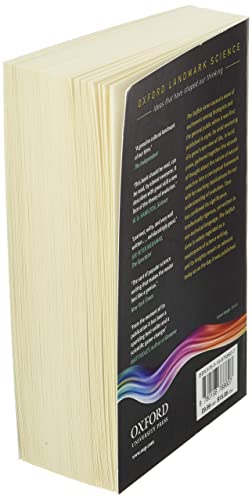


Buy The Selfish Gene: 40th Anniversary edition (Oxford Landmark Science) 4 by Dawkins, Richard (ISBN: 9780198788607) from desertcart's Book Store. Everyday low prices and free delivery on eligible orders. Review: Must read, even if you're not a biology nerd - Richard Dawkins does a good job in explaining some complex science, even for a halfwit like me to understand who hasn’t seen inside a biology lab since sixth-form. Dawkins explains that genes are the real "stars" of the show, explaining why selfishness and altruism (surprisingly) are such integral parts of successful societies/people. He makes tricky ideas understandable with clean examples and everyday language, covering everything from why animals help family to how ‘memes’ (he’s the originator of the meme) spread like genes do. It's insightful, entertaining, and still feels fresh decades now despite its age. A must-read. Review: One of those rare books - will probably make you see the world differently - I have always loved science and the natural world and I'm a big Dawkins fan - but hadn't read his first, ground-breaking book. "The Selfish Gene" is a provocative title, but gets to the essence of the big idea. DNA is a type of "replicator", a special type of molecule that copies itself. Because DNA "wants" to make copies of itself, it "uses" survival machines - us, other animals, all living organisms - to make as many copies of itself as possible. Thus genes - which Dawkins loosely defines as segments of DNA responsible for some behaviour - are "selfish" because they want to copy themselves as much as possible. This may involve co-operating with other genes. While the gene is the centre of this story, Dawkins looks at individual organisms and groups of organisms to make the examples concrete. This personification goes a long way. We go on a tour of aggression, kinship - including offspring, mates, interaction with other species and see how various things can be explained under the selfish gene hypothesis. Powerful ideas from other disciplines, like game theory are used to support the claims. For example, the prisoner's dilemma can be one way of highlighting why reciprocal altruism might exist. Way ahead of his time, Dawkins identifies another replicator - the "meme", now part of everyday speech, as a kind of cultural idea that spreads rapidly between minds. He then posits that replication might just be one of the fundamental aspects of life anywhere in the universe, which is an interesting thing to ponder. This book was hugely enjoyable to read. It is very well written - concepts are elaborated clearly and vivid, and fascinating examples of the natural world are frequently provided. It made me see the world in a very different way - not necessarily worse or better. After all, Dawkins points out that he is describing the truth, not prescribing values. He is optimistic and says that human altruism can of course be pure. Our minds may be free of the shackles of our genetic programming. To conclude, this is one of the most thought-provoking books I've ever read, and I will definitely re-visit it.
| Best Sellers Rank | 6,468 in Books ( See Top 100 in Books ) 2 in Genetics in Popular Science 4 in Animal Behaviour Science 5 in Biological Evolution |
| Customer reviews | 4.6 4.6 out of 5 stars (8,449) |
| Dimensions | 13.1 x 3.7 x 19.6 cm |
| Edition | 4th |
| ISBN-10 | 0198788606 |
| ISBN-13 | 978-0198788607 |
| Item weight | 430 g |
| Language | English |
| Part of series | Oxford Landmark Science |
| Print length | 496 pages |
| Publication date | 9 Jun. 2016 |
| Publisher | OUP Oxford |
M**N
Must read, even if you're not a biology nerd
Richard Dawkins does a good job in explaining some complex science, even for a halfwit like me to understand who hasn’t seen inside a biology lab since sixth-form. Dawkins explains that genes are the real "stars" of the show, explaining why selfishness and altruism (surprisingly) are such integral parts of successful societies/people. He makes tricky ideas understandable with clean examples and everyday language, covering everything from why animals help family to how ‘memes’ (he’s the originator of the meme) spread like genes do. It's insightful, entertaining, and still feels fresh decades now despite its age. A must-read.
H**.
One of those rare books - will probably make you see the world differently
I have always loved science and the natural world and I'm a big Dawkins fan - but hadn't read his first, ground-breaking book. "The Selfish Gene" is a provocative title, but gets to the essence of the big idea. DNA is a type of "replicator", a special type of molecule that copies itself. Because DNA "wants" to make copies of itself, it "uses" survival machines - us, other animals, all living organisms - to make as many copies of itself as possible. Thus genes - which Dawkins loosely defines as segments of DNA responsible for some behaviour - are "selfish" because they want to copy themselves as much as possible. This may involve co-operating with other genes. While the gene is the centre of this story, Dawkins looks at individual organisms and groups of organisms to make the examples concrete. This personification goes a long way. We go on a tour of aggression, kinship - including offspring, mates, interaction with other species and see how various things can be explained under the selfish gene hypothesis. Powerful ideas from other disciplines, like game theory are used to support the claims. For example, the prisoner's dilemma can be one way of highlighting why reciprocal altruism might exist. Way ahead of his time, Dawkins identifies another replicator - the "meme", now part of everyday speech, as a kind of cultural idea that spreads rapidly between minds. He then posits that replication might just be one of the fundamental aspects of life anywhere in the universe, which is an interesting thing to ponder. This book was hugely enjoyable to read. It is very well written - concepts are elaborated clearly and vivid, and fascinating examples of the natural world are frequently provided. It made me see the world in a very different way - not necessarily worse or better. After all, Dawkins points out that he is describing the truth, not prescribing values. He is optimistic and says that human altruism can of course be pure. Our minds may be free of the shackles of our genetic programming. To conclude, this is one of the most thought-provoking books I've ever read, and I will definitely re-visit it.
S**S
A classic text in popular biology
It's important to note that this is a book written back in the 1970s. The author who wrote it should not be mistaken for the divisive figure that he has become within the last 10 years. The edition I picked up was the 30th anniversary edition, which comes with 3 prefaces and a foreword. Reading the first few chapters, the most striking thing is Dawkins' engaging narrative style. It can be little surprise that subsequent to writing this he was made a professor for the public understanding of science, as his written communication is crystal clear. In addition to the main text, there are some lengthy endnotes which appear to be mostly the product of later editions where there is an extremely defensive tone, in some exasperation of opposition born out of misunderstanding of the ideas and terminology used in the first edition. Although the title of the book implies a book on genetics, this is largely confined to the early couple of chapters with the majority of the book looking at animal behaviour from a gene's point of view. It is easy to see why some might take him for an atomist from these discussions, as he gives little countenance to causes other than genetic inheritance. This may simply be a consequence of his emphasis rather than reflecting his actual views, though such atomism is common, in my experience, amongst those who cite Dawkins as a major source of their scientific knowledge and understanding. However, one has to recall warnings given early in the book about Dawkins' use of terminology. Much of the book is written in simile and metaphor, with many adjectives loaded with the capacity to be misread if one reads the text as a literalist. One of the key themes is altruism. That is, how do organisms end up helping one another out if their genes inheritance follows a rough pattern that might be described as "selfish." Aren't selfishness and altruism polar opposites? Dawkins argues that this is not so. In so doing, the prime target in Dawkins' crosshairs are proponents of "group selection" who (very broadly speaking) favour the idea that animals and plants behave in such a way as to ensure the survival of their particular group. Dawkins argues convincingly that this is an illusion and gives examples where such a theory is left somewhat lacking where the selfish gene theory can provide a reasonable hypothesis. With all this said, though, it has to be noted that Dawkins includes very little hard evidence in his book. To keep things interesting and engaging for the lay reader, we are presented with multiple anecdotes rather than scientific studies. So, reading with due scepticism, one should be wary of accepting all of Dawkins' ideas unquestionably. Indeed, shortly after finishing the book, I was given a link to a paper (though unfortunately, it is hidden behind a paywall) which calls into question Dawkins' "kin selection." This brings us to the weak points of the book. It begins in chapter 10, `You scratch my back, I'll ride on yours' where Dawkins make a quite startling comment for a scientist: "One cannot really speak of `evidence' for this idea, but...." (it's on page 182 of the 30th anniversary edition, if you want the full quote, it's rather too long to copy) - yet in the next chapter, where Dawkins introduces the idea of a meme, he makes his statement that faith is "blind trust, in the absence of evidence, even in the teeth of evidence." Of course, his definition has now become almost as famous as it is erroneous. Yet that fame could mistakenly lead one to think that this was an early example of Dawkins' departure from science into the world of atheistic diatribe; it absolutely is not. It is merely an example that he used to illustrate his innovative idea on the transmission of information. Of course, subsequent decades of works on memetics have proved fruitless, and it is now abandoned as a serious line of enquiry by all but a vocal minority. If this surprises you, I would point you to the last ever edition of the journal of memetics where the situation was summed up quite nicely. Following on from this, Dawkins looks at game theory which may seem out of place in a biology book, but which serves as a useful introduction to anyone who has not encountered it before. The book concludes with an additional chapter not included in the original edition. It is a concise summary of the follow-up book, The Extended Phenotype. It's not an extract for a sequel, which I have seen in some publications, but it serves the same purpose, as an advert for the reader to make a further purchase. In this respect, it is quite successful, as it is as immensely fascinating as the rest of The Selfish Gene. Though some of its ideas have now had severe doubt cast upon them, The Selfish Gene still stands as a wonderful pop science book on biology, and I would recommend it to anyone interested in science.
K**I
A great purchase and happy with the copy i received. Whether or not you agree with all his arguments, this book will challenge how you think about life and evolution. It is a great read to understand complex ideas in Evolutionary Biology.
R**N
Excellent book, great thought to the details and comparisons, perfect name for the book "selfish gene"refers to all living being.
A**S
The book is in good condition and has an elegant cover. I fully recommend it.
T**I
The book takes complex scientific ideas and makes them incredibly clear and engaging, using vivid examples that stick with you. It even introduced the concept of "memes" – ideas or cultural elements that spread from person to person, much like genes. While the title might make it seem like a bleak read, it actually offers profound insights without being overly deterministic. It helps us understand our fundamental biological drives while also acknowledging our capacity for higher thought and even altruism. If you're curious about the deep mechanisms of life and want a fresh, compelling view of evolution, this book is an absolute must-read. It's a classic that continues to challenge and inform new generations.
V**A
Aprendi sobre comportamento animal e humano
Trustpilot
3 weeks ago
1 week ago