
DOWNLOAD THE APP


Customer Services
Copyright © 2025 Desertcart Holdings Limited
DOWNLOAD THE APP
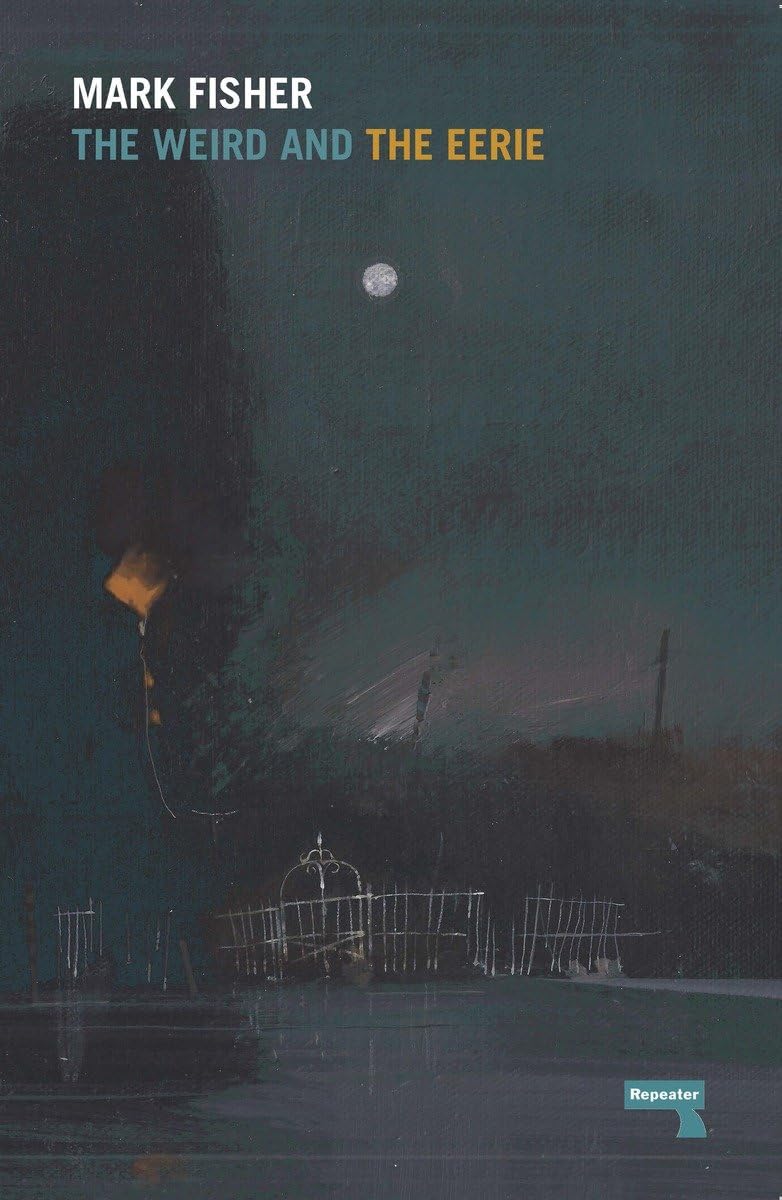
The Weird and the Eerie : Mark Fisher: desertcart.co.uk: Books Review: Go on, get the book - If you’re weird and eerie, you should read this book Review: Last words - Mark Fisher was one of the most interesting contemporary British writers on broader cultural issues, and it's a tragedy that his early death (by suicide) means that this slim volume is going to be his last. I'd like to be as enthusiastic about it as I was about his other work, but, to be honest, although it's never less than interesting, gracefully written and full of ideas, it reads more like a collection of linked essays than a finished product. One of those rare books, in fact, which would be greatly improved by being twice as long, and having the space to develop its ideas more. Ah well, that's all we're ever going to get, I fear.
| Best Sellers Rank | 13,271 in Books ( See Top 100 in Books ) 86 in Science Fiction History & Criticism 189 in Poetry & Drama Criticism 2,017 in Social Sciences (Books) |
| Customer reviews | 4.6 4.6 out of 5 stars (549) |
| Dimensions | 12.45 x 1.09 x 19.69 cm |
| Edition | 3rd Edition |
| ISBN-10 | 1910924385 |
| ISBN-13 | 978-1910924389 |
| Item weight | 142 g |
| Language | English |
| Print length | 135 pages |
| Publication date | 15 Dec. 2016 |
| Publisher | Repeater |
K**T
Go on, get the book
If you’re weird and eerie, you should read this book
J**R
Last words
Mark Fisher was one of the most interesting contemporary British writers on broader cultural issues, and it's a tragedy that his early death (by suicide) means that this slim volume is going to be his last. I'd like to be as enthusiastic about it as I was about his other work, but, to be honest, although it's never less than interesting, gracefully written and full of ideas, it reads more like a collection of linked essays than a finished product. One of those rare books, in fact, which would be greatly improved by being twice as long, and having the space to develop its ideas more. Ah well, that's all we're ever going to get, I fear.
S**N
Love
Mark fishers writing continues to amaze and haunt modernity long after his passing
A**Y
A Great Book
So sad that the day I received this book the author took his own life. Mark Fisher was the best of writers. He wrote beautifully, of course, but the act of writing is secondary to his observation of the world, the ability to see the world aslant, to make of the the ordinary something extraordinary. I think that someone like Mark Fisher who had experienced itensely what the world calls 'depression' for the usual reason of needing to classify, make safe, box off our most intense and utterly lonely apprehensions, would have inevitably be drawn to the weird and eerie. It's a great book.
I**S
sublime
Like everything else Mark Fisher wrote, this book is thought provoking and mind bending. His perspective will seriously challenge how you see things. Which is a good thing. This book needs to be read.
A**Y
Distinguishing the Weird and the Eerie from mainstream horror
Mark Fisher examines two distinct sub-genres that are usually lumped in with Horror. Both are characterised by a preoccupation with the strange, but not the horrific. They are both “to do with a fascination for the outside, for that which lies beyond standard perception, cognition and experience. This...usually involves a certain apprehension, perhaps even dread.” The weird encompasses writers like HP Lovecraft and HG Wells, director David Lynch, and post-punk UK rock group The Fall. Fisher defines “weird” as involving “a sensation of wrongness: a weird entity or object so strange that it makes us feel that it should not exist, or at least it should not exist here. Yet if the entity or object is here, then the categories which we have up until now used to make sense of the world cannot be valid. The weird thing is not wrong, after all: it is our conceptions that must be inadequate.” The eerie includes writers MR James and Margaret Atwood, director Stanley Kubrick, and musician Brian Eno. According to Fisher, the eerie is “a failure of absence (e.g. the cry of a bird that invites speculation—is it really a bird? Is it possessed?) or by a failure of presence (e.g. ruins or abandoned structures, again inviting speculation—Who built them? What happened to them?). Both cases are an issue of agency: is there an agency, or what is its nature? I’ve long thought that Lovecraft, for one, doesn’t fit into the “classic horror” category that the BISAC and Amazon categories place him in, and Fisher provides a convincing argument for the weird and the eerie to gain the recognition they deserve. I’ve dropped one star as, in places, the arguments become a little abstruse for me. However, it is a much more accessible book than some others in the field, and I highly recommend it.
B**B
Mark Fisher is/was/will long be loved, missed and appreciated as a first genius of ...
Mark Fisher is/was/will long be loved, missed and appreciated as a first genius of the 21st century. This is every bit as good as I expected it to be. If you have any interest in the state of the world, you must read Fisher's 'Capitalist Realism' - the best book on its subject and in its class.
R**O
This, the last publication from the much missed Mark Fisher is as idiosyncratic and erudite as ever.
Extraordinary collection of haunted writings by the late Fisher. For those who love Nigel Kneale, M.R. James and Lovecraft.
F**Z
alles bestens
T**A
Li esse livro há muitos anos, numa versão digital, e ele acabou sendo fundamental pra moldar minha visão de mundo e sobre a arte. A partir dele conheci vários conceitos, ideias e autores, alguns em relação aos quais eu tinha um pouco de resistência, e que vieram a influenciar enormemente minha vida acadêmica e meus posicionamentos políticos. E tudo começou com esse livrinho. Muito feliz por finalmente ter adquirido uma cópia física.
A**R
Thank you.
B**P
I thought this book was incredible. I am a fan of books, movies and music so this really satisfied my interests. Many of the examples he used I was familiar with but many I wasn’t. However, of the familiar things, I was given a bit more to chew on with how I think about and consider them. Our western culture really promotes that we need to resolve or feel resolved about things especially if they are to be considered acceptable on scale. But this book feels like part of its treatise is to encourage an appreciation and the value of perhaps never quite being resolved, at least in our minds, and to appreciate the sensation that is the essence of the weird and the eerie. Highly recommend!
M**L
Mark Fisher's final completed work examines two distinct but related modes that haunt literature and film: the weird and the eerie. Fisher defines the weird as "the presence of that which does not belong" while the eerie emerges from "a failure of absence or a failure of presence" - something being where it shouldn't be, or nothing being where something should be. I'll be honest: much of this went over my head, particularly when Fisher ventures into theoretical territory about jouissance, transcendental exteriority, and various ontological abstractions. And about a million other concepts. But what's remarkable is how intensely fascinating it remained even when I couldn't follow his philosophical threads. Fisher's discussions of Kubrick and du Maurier were particularly compelling - his analysis of the alien agency in 2001's monolith and the undisclosed forces lurking in The Shining's hotel, plus his reading of "Don't Look Now" as a story about how denying the power of foresight actually contributes to the very disaster you're trying to avoid. His readings made me want to immediately rewatch and reread everything he discusses, which is probably the highest compliment you can pay a critic. He can find the eerie in everything from ruins to capital itself (describing our economic system as an invisible force with tremendous power to destabilize society), which feels both illuminating and mildly unhinged. Very much the kind of insight that makes you wonder if you're learning something profound or just getting successfully convinced by a very smart person's obsessions. A key distinction Fisher makes is that these modes aren't about horror but about "fascination for the outside, for that which lies beyond standard perception, cognition and experience." Most people would lump weird/eerie stuff in with horror, but Fisher argues they're actually about something different - not fear, but a kind of magnetic pull toward the unknown or inexplicable. It's the difference between being scared of something and being weirdly drawn to it, like staring at a road accident or feeling compelled by abandoned places. Though without that context, it sounds like so much academic throat-clearing.The book works best when he's doing close readings of specific works rather than building grand theoretical frameworks, though I suspect readers more versed in critical theory would appreciate those sections more than I did. This feels like essential reading for anyone interested in weird fiction or liminal spaces, even if - especially if - you don't understand all of it.
Trustpilot
2 months ago
1 week ago