

Desert Online General Trading LLC
Dubai, United Arab Emirates
Desert Online General Trading LLC
Dubai, United Arab Emirates
Full description not available
K**I
Five Stars
It's very good.
B**R
Three Stars
Somewhat disappointed. Book does not keep interest.
R**Y
Five Stars
Book is as described. Prompt delivery.
M**H
Great Book for Amatuer Mathematicians
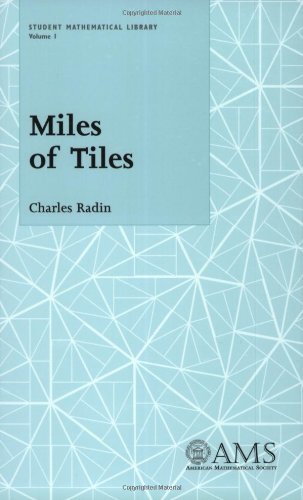
This book is excellent fun, needing only undergraduate mathematics to get to grips with the essentials of irregular tilings - including tilings that lack even the Penrose Tiling's classic (statistical) five-fold symmetry!Please note that many of the theorems quoted in this book are not proved in the book, although clear references are made to other texts. This is clearly necessary for the book to be as accessible as it is, but for me, despite the book's great clarity, it cost one star of rating.
P**N
Mathematics needs books like that!
This book can't miss,--*not with a title like that!* And it *is* a hit!-- Perhaps few math books are hits in the corner-book store, or at amazon. In this case, my undergrad students, and the grad students too!,-- reacted very positively. And they aren't easy to please! This lovely little book also worked great when I tried it in an individual undergrad research project. --What does the old positional number system (the one we all learned in school)-- have to do with dynamics,-- or with various "mystery-tiles", pinwheel tilings...? Look!! It is in the book! (Hint: They all come about by clever manipulation of the letters in a finite alphabet, or the chosen 'digits' in our familiar number system.) These manipulations follow rules, and they come from specifying a matrix. Then the more abstract tools from mathematical analysis, and ergodic theory, enter when second generation dynamical systems, (abstractions if you will!)-- are built on "spaces" of all tilings in a given class,-- or on a specified varity of outcomes in symbolic dynamics. We then arrive at iterated matrix operations, and limits: We must solve associated eigenvalue problems. Take limits, and if you are careful, you find equilibrium states which represent solutions to otherwise intractable puzzles,-- from math (for example, familiar, or unfamiliar, completions of number systems),-- and from applications to real life problems, familiar,-- or perhaps unexpected, tilings. Useful ones!
Trustpilot
2 weeks ago
1 month ago