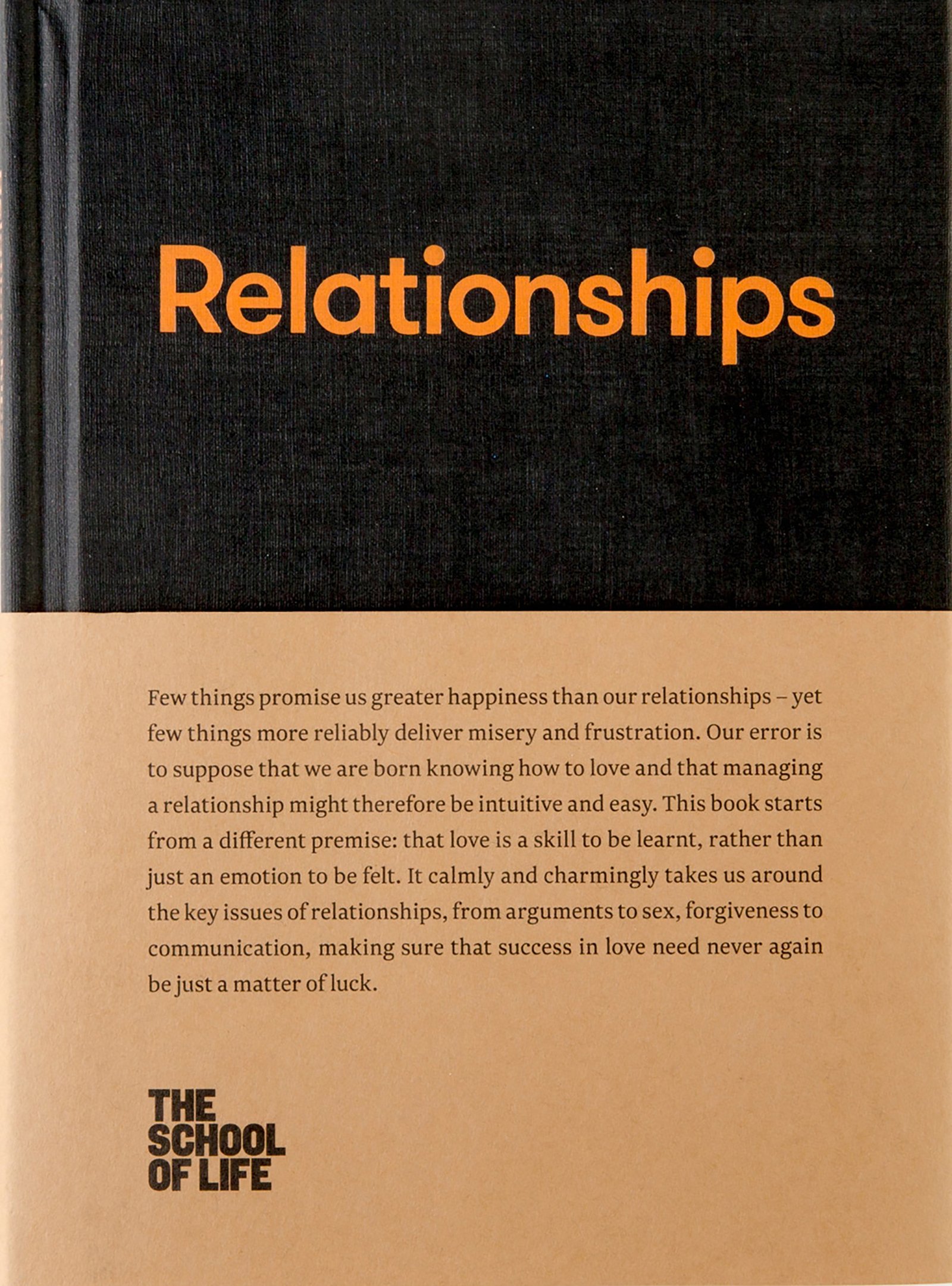
Relationships (The School of Life Library) [The School of Life, de Botton, Alain] on desertcart.com. *FREE* shipping on qualifying offers. Relationships (The School of Life Library) Review: Insightful and entertaining - What I loved about this book is its conciseness and being direct to the point without losing the beauty in the way it was written. Helpful and optimistic, it shows different kinds of perspective in love that were unheard of. Review: Insightful - Anyone one that needs a reality check on the subject of relationships should read this book. I like that it caters to the logical side of "love" and it isn't so much fairytale-y but realistic about topics, issues within this particular partnership. It too confirmed my own feelings about how the wheels should effectively turn and happen already to in my own relationship. two thumbs up. Required reading.
| Best Sellers Rank | #1,310,876 in Books ( See Top 100 in Books ) #1,874 in Love & Romance (Books) #2,881 in Communication & Social Skills (Books) #3,645 in Marriage |
| Customer Reviews | 4.6 4.6 out of 5 stars (1,076) |
| Dimensions | 5.75 x 0.75 x 8 inches |
| Edition | Illustrated |
| ISBN-10 | 0993538746 |
| ISBN-13 | 978-0993538742 |
| Item Weight | 11.2 ounces |
| Language | English |
| Part of series | Lessons for Life |
| Print length | 120 pages |
| Publication date | April 3, 2018 |
| Publisher | The School of Life |
A**Z
Insightful and entertaining
What I loved about this book is its conciseness and being direct to the point without losing the beauty in the way it was written. Helpful and optimistic, it shows different kinds of perspective in love that were unheard of.
G**!
Insightful
Anyone one that needs a reality check on the subject of relationships should read this book. I like that it caters to the logical side of "love" and it isn't so much fairytale-y but realistic about topics, issues within this particular partnership. It too confirmed my own feelings about how the wheels should effectively turn and happen already to in my own relationship. two thumbs up. Required reading.
S**N
Time for real life but..
This is a very good book, giving thought and voice to a classic view of couples. There are however the mentally disordered not suitable for any relationship, that should not be ignored.
J**H
A beautiful book
I have read this book, and given it many times as a gift at the very least is helpful Guide understand conceptions of love.
J**N
Building Blocks Of Self Understanding
Breaks down everything I knew about love. It made me sit down and self analyze. It's a great book for self growth.
A**E
This book removed all my language anxieties.
I can’t thank the authors enough. This book single-handedly changed my perspective on my romantic relationship and lifted my anxieties about our future. Almost every chapter had learnings for me I will take to heart every day.
J**O
Great read
I recommend reading it, specially if you’re in a long term relationship. It puts relationships in a more clear perspective.
N**C
Incredibly insightful
Again and again this book reveals flaws deeply engrained in our cultures, stories we hear everyday, and most importantly, ourselves. This book made me be more observant and understanding of these flaws, which is no easy task. Looking forward to read it again.
A**E
Das Buch erörtert in 20 Kapiteln die Wichtigkeit der verschiedenen und bedeutendsten Komponenten einer Beziehung zwischen, sich zwei liebenden, Menschen und deren oft missverstandenen gegen Komponenten. Das Buch behandelt sowohl pro als auch contra gleichermaßen fair, nachvollziehbar, als auch ausführlich genug. Hier geht es zum Beispiel um banale Themen wie die Wäsche oder der Abwasch, die für jeden Leser eine unbekannte Perspektive beleuchtet und somit den eigenen Horizont sowie das Verständnis gegenüber seines Partners schaffen soll. Weiterhin nimmt das Buch Bezug zu Themen wie Monogamie versus Polygamie, Single Leben, sowie die Unterschiede zwischen romantischer und klassischer Liebe. Zudem gibt es hilfreiche Anweisungen zum Beispiel durch das führen künstlicher inszenierte Gespräche, die als eine Art der Selbsttherapie helfen sollen. Das Buch warnt auch vor der Romantisierten Gesellschaft. Das Buch nimmt den liebenden Leser, mit einer holistischen Sichtweise, an die Hand und hilft ihm sich durch das Chaos der Liebe durch Wissen und Balance neu zu orientieren, ohne dabei auf der einzig richtigen Wahrheit zu plädieren. Man kann das Buch auch als eine Art Streitschlichter sehen, der Konflikte der Unwissenheit durch Weisheit schlichten will, also Augen öffnend. Ich kann das Buch vor allem für junge Paare empfehlen, die hier eine gute Basis für ihre Beziehung erhalten werden.
C**E
Great and complete arguments
F**E
1. Post-Romanticism Our loves unfold against a cultural backdrop that creates a powerful sense of what is ‘normal’ in love; it subtly directs us as to where we should place our emotional emphases, it teaches us what to value, how to approach conflicts, what to get excited about, when to tolerate and what we can be legitimately incensed by. Love has a history and we ride – sometimes rather helplessly – on its currents. 2. Object Choice But there’s another school of thought, this one influenced by psychoanalysis, which challenges the notion that instinct invariably draws us to those who will make us happy. The theory insists that we don’t fall in love first and foremost with those who care for us in ideal ways, we fall in love with those who care for us in familiar ways. Adult love emerges from a template of how we should be loved that was created in childhood and is likely to be entwined with a range of problematic compulsions that militate in key ways against our chances of growth. 3. Transference Relationships are filled with curious moments where one or the other partner appears to ‘overreact’ to a situation. For all of us, there are situations and behaviours which can be counted upon to elicit swift and powerful responses which don’t seem in any way in line with what is happening right now. Our behaviour seems not to fit what is unfolding in front of us. The concept of transference provides a vantage point on some of the most frustrating behaviours that we ever have to meet with in relationships – and it allows us to feel sympathy and understanding where we might have only felt irritation. If we cannot always be entirely sane in our relationships, the kindest thing we can do for those who care about us is to hand over some maps that try to chart and guide others through the more disturbed regions of our internal world. A third transference exercise asks us to say the first thing that comes to mind when we try to finish particular sentences. For example: Men in authority are generally … Young women are almost always … When I am promoted, what’s bound to happen is … When someone is late, it must be because … When I hear someone described as ‘very intellectual’, I imagine them being 4. The Problems of Closeness If we’re going to deal a bit better with the very common (and difficult) responses to intimacy, we have to start by looking with calm honesty at ourselves. A good question to ask is: What do we characteristically do when we need someone but aren’t able to reach them? Do we withdraw, attack or – this is so rare – explain our requirements in an un-frightened way? The hopeful move is that we can learn to recognise our own and our partner’s typical defensive manoeuvres in our calmer moods. 5. The Weakness of Strength The failings of our lovers can be deeply galling. We got close to them because of their skills and merits – but after a while it can be the disappointing sides of their personalities that dominate our view of them. We look upon their faults and wonder again and again why they are the way they are. Why so slow? Why so unreliable? How can they be so bad at explaining things or telling an anecdote? Why can’t they face bad news straight on? Even worse, we feel they could change – if only they really wanted to, if only they weren’t so mean … 6. Partner-As-Child Small children sometimes behave in stunningly unfair and shocking ways: they scream at the person who is looking after them, angrily push away a bowl of animal pasta, throw away something you have just fetched for them. But we rarely feel personally agitated or wounded by their behaviour. And the reason is that we don’t assign a negative motive or mean intention to a small person. We reach around for the most benevolent interpretations. We don’t think they are doing it in order to upset us. We probably think that they are getting a bit tired, or their gums are sore or they are upset by the arrival of a younger sibling. We’ve got a large repertoire of alternative explanations ready in our heads – and none of these lead us to panic or get terribly agitated. 7. Loving and Being Loved We speak of ‘love’ as if it were a single, undifferentiated thing, but in truth it comprises two very different modes: being loved and loving. Part of getting better at relationships means growing a little readier to do the latter and a little more aware of our unnatural and dangerous fixation on the former. 8. The Dignity of Ironing When intelligent and sensitive people – guided by Romanticism – come together in relationships, they tend to be agreed on an implicit hierarchy of what is and isn’t important for the success and endurance of their love. They tend to be highly aware of the importance of spending time together (perhaps in museums or by the sea), of having fulfilling sex, of assembling a circle of interesting friends and of reading stimulating books. They are unlikely to give much thought, however, to the question of who will do the ironing. In the arts, we acknowledge that small things – details – are densely packed with significance. Domestic details, too, look small but carry big important ideas. It might sound very odd at first to make the comparison, but the objects of domestic agitation are very like works of art: they condense complex meaning into tightly packed symbolic details. 9. Teaching and Learning We should never feel ashamed of instructing or of needing instruction. The only fault is to reject the opportunity for education if it is offered – however clumsily. Love should be a nurturing attempt by two people to reach their full potential – never just a crucible in which to look for endorsement for all one’s present failings. 10. Pessimism Our lives are powerfully affected by a special quirk of the human mind to which we rarely pay much attention. We are creatures deeply marked by our expectations. We go around with mental pictures, lodged in our brains, of how things are supposed to go. We may hardly even notice we’ve got such phantasms. But expectations have an enormous impact on how we respond to what happens to us. They are always framing the way we interpret the events in our lives. It’s according to the tenor of our expectations that we will deem moments in our lives to be either enchanting or (more likely) profoundly mediocre and unfair. 11. Blame and Love Irrational blame is at heart just a symptom of an intensity of investment in another person. We attack because we have richly entangled our deepest dreams and anxieties with our lover. It is because we are so very close to them that they draw us into very private zones of turbulence and distress – from which absolutely everyone else is excluded. That is one of the stranger, more unfortunate and yet (from a very calm angle) almost flattering gifts of love. 12. Politeness and Secrets It is assigning too great a weight to all our feelings to let them always be the lodestars by which our lives must be guided. We are chaotic chemical propositions in dire need of basic principles to which we can adhere during our brief rational spells. 13. Explaining One’s Madness At the heart of much comedy is a brilliant act of explanation. The makers latch onto a character who normally would seem weird and off-putting, but they guide us to see that they don’t need to be viewed that way. Instead of covering up or condemning the oddities, they explore the ongoing possibilities for love amidst the maddening flaws of human nature. For relationships to survive, it appears we too must take on – at key moments – some of the underlying perspectives of a great comedy writing team. 14. Artificial Conversations An artificial conversation can sound like quite a strange idea. But what it involves is deliberately setting an agenda and putting a few useful moves and rules into practice. Over dinner with a partner, we might – for example – work our way gradually yet systematically through a list of difficult but important questions that we’d otherwise likely shelve or not find our way to: – What would you most like to be complimented on in the relationship? – Where do you think you’re especially good as a person? – Which of your flaws do you want to be treated more generously? – What would you tell your younger self about love? Another thing we can do with a partner is to finish these sentence stems about our feelings towards one another – the idea is to finish them very fast without thinking too hard. What emerges isn’t of course a final statement. But it helps to get awkward material into the light of day, so that it can be examined properly. I resent… I am puzzled by … I am hurt by … I regret … I am afraid that … 15. Crushes The error of the crush is subtler; it lies in how easily we move from spotting a range of genuinely fine traits of character to settling on a recklessly naive romantic conclusion: that the other across the train aisle or pavement constitutes a complete answer to our inner emotional needs. 16. Sexual Non-Liberation This narrative of enlightenment and progress, however flattering it may be to the modern age, conveniently skirts an immovable fact: we remain hugely conflicted, embarrassed, ashamed and odd about sex. Sex refuses to match up simply with love and remains as difficult a subject as ever, with one added complication: it’s meant to be so simple. And yet our sexual imaginations will always refuse to bow to normative parameters. 17. The Loyalist and the Libertine The painful fact is there is no answer to the Libertine-Loyalist dilemma, if what one means by an ‘answer’ is a cost-free settlement in which no party suffers a loss, and in which every positive element can coexist with every other, without either causing or sustaining grievous damage. There is wisdom on both sides; and therefore each side must involve loss. There is, in a sense, only one answer of sorts, and it can be called the Melancholy Position, because it confronts the sad truth that in certain key areas of human existence, there simply are no good solutions. 18. Celibacy and Endings So much can go right with short-term love: – When two people know they don’t own one another, they are extremely careful to earn each other’s respect on a daily basis. Knowing someone could leave us at any time isn’t only grounds for insecurity, it’s a constant catalyst for tender appreciation. 19. Classical vs Romantic Both Romantic and Classical orientations have important truths to impart. Neither is wholly right or wrong. They need to be balanced. And none of us are in any case ever simply one or the other. But because a good relationship requires a judicious balance of both, at this point in history, it might be the Classical attitude whose distinctive claims and wisdom we need to listen to most intently. It is a mode of approaching life which is ripe for rediscovery. 20. Better Love Stories We don’t particularly notice it day-to-day, but the stories our culture presents us with concerning love and relationships – via films, songs, novels and adverts – have a major subterranean influence on how we think and feel. They shape our sense of what is normal and hence of what is troublingly abnormal; they seed certain hopes and expectations and foster particular opportunities for disappointment, indignation or alarm.
J**E
It changed a few of my beliefs. Solid book.
J**Z
Recomendado. Editorial y publicación
Trustpilot
5 days ago
1 day ago