Some deliveries may take a little longer than usual due to regional shipping conditions.

DOWNLOAD THE APP


Customer Services
Copyright © 2025 Desertcart Holdings Limited
DOWNLOAD THE APP
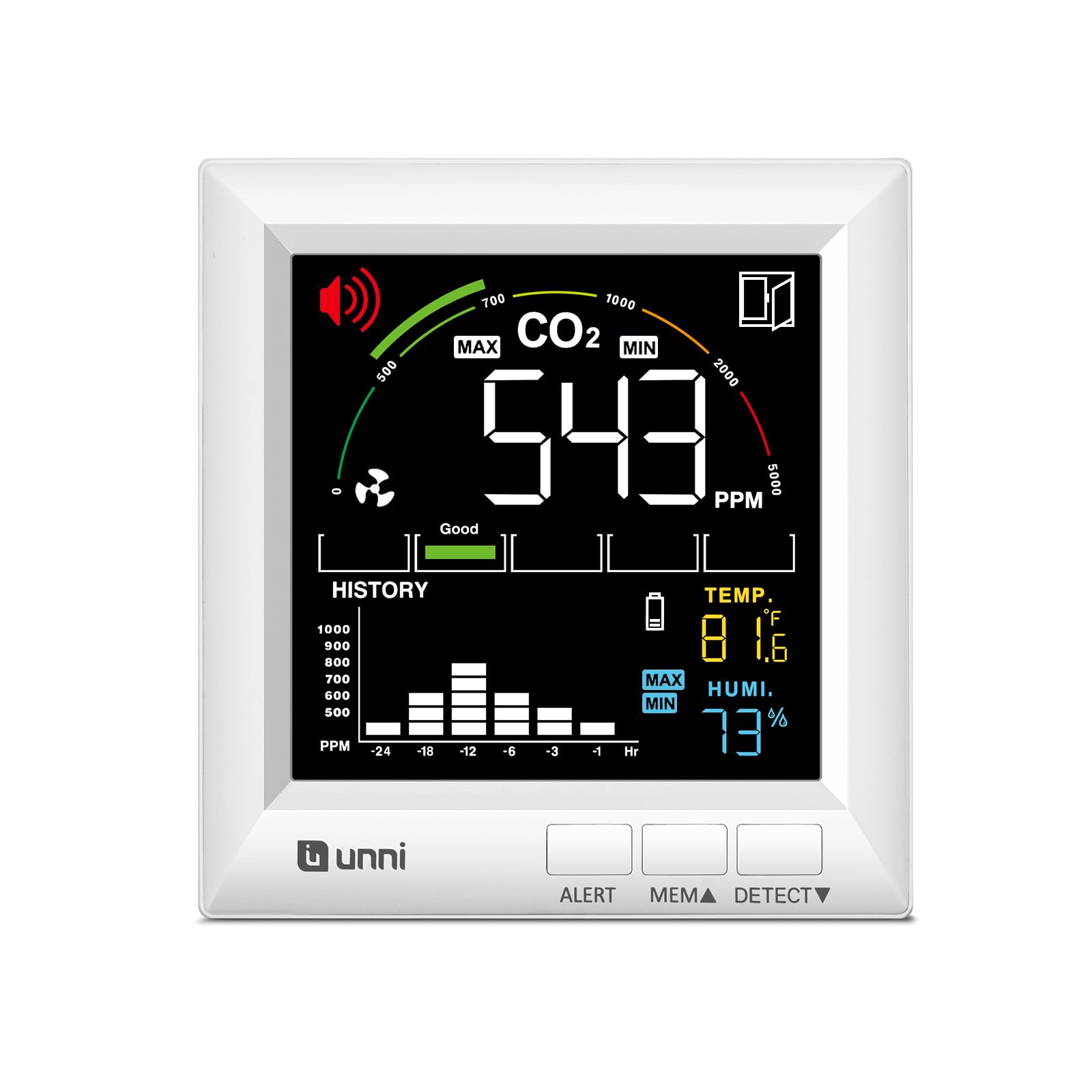
🌬️ Breathe smarter, live better — your air’s new best friend!
The U UNNI CO2 Monitor uses a high-precision Swiss photoacoustic sensor to deliver real-time, reliable readings of carbon dioxide (400–5000 ppm), temperature (14.2°F–122°F), and humidity (20%–95%). Featuring 3 adjustable alarm volumes and backlight settings, it alerts you to poor indoor air quality, helping prevent headaches and fatigue caused by elevated CO2. USB powered with battery backup, it’s perfect for homes, offices, and RVs, combining advanced air quality monitoring with sleek, user-friendly design.




| Alarm | Audible |
| Brand | U UNNI |
| Color | White |
| Power Source | USB POWERED OPTION & BATTERY BACKUP |
| Sensor Type | Photoacoustic Sensor |
| Style | Classic |
T**Y
UNNI Air quality monitor UN0602 appears accurate - Comparing to UN0601
The Unni carbon dioxide monitor UN0601 is small and light and seems very accurate. The display is clear and easy to read and can be dimmed or turned off. It comes with a USB cord that plugs in to any charger. Batteries can be used for memory or temporary testing, but are not necessary for the unit to function. To test the accuracy, I placed it outdoors and it was reading 401 ppm, which is normal carbon dioxide level in outdoor air. Indoor it was reading 568 ppm and it was going up when there were more people in the room and with some candles lit. The level went down to 489 ppm in the same room overnight when there were no people or lit candles. The monitor also has a thermometer and humidity function. I tested it side-by-side with a UNNI thermometer and it displayed the same temperature and humidity digits as the other unit, with only a fraction difference. The temperature can be set to Fahrenheit or Celsius. The monitor has an alarm feature that can be set if the CO2 level becomes too high. I tested by blowing on it and it went up to over 1000 ppm and a window symbol was lit on the display, indicating it is time to ventilate the room. This carbon dioxide monitor appears to work great and can be used in places where people gather, such as in schools, churches or similar, but also in your home. EDIT: This is a review of Unni Air Quality Monitor UN0602. There is a USB power cable and adapter included in the box along with instructions. When you first plug it in, there is a few minutes of count down before the display starts to show any values. The calendar and clock is easy to set and there is an option for 12 hour or 24 hour format, and daylight savings time. The unit monitors CO2 in the air, expressed in parts per million (ppm). The outdoor air is typically around 400 ppm for normal clean air. CO2 values over 1000 is too high and ventilation is needed. I tested the device side by side with an older same brand CO2 monitor UN0601 and found that the values were close, but not in agreement until after one week of testing. There was a 60-100 ppm difference in the values, sometimes the old unit was lower and the new unit higher, and sometimes it was the other way around. I tested both of them outdoors and noted the value was close to 400 ppm for each. The CO2 reading can be calibrated if it seems off. I did not calibrate it, since the outdoor reading seemed accurate. After a week the old and the new monitor were displaying the same CO2 values. The CO2 monitor is using a photo acoustic sensor. The unit also monitors the total Volatile Organic Compounds (TVOC) and is displayed with five different color indicators, green being the lowest and purple the highest level. The monitor was mostly green during testing, but would quickly go to purple within an hour when cooking. Just boiling a pot of pasta on an electric stove, caused the monitor to show a purple indicator even if it was in an other room. I am more interested in VOCs from paint, flooring, furniture etc. in the home, so this can be a little misleading. The particulate matter (PM) measures pollutants smaller than 1 microns (PM1) or fine, measured in micrograms per cubic meter, smaller than 2.5 microns (PM2.5), and smaller than 10 microns (PM10), or coarse. These smaller particles are invisible, like soot, viruses, smoke etc. and can cause asthma and other health issues. Values below 75 are generally considered safe. All three PM values were showing the same numbers during testing, from 0-5. The values seemed to go up at the same time when the TVOC value was going up. Both TVOC concentration value and the PM values are measured with laser detection. Not sure how accurate they are. The ambient temperature and humidity is also measured and displayed. These values seem accurate, since I compared them to several other devices. The Unni air quality monitor also has alert functions that can be set for CO2 and PM levels. The alerts can be turned on/off. The backlight on the display has two brightness levels and can be turned off by touching the upper part. This monitor can be useful after home renovations or when moving into new places with unknown materials. It can also be useful if living in areas with suspected high air pollution.
M**N
Very Handy Air Quality Monitor!
We just purchased the Unni Air Quality Monitor for our home and fell in love with it right out of the box! It was very easy to set up. There is a nice instruction book that comes with it. The one thing missing in the manual is an explanation of the air quality acronym meanings. I had to look up their definitions. The display is clean, and colorful and very easy to read. Not only do you see current CO2 (carbon dioxide) levels, TVOC level (Total Volatile Organic Compounds, representing the combined concentration of many different organic chemicals that easily turn into gas at room temperature, used as a key indicator of indoor air quality level), and PM2.5 and PM10 levels (particulate matter in sizes 10 microns and smaller and 2.5 microns and smaller). You can set alarms for these values too. In addition to the numeric values, it also gives you readings of very good”, “good”, “normal”, “bad”, “very bad”. Bonus data displayed is indoor temperature and humidity as well as a calendar! Poor air quality could lead to headaches, drowsiness and fatigue. We are very pleased with this purchase - it is a great value for money well spent!
R**N
Accurate, Reliable, and Ideal for Nursery Air Quality
I’ve been really impressed with this CO₂ Monitor Carbon Dioxide Detector. The readings are accurate and refresh quickly, which gives me a lot of peace of mind—especially with a new baby at home. The built-in temperature and humidity monitor is a huge bonus. It helps me keep the nursery at a comfortable and healthy level throughout the day, and the indoor air quality indicator makes it easy to catch issues before they become a problem. I also appreciate the 3 adjustable alert volumes and the 3-level backlight. They make the device flexible for both daytime use and quiet nighttime monitoring without disturbing the baby. Overall, this monitor is easy to use, reliable, and packed with practical features. Highly recommend it for anyone who wants to maintain a safe and healthy environment at home, especially for newborns.
M**E
Easy to set up right out of the box.
Here's what I like about the unni CO2 Sensor (UN0601). 1. Easy to set up right out of the box, it only takes a minute or two. 2. It seems to be very sensitive, do not put it to close where you could breathe on it because it picks up your breath and causes the sensor to read high. 3. It displays real time temperature, humidity and of course CO2 levels. 4. The monitors volume can be adjusted, it has 3 volume levels so depending on where you place it you can hear an alert in your home. It also has an adjustable back light for easy reading with three settings. 5. This would work great I think in an RV when running the generator to alert you of any issues. 6. It also has a battery back-up, takes 3 AAA batteries. 7. It allows you to improve your home ventilation if readings are too high by possibly opening a window or changing your ventilation if needed. 8. It is easy to view from a distance. 9. in the short time I've had this it gives me the peace of mind that if there was an issue I would be alerted. What I would change: 1. It would help if it came with the plug adaptor as noted in the picture. Though I guess many people like me have an extra cell phone adaptor that could work. 2. They could also let purchasers know the plug is not included, just the usb to usb C cord. Overall, I am very happy with my purchase!!
L**G
Works Well and Looks Great
To test it the U Unni CO2 Monitor I compared it to the Aranet4 Home I also have. Over all they give the same readings. Often they are identical for a while, sometimes one gives a higher or lower Carbon Dioxide reading than the other. The U Unni CO2 Monitor takes measurements constantly it looks like as the numbers change quickly depending on the changes in environment around it. The Aranet4 Home has a default setting of taking a measurement once every 5 minutes. So in that setting if the environment changes it may give the reading of a few minutes ago while the U Unni already gives the current reading. The Atanet4 Home can be set to take a measurement once every 1, 5, or 10 minutes. But to change that default setting one needs the app for it on one's smartphone. When that measurement interval is set for every 1 minute both devices usually give the same readings or with minimal differences. Also to activate the Aranet4 Home alarm beeper one needs the app, and also for re-calibration.. For those who want to see more settings and data and share or save them utilizing the app may be more attractive. For those who do not care for that and just want to see the Carbon Dioxide, temperature and humidity levels and see a simple graph of the Carbon Dioxide measurements over the last 24 hours the U Unni may be more convenient considering the price difference. The U Unni's screen goes dark shortly after calibration and showing the measurement results when only operating on batteries. But a light touch on the top of the device lights up all the data again right away. When connected to current via a USB the screen remains lit. Although one can dim it somewhat by touching the top again, and even turn the light off. Also on batteries one can thus choose between two levels of brightness. To re-calibrate the U Unni it looks like I can just leave it outside for a short while or remove a battery and put it back in again. The U Unni's user manual comes in English and German and is easy to understand.
A**A
Good accuracy, nice design
EDIT: Received a free replacement unit that doesn't have the below issues, thus increasing my rating. Accuracy is decent for the price, though this unit tends to read a bit low. Sometimes up to 100 ppm below my Aranet4, but typically within 50 ppm. While this is already very good, a similarly priced device (from Newentor, see picture) tracks more closely, which is why this one doesn’t rate higher. So minus one star so far. I’m marking it down by another star because the display has some visible artifacts. They don’t affect readability but look a little ugly when viewed up close. Given I only see this issue in 1-2 of the pictures other people posted, it seems that mine is from a bad batch. I do like the size of the device and the layout of the display, though. Overall, a fine device with good accuracy, but the strong competition and display flaws result in my 3/5 rating. PS: All 3 devices in the picture were calibrated together a few days prior.
S**R
Calibration drift makes monitor useless; monitor requires frequent re-calibration
This is a review of the U UNNI carbon dioxide monitor. I have to give this product a one-star rating because the carbon dioxide reading is completely unreliable, due to excessive calibration drift. From my brief experience, I have concluded that this monitor needs to be calibrated daily. Update 12/11/2025: I've now had this CO2 monitor for over two months. During those two months, I've run many experiments, maintaining careful log readings. Two months of experiments confirmed my initial judgements: My monitor drifts low after calibration, making it unreliable. The calibration process involves taking the monitor outside, where the monitor sets itself to read 400 ppm in outside air. Of course, CO2 in outside air might vary between 350 ppm and 600 ppm, but the monitor will set itself to read 400 ppm no matter what. Whenever I would calibrate the instrument, the indication would rise 20% to 50% from its value prior to calibration. After calibration, the CO2 indication drifts slowly lower and lower as time passes, as much as 150 ppm to 250 ppm. Either outside air CO2 is changing by 150 ppm to 250 ppm between calibrations, or the monitor's calibration is drifting low. Calibration drift makes this CO2 monitor useless for our home. Pros: Very nice display. Cons: -- [Major] Not accurate. Carbon dioxide reading drifts significantly after calibration. -- [Moderate] Inconvenient calibration process. -- [Minor] Requires power input, but power supply is not included. -- [Minor] Inaccurate temperature indication. Unreliable accuracy: I have to give this carbon dioxide monitor a one-star rating because I cannot trust its accuracy. After unpacking the carbon dioxide monitor, I performed the calibration procedure per the user manual. After calibration, the monitor read 400 ppm while outside, confirming the calibration was successful. I moved the monitor inside and the reading was between 800 and 1000 ppm. By the next day, the reading had decreased to about 600 ppm. The following day (two days after calibration) the reading had decreased to 430 ppm. I then recalibrated the monitor (so it read 400 ppm in outdoor air). Moving it back inside, it read 650 ppm (220 ppm higher than immediately before calibration!). For the monitor to drift so far out of calibration in just two days makes this monitor completely unreliable and unusable. I may try to borrow a calibrated industrial carbon dioxide monitor to compare to this device immediately after calibration. Inconvenient calibration process: Some carbon dioxide monitors have a very simply calibration process. For example, some monitors might have you press a button three time in rapid succession. This monitor has a very inconvenient process. You must unplug the USB cable and batteries and take the monitor outside. While outside, you must continuously hold a button while you insert the three batteries. When you hear beeps, you leave the monitor for a few minutes until it finishes its calibration. Finally, you must remove all power again (remove the batteries), then restore power (reinstall the batteries or plug in the USB cable). This process is unnecessarily complicated! I especially hate having to hold a button down with one hand while inserting three batteries with the other hand. I also find it odd that users must remember to remove power and restore power to complete the calibration. Why couldn’t they just follow the example of others and press a one button three times? Or at least have the monitor automatically reset following calibration without requiring a power-off, power-on. Power supply not included: This monitor needs a power supply. It can operate only a very short time on batteries. The power is supplied via a USB C socket on the monitor. A USB A to USB C cable comes in the box. You must provide your own USB power source. If you want to move this monitor to different rooms in your home, you might need to buy a new USB power supply block, raising your total cost to use this monitor. Temperature reading is 2 degrees F too high compared to calibrated instrument.
A**A
Nice little CO₂ monitor
PROS • Large, easy-to-read display • Displays both the ppm # and what that means (Very Good, Good, Normal, Bad, Very Bad) • Shows a 24-hour history of CO₂ readings in a graph on the bottom half of the display. • CO₂ alert (nice addition and can be changed to a custom ppm between 800 ppm and 2400 ppm; volume can also be adjusted or can be turned off completely) • Also measure indoor humidity and temperature. CONS • Does not come with batteries (not a huge deal since batteries are only for backup) • Only includes a cord, not a wall plug attachment, which my husband finds very annoying because more and more things are being sent without the attachment to plug into the wall. • Alarm design of the alert (I will explain more below) • Has both a fan icon and a window icon (which I think is helpful to know when to ventilate), but the instructions only mention a ventilation icon and list the two on the display, so I could not figure out if they are supposed to mean different things. MY THOUGHTS I was pleasantly surprised by how sensitive this monitor is. When I was home alone, it showed a reading of 450 ppm and displayed on the screen, "Very Good." When my husband got home, he smoked a cigarette, and almost immediately this monitor picked up the changes in the air quality, and it raised to 550 ppm and displayed on the screen, "Good." Another feature I found nice was the design of the alert. Not only can you set a custom ppm value to trigger the alert, but if the alert is turned off and CO₂ reaches the set value, it still alerts you by displaying the ventilation icon and flashing the CO₂ icon. One of the things I feel could be improved is the alarm that is set off when the alert is on. When on, it will sound for one minute and automatically turn off. If your levels don't change, the monitor will just continue to flash the CO₂ icon and display the ventilation icon until they do return to a lower ppm. I don't like this because if you're expecting to be alerted when the CO₂ reaches a certain ppm value, and you're not home or in a different room and miss the alarm, you could be unaware you have an issue. Also, there is no way to turn the ringing alarm off if you are in the room and have to listen to it for the entire minute until it shuts off. I do think that this small design flaw with the alarm and the confusion with the fan and window icons could be worked with and that this monitor would be a great addition to any household or for anyone who has fatigue, headaches, and reduced concentration when in enclosed spaces. It is an affordable price and has many features that help monitor air quality. This monitor also lets you know when it's time to ventilate the air (the fan and window icon I think mean the same thing), which is very helpful for any household, especially in the winter to reduce the spread of germs.
Trustpilot
1 day ago
3 weeks ago