
DOWNLOAD THE APP


Customer Services
Copyright © 2025 Desertcart Holdings Limited
DOWNLOAD THE APP
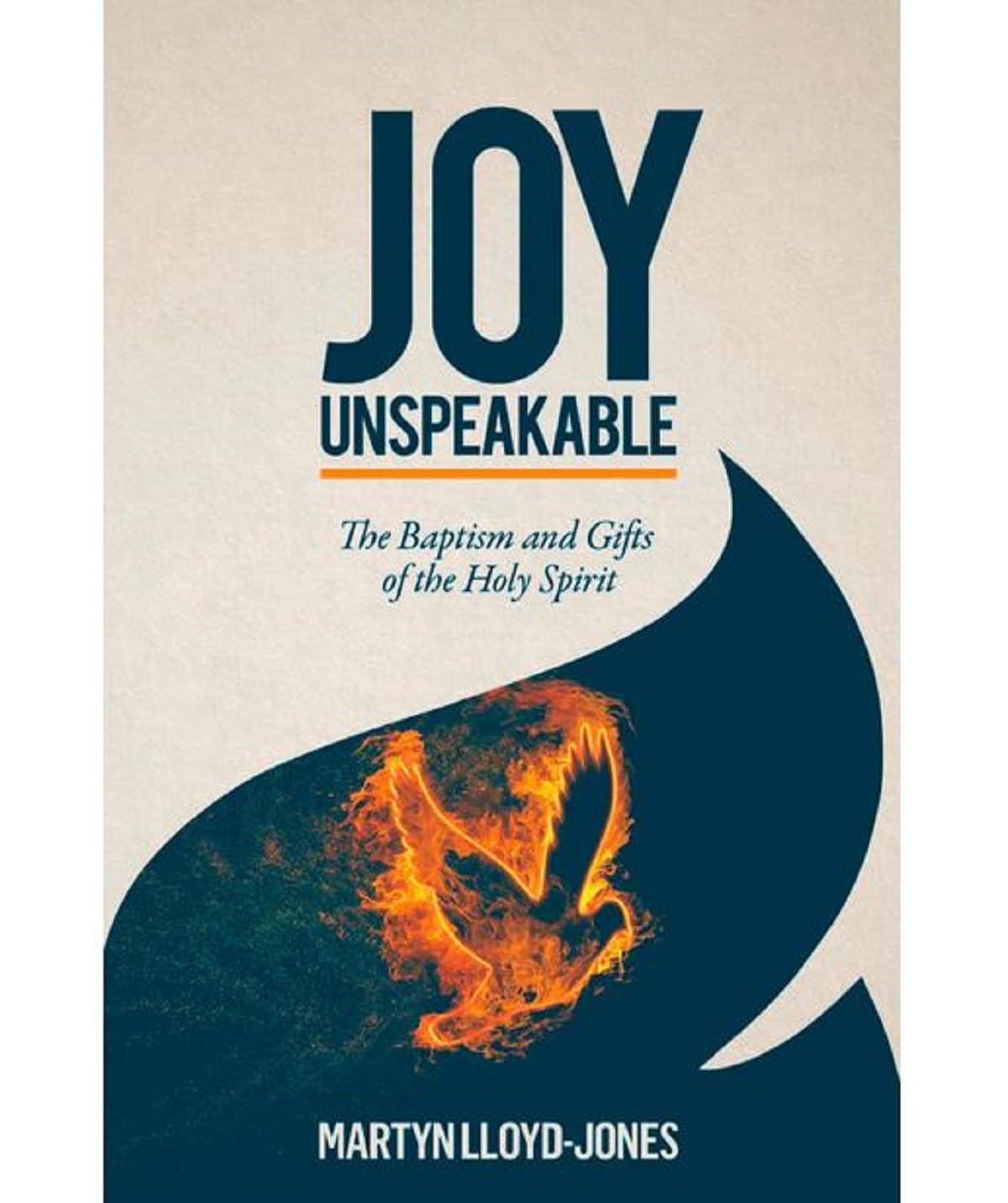
Buy Joy Unspeakable: Power and Renewal in the Holy Spirit by D. Martyn Lloyd-Jones (ISBN: 9781842913956) from desertcart's Book Store. Everyday low prices and free delivery on eligible orders. Review: The Baptism in the Holy Spirit as Joy Unspeakable - A carefully reasoned step by step apologetic for the Baptism in the Holy Spirit as distinct from the New Birth, along with wise pastoral counsel about seeking this. Review: Five Stars - A very informative book that everyone should read
| Best Sellers Rank | 46,662 in Books ( See Top 100 in Books ) 208 in Christian Theology |
| Customer reviews | 4.7 4.7 out of 5 stars (206) |
| Dimensions | 14 x 1.9 x 21 cm |
| ISBN-10 | 1842913956 |
| ISBN-13 | 978-1842913956 |
| Item weight | 446 g |
| Language | English |
| Print length | 480 pages |
| Publication date | 1 April 2008 |
| Publisher | David C Cook |
M**G
The Baptism in the Holy Spirit as Joy Unspeakable
A carefully reasoned step by step apologetic for the Baptism in the Holy Spirit as distinct from the New Birth, along with wise pastoral counsel about seeking this.
A**R
Five Stars
A very informative book that everyone should read
M**Y
Good book
Reading!
R**T
Vintage Dr Lloyd-Jones.
Brilliant book from the Doctor on the baptism and gifts of the Holy Ghost. Highly informative too, and greatly moving.
A**.
Five Stars
A wonderful book on a wonderful subject
T**J
Five Stars
wonderful book & great service
D**S
If this is not Martyn Lloyd-Jones’ worst book, it must surely come close
If this is not Martyn Lloyd-Jones’ worst book, it must surely come close. This is sad, because the “Doctor,” as he is affectionately known by some, is, generally, a good expositor and exegete of Scripture. For example, I found his work on Ephesians very helpful in studying the armour of God in Ephesians 6 and his treatment of original guilt in Romans 5 very helpful indeed in studying the doctrine of original sin. That is to say, I am not someone who dislikes Lloyd-Jones, hereafter abbreviated to MLJ. Nevertheless,Joy Unspeakable is a truly dreadful book. It is dreadful exactly because it is not exegetical. Although Joy Unspeakable purports to be a series of sermons on John, the “Doctor” strays from an exegetical treatment of John into flights of fancy, which continue for almost the entirety of the book. MLJ launches off from John 1:26, 33, takes the phrase “baptizeth with the Holy Ghost,” and runs amok with it. The book is also long and repetitive, which makes a concise review of the work difficult. Perhaps, MLJ imagines that, if he beats the “baptism with the Holy Spirit” drum long and hard enough, he will beat the reader into submission. Throughout the reading of the book, this reviewer kept waiting for the proof—the exegetical proof—of MLJ’s central assertion: “baptism with the Holy Spirit” is a post-conversion experience available to all believers, but lacking in the lives of most believers, especially today in the age of declension in which we live; and, since “baptism with the Holy Spirit” is the church’s only hope, we must all cry out for revival, for revival and “baptism with the Holy Spirit” are inextricably linked. Egregiously, MLJ uses the old Pentecostal/Charismatic tactic of quoting repeatedly, “Quench not the Spirit” (I Thess. 5:19), as if quoting (but not providing any exegesis of) this text were enough to shut the mouths of all those who disagree with MLJ’s central thesis. MLJ offers a false dichotomy—either you believe in the “baptism with the Holy Spirit,” as he defines it, or you are a Spirit-quencher, which is dangerously close to being unregenerate! I counted at least thirteen references to I Thessalonians 5:19, but not one attempt to exegete the text! If anyone would like me to go in deeper as to why this book is just awful, send me a comment. <><
T**Y
Good book, not really my cup of tea
Good book, not really my cup of tea. If you are not into charismatic Christianity then this is not for you
B**G
I am extremely happy that I bought and own this book. It's a good buy, with over 450 pages, and it seems to consist of twenty four sermons that Lloyd-Jones preached on the subject of The Baptism with the Holy Spirit. I say this because Lloyd-Jones died in 1981, but this book is copyrighted in 1984 by Lloyd-Jones' wife. Also, his grandson is the editor, and he also wrote an introduction. In spite of the fact that this may be transcripts of sermons, it is very well written and easy to read and understand. So either the editor did a marvelous job, or Lloyd-Jones wrote out his sermons in addition to preaching them. Now to content. I was for many years a member of a traditional Pentecostal church, and we were taught that the Baptism with the Holy Spirit was an event separate and usually subsequent to salvation and was always accompanied by speaking in tongues. After many years under this teaching, and being very well schooled in the arguments to back up the traditional Pentecostal teaching, a series of events of a very negative nature shook my faith in this type of church and caused me to almost "start over" in my Christian education. Through this journey, I studied the teachings of many non-Pentecostal preachers, teachers, and authors. One of my favorite teachers and authors is John MacArthur of Grace Community Church in California, who radio ministry is called "Grace to You." He is extremely prolific and a wonderful, thorough, and uncompromisingly scriptural teacher of the Bible. Well John MacArthur wrote a book entitled "Charismatic Chaos" in which he gives a very good presentation of his positions: 1) that "miracle gifts," [speaking in tongues, interpretation of tongues, miracles, healings] ceased even before the end of the Apostle Paul's ministry and life and 2) that the Baptism with the Holy Spirit occurs now concurrent with salvation. In the early church, it came it stages, but MacArthur gives his reasons for that, and he does a really good job. Based on his book, I stopped praying in tongues, and became even more suspicious of people who say "The Lord told me . . . ." and who want to give me prophesies or operate in other "spiritual gifts." Still, I was not convinced that John MacArthur had the whole story, because I have not seen anything in the church during my lifetime that has come close to the Book of Acts. And I don't see anything in the Bible that says the church today should be different from then. Now MacArthur also claims that Martin Lloyd-Jones is one of his "heroes." He uses quotes from him in his MacArthur commentaries. So when I discovered that Lloyd-Jones was a Calvinist (or Reformed) theologian, AND he believes that the Baptism with the Holy Spirit occurs separate and generally subsequent to salvation and that all the gifts of the Spirit can occur today, well this book was for me a "must." And I am not disappointed. Lloyd-Jones gives his exegesis that the Baptism with the Holy Spirit occurs separate from salvation, it does not require speaking with tongues, it does not require accompaniment by any manifestation of the Spirit or any particular gift, it is not equivalent with sanctification, that gifts of the spirit or "manifestations" can be counterfeited, that there are many reasons to be cautious about manifestations, and much, much more. There are twenty-four chapters and twenty-four topics, and I have enjoyed them all. I especially appreciate the chapters showing that we have to be cautious when people claim that they have gifts of the Spirit. Do I now have all the answers? No, not at all. In fact, I may have more questions than ever, but I believe that my love for, and knowledge of, Scripture is greater than ever. And so I'll keep on studying and searching and reading and researching, and I believe I'll get the answers eventually. Finally, I am asking God to grant me the Baptism with the Holy Spirit as Lloyd-Jones defines and describes it, so I would have to say I found his presentation very persuasive.
M**N
This book is a must-read for anyone seeking truth about the baptism of the Holy Spirit by a highly respected 20th Century Leader
Y**D
I just love the Doctor, he is such a wonderful expositor of scripture. What I find challenging and hopeful about this book is the basic premise; that one can have saving faith, be a Christian but not have the baptism of the Holy Spirit (that often comes later). I think the argument is well put in this book and most importantly it ask for we Christians to pray and ask for more!! Having over two decades in a bible believing church that teaches the standard line of "One baptism (upon conversion), many fillings", I found many Christians with no power of the spirit, a weak faith, and an over intellectualized view of the bible and the Holy Spirit. I really think Martin Lloyd is on to something here and this is a worthwhile book. I am also just finishing his book on Romans 8, the Sons of God which conveys much of the same argument. It has helped me see that the current evangelical state of "take it by faith", "an experience is not needed" is not historical Christianity, it really is only the last 150 years. A worthwhile and provocative read.
-**)
Pentecostalism and subsequent Charismatic excesses have created an uncomfortable quandary for those of us who believe that Gods Spirit can do wonders in our day, but wonder why He doesn’t seem to be active in our midst. We do not want to leave our brains at the door - we want the meat of Bible-centered theology and history, and are also desperate to experience the power of God! Dr. Lloyd-Jones dogmatically and patiently lays out the biblical and historic case for the Baptism of the Holy Spirit as a separate experience that Jesus sovereignly chooses to pour out on His people. This experience dramatically increases a believer’s faith and power to bear witness to Christ as Lord, and can be manifested in entire communities as a revival. It is a separate experience that can come at the point of conversion or at another point in time. There can be additional outpourings of the Spirit, and it is possible to cease walking in this power due to various reasons. This book does not deal with specific phenomena that accompany the baptism of the Holy Spirit, but only what the baptism is and what it is intended to bring about. This book is well-written, and I suspect I will read it again.
D**R
Martyn Lloyd-Jones was a Welsh Protestant preacher described by the MLJ Trust as "influential in the Reformed wing of the British evangelical movement in the 20th century." Some in the Reformed camp rued that influence, especially after publication of the sermons here on baptism with the Holy Spirit: "The family of the Rev. Martyn Lloyd-Jones did not do the Reformed faith any favor when they published his defense of this doctrine in Joy Unspeakable." The Presbyterian Reformed Church in America "Jones' prescription for new life in the church is wrong, dead wrong. This book is a bad book." The Reformed Free Publishing Association and The Standard Bearer. What did these Reformed stalwarts have against Lloyd-Jones and his unspeakable joy? For starters, Lloyd-Jones considered the experience of baptism with the Holy Spirit, as described in the book of Acts, to be both available and desirable for Christians today. That is a major departure from the standard Reformed position that the occurrences in Acts were one-off, once for all experiences that were not intended for and should not be desired by believers today. The book of Acts, they say, is "descriptive, not prescriptive" meaning that it describes unique circumstances in the first century church and does not establish any regulatory or normative principles for subsequent believers. To the extent baptism with the Holy Spirit is recognized at all by the old guard, it is subsumed within one's initial conversion, and is decidedly non-experiential. John MacArthur speaks for many Reformed leaders when he writes, "Each of us possesses the entire Holy Spirit from the time we repent and believe" and "Holy Spirit baptism is not an extra experience you need to seek; it is something you have from the moment you are saved." But that is not how Lloyd-Jones saw it. He wrote, "what is established beyond any doubt is that one can be a believer without being baptized by the Holy Spirit." (31.) As for the John MacArthurs who equate Spirit baptism with regeneration, Lloyd-Jones said that they "seem to me not only to be denying the New Testament but to be definitely quenching the Spirit." (141.) Lloyd-Jones repeatedly points out the wide disparity between the Christian life as seen in the New Testament and the Christianity promoted and practiced by a large segment of the church today: "[W]e look at the new Testament church, we see this amazing life that was in it - this power, this joy, this abandon, this thrill, and we ask ourselves, 'Are we like that?' We then read the subsequent history of the church and ... [w]e see that there have been periods in the church like this present era when the church has been weak and lethargic and ineffective." (199.) Many, if not most, in the church today "cannot say that they rejoice in Him 'with a joy unspeakable and full of glory.'" (183.) The current state of affairs is largely blamed on church leaders who interpret the New Testament through the reductionist lens of their own limited experience and, consequently, "reduce everything to the ordinary." (18, 74). Without delving into philosophies of knowledge and epistemology, Lloyd-Jones exposes the real problem as an Enlightenment era rationalism that now permeates much of Protestant theology. Modernism might be dead everywhere else, but it is alive and well in mainline Reformed churches. No one mixed more philosophic rationalism into today's Christianity than Reformed philosopher Gordon Clark who substituted "Logic" for the Logos in John, Chapter 1, and read the opening verse as: "In the beginning was Logic, and Logic was with God, and Logic was God." Clarkian apologist John Robbins of the Trinity Foundation took this rationalism about as far as one could go with statements such as "truth always comes from propositions" and "the mind of God, that is, God himself, is propositional." If God is essentially logic and propositions, then the rational understanding of propositions becomes the ultimate spiritual experience. While Clark and Robbins are at the extreme, the reduction of spiritual knowledge and spiritual life to logic, propositions and dogma is widespread. But mere orthodoxy is not enough. "It is not enough for us as Christian people to make sure that we are orthodox and to bemoan the statements that are made in the name of Christ that are denials of the Scriptural teaching. ... Are we - let us ask it again - are we rejoicing in the Lord Jesus Christ with a joy which is unspeakable and full of glory?" (231.) Spiritual life, spiritual reality and unspeakable joy are described by, but are not found within, the propositional statements of Scripture. They come from Jesus himself: "You search the Scriptures thinking that in them you have eternal life; and it is they that bear witness about me, yet you refuse to come to me that you may have life." John 5:39-40. Commenting on this passage, Charles Spurgeon added, "You stop short at the Scriptures, and therefore short of eternal life." Aside from giving the Rationalists a good poke in the eye, Lloyd-Jones recounts dozens of personal testimonies from prominent Christians throughout the ages who received direct, immediate, divine illumination of spiritual reality and who gave witness to their own rejoicing with joy unspeakable and full of glory. My one critique of Lloyd-Jones here is that while these witnesses recognized the Holy Spirit as active in their experiences, many did not attribute the experience specifically to "baptism with the Holy Spirit" as Lloyd-Jones does. Some of these witnesses were superb theologians and philosophers, such as John Owen and Jonathan Edwards, who placed their experiences within the context of a well-developed epistemology, theology and biblical exegesis. By lifting the experiences out of that context and linking them all to his own particular view of baptism with the Holy Spirit, Lloyd-Jones does something of a disservice to the works of these great thinkers and believers. Moreover, as Lloyd-Jones himself acknowledged, the desire and search for spiritual experience can be fraught with personal and communal dangers. Owen and Edwards took pains to identify those dangers and to mark out the narrow path that leads to life. With that caveat, I recommend this book.
Trustpilot
2 weeks ago
2 weeks ago