Some deliveries may take a little longer than usual due to regional shipping conditions.

DOWNLOAD THE APP


Customer Services
Copyright © 2025 Desertcart Holdings Limited
DOWNLOAD THE APP
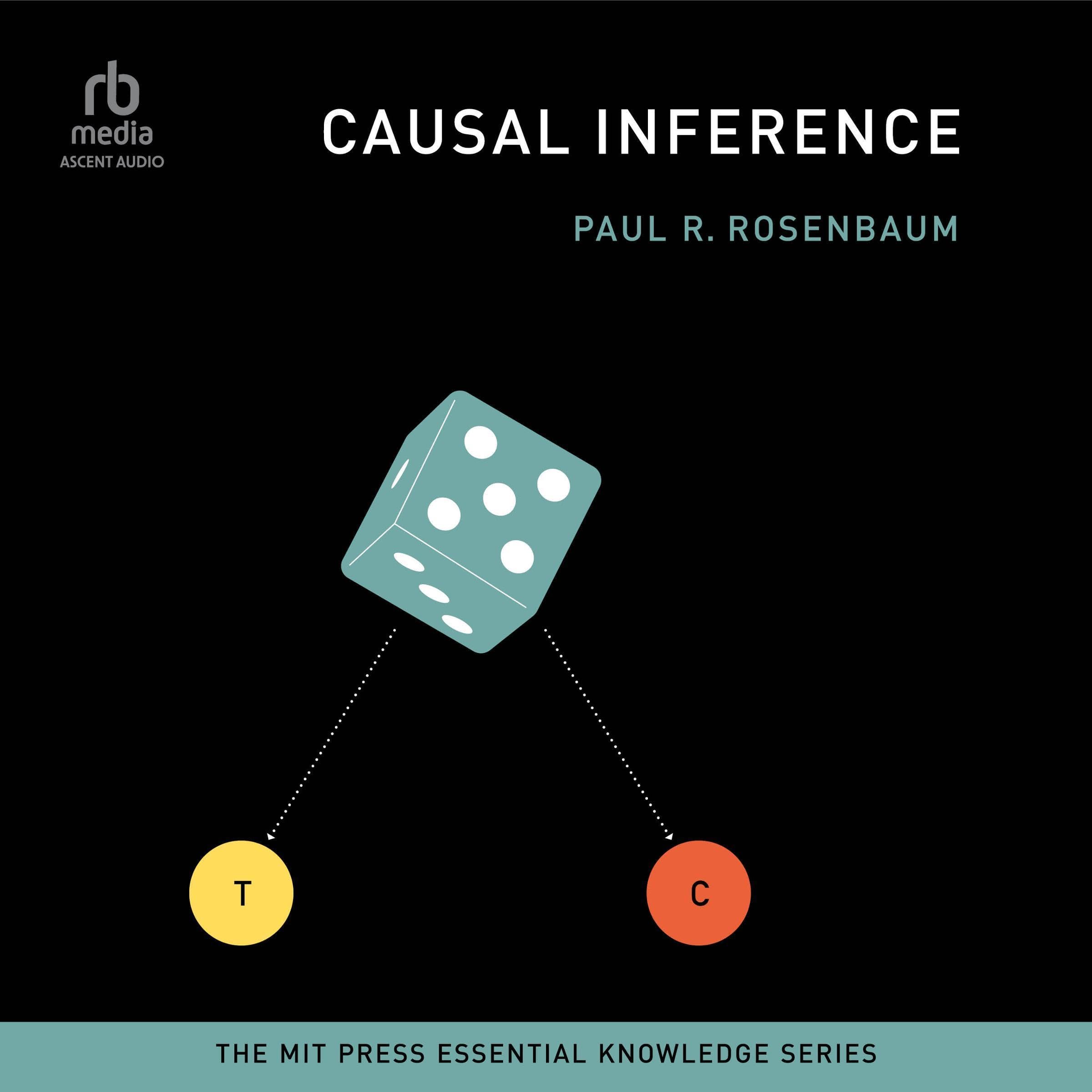
Causal Inference: MIT Press Essential Knowledge Series (Audio Download): Paul r. Rosenbaum, Chris Monteiro, Ascent Audio: desertcart.co.uk: Books Review: A good introduction for undergrad scientists but not for the general reader - The whole business of how we can use statistics to decide if something is caused by something else is crucially important to science, whether it's about the impact of a vaccine or deciding whether or not a spray of particles in the Large Hadron Collider has been caused by the decay of a Higgs boson. 'Correlation is not causality' is a mantra of science, because it's so easy to misinterpret a causal link from things that happen close together and space and time. As a result I was delighted with the idea of what the cover describes as a 'nontechnical guide to the basic ideas of modern causal inference'. Paul Rosenbaum starts with a driving factor - deducing the effects of medical treatments - and goes on to bring in the significance of randomised experiments versus the problems of purely observational studies, digs into covariates and ways to bring in experiment-like features to observational studies, brings up issues of replication and finishes with the impact of uncertainty and complexity. This is mostly exactly the kind of topics than should be covered in such a guide, and as such it hits spot. But, unfortunately, while it is indeed an effective introductory guide for scientists who aren't mathematicians, Rosenbaum fails on making this accessible to a nontechnical audience. Rosenbaum quotes mathematician George Pólya as saying that we need a notation that is 'unambiguous, pregnant, easy to remember…' I would have been happier with this book if Rosenbaum had explained how a mathematical notation could possibly be pregnant. (He doesn't.) But, more importantly, the notation used is simply not easy to remember for a nontechnical audience. Within one page of it starting to be used, I had to keep looking back to see what the different parts meant. We are told that a causal effect is 'a comparison of outcomes' and in the first example given this is rTw - rCw. Bits of this are relatively clear. T and C are treatment and control. W is George Washington (as the example is about his being treated, then dying soon after). I'm guessing 'r' refers to result, though that term isn't used in the text, but most importantly it's not obvious why the 'causal effect' is those two variables, set to arbitrary values, with one subtracted from the other. I'm pretty familiar with algebra and statistics, but I rapidly found the symbolic representations used hard to follow - there has to be a better way if you are writing for a general audience: it appears the author doesn't know how to do this. The irritating thing is that Rosenbaum doesn't then make use of this representation - he's lost half the readership for no reason. The rest of the book is more descriptive, but time after time the way that examples are described is handled in a way that is going to put people off, bringing in unnecessary jargon and simply writing more like a textbook without detail. Take the opening of the jauntily headed section 'Matching for Covariates as a Method of Adjustment': 'In figure 4 [which is several pages back in a different chapter], we saw more extensive peridontal disease amongst smokers, but we were not convinced that we were witnessing an effect caused by smoking. The figure compared the peridontal disease outcomes of treated individuals and controls who were not comparable. In figures 2-3 we saw that the smokers and nonsmokers were not comparable. The simplest solution is to compare individuals who are comparable, or at least comparable in ways we can see.' This is a classic example of the importance of being aware of who the audience is and what the book is supposed to do. To reach that target nontechnical audience, the book would have to have been far less of a textbook light, rethinking the way the material is put across. The content is fine for a technical audience who aren't mathematicians - so this is still a useful book - but the content certainly isn't well-presented for the general public. Review: I preferred the book. - While understandable, this is generally better as a printed book.
B**G
A good introduction for undergrad scientists but not for the general reader
The whole business of how we can use statistics to decide if something is caused by something else is crucially important to science, whether it's about the impact of a vaccine or deciding whether or not a spray of particles in the Large Hadron Collider has been caused by the decay of a Higgs boson. 'Correlation is not causality' is a mantra of science, because it's so easy to misinterpret a causal link from things that happen close together and space and time. As a result I was delighted with the idea of what the cover describes as a 'nontechnical guide to the basic ideas of modern causal inference'. Paul Rosenbaum starts with a driving factor - deducing the effects of medical treatments - and goes on to bring in the significance of randomised experiments versus the problems of purely observational studies, digs into covariates and ways to bring in experiment-like features to observational studies, brings up issues of replication and finishes with the impact of uncertainty and complexity. This is mostly exactly the kind of topics than should be covered in such a guide, and as such it hits spot. But, unfortunately, while it is indeed an effective introductory guide for scientists who aren't mathematicians, Rosenbaum fails on making this accessible to a nontechnical audience. Rosenbaum quotes mathematician George Pólya as saying that we need a notation that is 'unambiguous, pregnant, easy to remember…' I would have been happier with this book if Rosenbaum had explained how a mathematical notation could possibly be pregnant. (He doesn't.) But, more importantly, the notation used is simply not easy to remember for a nontechnical audience. Within one page of it starting to be used, I had to keep looking back to see what the different parts meant. We are told that a causal effect is 'a comparison of outcomes' and in the first example given this is rTw - rCw. Bits of this are relatively clear. T and C are treatment and control. W is George Washington (as the example is about his being treated, then dying soon after). I'm guessing 'r' refers to result, though that term isn't used in the text, but most importantly it's not obvious why the 'causal effect' is those two variables, set to arbitrary values, with one subtracted from the other. I'm pretty familiar with algebra and statistics, but I rapidly found the symbolic representations used hard to follow - there has to be a better way if you are writing for a general audience: it appears the author doesn't know how to do this. The irritating thing is that Rosenbaum doesn't then make use of this representation - he's lost half the readership for no reason. The rest of the book is more descriptive, but time after time the way that examples are described is handled in a way that is going to put people off, bringing in unnecessary jargon and simply writing more like a textbook without detail. Take the opening of the jauntily headed section 'Matching for Covariates as a Method of Adjustment': 'In figure 4 [which is several pages back in a different chapter], we saw more extensive peridontal disease amongst smokers, but we were not convinced that we were witnessing an effect caused by smoking. The figure compared the peridontal disease outcomes of treated individuals and controls who were not comparable. In figures 2-3 we saw that the smokers and nonsmokers were not comparable. The simplest solution is to compare individuals who are comparable, or at least comparable in ways we can see.' This is a classic example of the importance of being aware of who the audience is and what the book is supposed to do. To reach that target nontechnical audience, the book would have to have been far less of a textbook light, rethinking the way the material is put across. The content is fine for a technical audience who aren't mathematicians - so this is still a useful book - but the content certainly isn't well-presented for the general public.
B**E
I preferred the book.
While understandable, this is generally better as a printed book.
M**N
Excellent summary of modern techniques for identifying cause
A**N
Boa introdução para inferência causal.
T**S
one of the coolest books ive ever read so far
M**R
This book is exceptionally well-written and well-argued, making it a valuable read for those interested in the econometrics of causal inference. However, my two-star review is not based on the intellectual quality of the book itself, but rather on the published version. The book is printed on low-quality paper and is significantly smaller than I anticipated. To cut costs, the font size is small, the paper quality is subpar, and these factors detract from the overall reading experience. I would have preferred the physical quality of the book to match the intellectual quality of its contents.
E**L
Nice book for the lovers of casual inference
Trustpilot
4 days ago
2 days ago