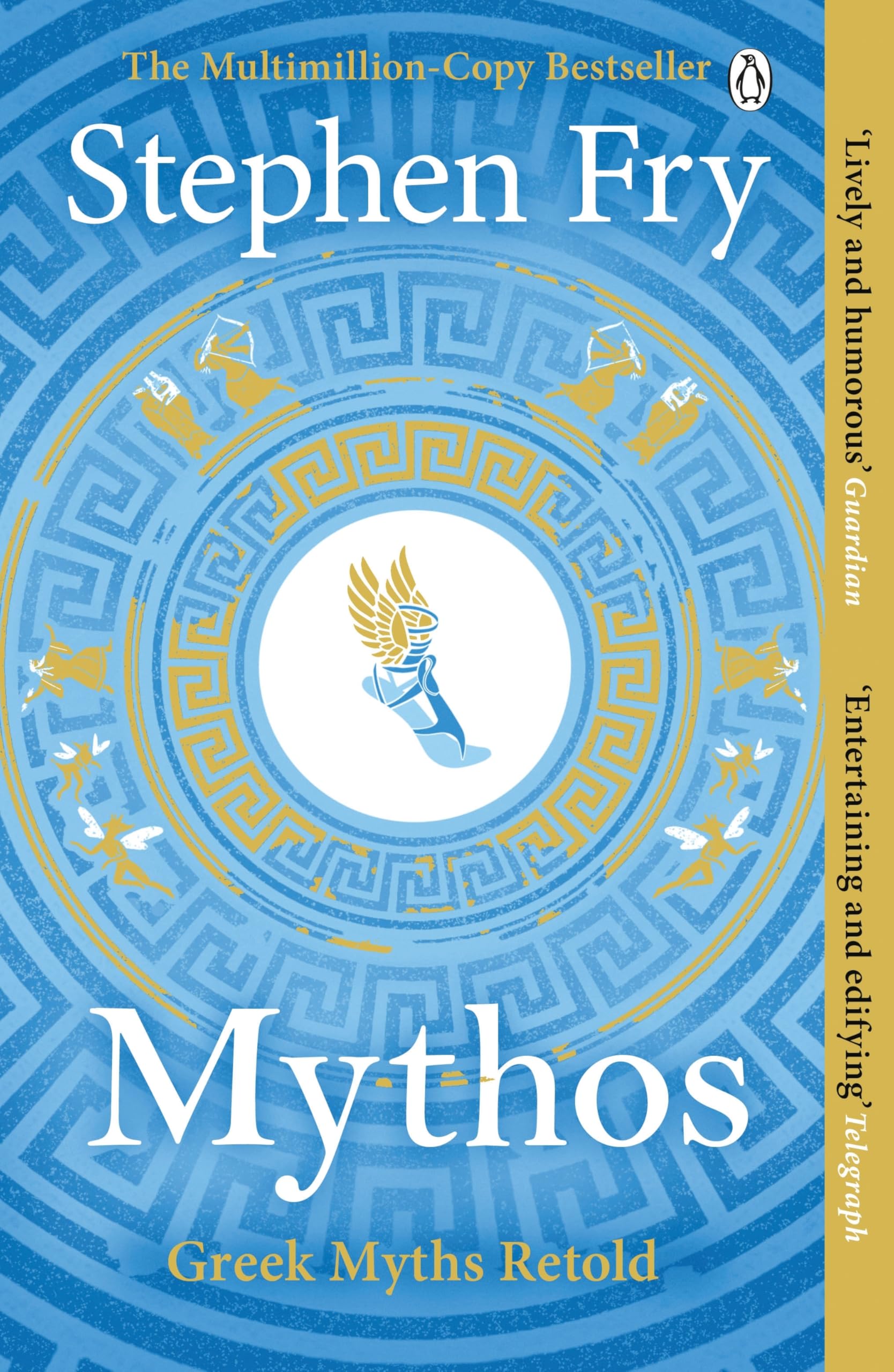
Mythos: The Greek Myths Retold : Fry, Stephen: desertcart.in: Books Review: A fun and an insightful retelling of the Greek myths - Its a contemporary retelling of Greek myths without losing depth and humor. It will keep you hooked. The footnotes are as interesting...the origins of words especially the biological nomenclature etc has a lot to owe to these myths. The Gods will at once appear as flawed, beautiful and enigmatic. Pick this book up for a leisurely read and when you finish, you would have gathered so much insight. Review: Great narration of greek myths - A must read. Great writing by Stephen Fry. Anyone who needs an initiation into greek myths, needs to read this.
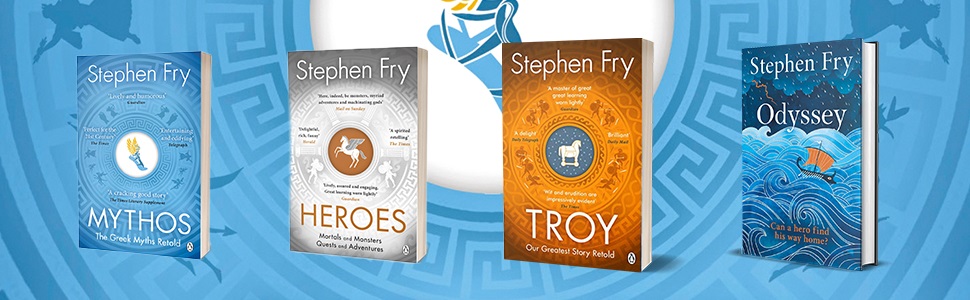
| Best Sellers Rank | #6,371 in Books ( See Top 100 in Books ) #2 in History of Ancient Greece #19 in Occult & Paranormal #60 in Dragons & Mythical Creatures Fantasy |
| Country of Origin | United Kingdom |
| Customer Reviews | 4.6 4.6 out of 5 stars (20,975) |
| Dimensions | 12.8 x 2.8 x 19.8 cm |
| Generic Name | BOOK |
| ISBN-10 | 1405934131 |
| ISBN-13 | 978-1405934138 |
| Importer | Penguin Random House India Pvt Ltd |
| Item Weight | 349 g |
| Language | English |
| Packer | Penguin Random House India Pvt Ltd |
| Paperback | 464 pages |
| Publisher | Penguin (26 July 2018); Penguin Random House Ireland Limited; [email protected] |
P**I
A fun and an insightful retelling of the Greek myths
Its a contemporary retelling of Greek myths without losing depth and humor. It will keep you hooked. The footnotes are as interesting...the origins of words especially the biological nomenclature etc has a lot to owe to these myths. The Gods will at once appear as flawed, beautiful and enigmatic. Pick this book up for a leisurely read and when you finish, you would have gathered so much insight.
P**H
Great narration of greek myths
A must read. Great writing by Stephen Fry. Anyone who needs an initiation into greek myths, needs to read this.
S**I
This book is a great starting point in greek mythology.
Started with nothing and ended up learning a lot. Some of the words we use today and names of plants, flowers and animals had so much history connected to them is just mesmerizing to know and read. Loved the story of Echo and Hera.
A**N
A dummy's guide to Greek mythology
For someone like me who had little knowledge of Greek mythology, Mythos is the perfect introduction to this subject. Fry covers it comprehensively, even if not in great detail, and his easy and humorous writing style makes the book an easy read. The book tries to be as comprehensive as possible, commencing from the origins of the titans and the gods, and concluding with several fables. It also discusses the origin of many words commonly used today — euthanasia coming from Thanatos, Kronos contributing to chronometers, and tantalised from Tantalus for example. As Fry puts it, this “splendidly exemplifies the continuing relationship between Greek myth and our language”. There are interesting origin stories as well — the creation of peacocks or the Sahara desert and icy polar regions or a swan song for example. The book also provides insights into the linkages between Greek (and Roman) mythological characters, even minor ones — an interesting bit of trivia is that Apollo was the only Greek god worshipped by the Romans under the same name. This book is essentially a dummy’s guide to Greek mythology. If your objective is to learn more about the subject, “Mythos” is a great read. Pros: A great introduction to Greek mythology, easy writing style Cons: In his attempt to be comprehensive, there is a bit of an overload of characters
N**I
Wow!
Having been a student of English literature, I am not unfamiliar with Greek and Roman mythology. Book: Mythos is a retelling of the tales of Gods, Goddesses, Titans, and humans. It is the first book in the five-part series on Greek mythology. The author starts from the beginning of Chaos and proceeds to tell us about the future events—like the birth of Zeus, the punishment of Prometheus, and the opening of Pandora’s box. Review: Narrated in Fry’s trademark wry humour, Mythos is a treasure trove of information for those fascinated with Greek mythology. The author doesn’t pass any judgements but narrates tales as they occurred. For a beginner, the zillion names in this book might make one’s head spin. I must salute the writer for his deep research and dedication. While most of the names are secondary and need not warrant a second look, they add meaning to the retellings. It was amusing to read about the divine men and women fornicating like there were no tomorrow to procreate. None are spared. Sisters. Mothers. You name it, you get it. Most of the gods would give the Lannister siblings (Game of Thrones) a run for their incestuousness. Nevertheless, it’s not always lust. Gods are as much prone to vanity and jealousy as the humans. Prometheus getting punished by Zeus for teaching mankind about fire—a jealous Hera always on the lookout for her husband’s mistresses—this book has every vice and emotion present in the dictionary. It was amazing to read about some English words and their possible origins from these tales. The wicked king Tantalus invokes the wrath of the gods. He was cursed to be in a neither-here-nor-there place, agonisingly close to satisfaction, only to be denied at the last moment. [tantalizing] The beautiful Arachne can spin, but her skill stirs envy in Athena’s heart. Finally, the repentant Goddess makes up for the girl’s suicide by rewarding her with a permanent talent to spin [arachnid] Midway, I found myself overwhelmed by the information dump, but the book picked up pace again. I reiterate that it is useful for aspiring writers who seek inspiration from myths. Even minor characters have so much scope in such majestic tales. It’s no wonder that heroes have found voices in subsequent works of literature—Shelley, Byron, and the great Shakespeare. If you’re a fan of this genre, you won’t be disappointed.
P**D
A narrative, not an encyclopedia type
Honestly, this book requires patience. It's more of a narrative rather than an encyclopedia which let me down to be honest, for one like me who is new to the subject and just want to look-up some specific Gods, their powers and relations at once but not dive very deep into the tales it's kinda hard to start with, especially considering the fact it doesn't include any index as well. Though, even tho the narrative is in continuity, it's divided into different sections which makes it feasible to get into.
P**I
Loved it
Great book!
M**R
Very Entertaining Read
Stephen Fry's dry, British humor shines in this retelling of Greek mythology. The quick turn of the phrase and the real-sounding dialogues between various characters makes this book a must read.
G**I
As a comedian and witty commentator with an unparalleled breadth of knowledge and command of the English language, Stephen Fry needs no introduction. Not surprisingly, he happens to be a talented author with exquisite style. An avid defender of freedom of Speech, Fry is an atheist and considers himself an empiricist. Empiricism is the idea that what we can know about the world is bonded to what we can observe. We sometimes see patterns within our observations and derive hypotheses that help us describe and, hopefully, predict natural phenomena. Empiricism is also about accepting that reason alone cannot explain everything; there are many things that we can predict with incredible accuracy but which still elude explanation. So how can an empiricist like Fry explain his devotion to Greek mythology? Because myths are narrative metaphors that teach us about human nature. They show us who we are at our worst and how we can be at our best. Midas teaches us about the unintended consequences of our decisions; Sisyphus's story is a masterclass in hubris, vanity, and the meaningless arrogance of believing that one can escape fate; Prometheus' punishment is a symbol of the price of free will. Speaking of metaphors, Greek gods are metaphorical archetypes. They are not the perfect, idealized, all-powerful beings one can find in Judeo-Christian religions. They are divinely flawed and profoundly human, which make them relatable. By any standard, they are a bunch of a**holes. Loudly proud, petty, envious, unreasonably vengeful, and with a very nasty sense of humor, they painstakingly render our lives miserable and futile. I guess that is one important lesson we can learn from Greek mythology; we may have free will, be decent people and work hard toward happiness, we will always be at the mercy of selfish gods (misfortune) and their agenda (entropy). Fry's enthusiasm is palpable in his prose and will put a smile on your face.
Z**R
Funny and well written, an absolute must for any fan of mythology.
Z**H
Geachte klantenservice, Mijn bestelling met bestelnummer 404-4941000-3680360 wordt niet weergegeven in mijn account onder "Orders", waardoor ik de status van de levering niet kan doorgeven. Wilt u alstublieft zo snel mogelijk de exacte locatie van de levering aan mij doorgeven, aangezien het niet duidelijk is waar mijn bestelling is en ik deze dringend nodig heb. Alvast hartelijk dank voor uw medewerking
T**N
1. Libro arrivato in perfette condizioni e un paio di giorni prima del previsto. 2. La mitologia greca ri-raccontata con umorismo e semplicità! Se poi conosci la voce di Stephen Fry, lo leggi con le sue voci in mente! Non potevo non acquistare anche i seguiti! (4 libri in tutto, si conclude con l’odissea)
T**E
"Their myths understand that whoever created this baffling world, with its cruelties, wonders, caprices, beauties, madness and injustice, must themselves have been cruel, wonderful, capricious, beautiful, mad and unjust". The Greeks created gods that were in their image: warlike but creative, wise but ferocious, loving but jealous, tender but brutal, compassionate but vengeful". (Prologue) Stephen Fry is one of the most versatile and multi-skilled artists of our time and his work as an author, actor, producer, director, presenter, etc, has won both critical acclaim and people's deep respect. From a man of this stature, one could expect nothing less than bold artistic creations that dare to approach grand themes and subjects through an innovative perspective. In Mythos: The Greek Myths Retold, Fry attempts to retell the Greek myths, in chronological order, beginning with the existence of the primordial Chaos -the Greek equivalent to the scientific "big bang" theory- and the birth of the first order of divine beings such as the Nychta, Erevos, Gaia, Ouranos, Eris,and many others. These primordial deities were called the Titans, the word meaning "the striving, straining one", and the most notorious of them was Cronos, the titan who conspired with his mother to kill his father, Ouranos, and thus became the first among them. Cronos is known to the masses for the fact that he ate his own children to remain the king of the universe, but he finally took a taste of his own medicine as his wife, Rhea, deceived him and kept her last child that was called Zeus. Zeus grew up in Crete, far away from his wicked, cruel father and when he was in the appropriate age took revenge on his father and dethroned him from his regal status. As we are all well aware of Zeus was going to be the first among the twelve gods of Olympus, but this would not happen until this new order of divine entities, the second order, have removed once and for all the remaining titans from the face of the Cosmos. It should be mentioned that for ancient Greeks the word Cosmos meant what we call today the universe. What followed was a ten-year brutal war, an "earth-shattering conflict", known as the "Clash of the Titans" or "Titanomachy", and by the end of it, the Dodekatheon (meaning the twelve gods) was established as ruling the universe and everything in it. The new gods took the place of the titans through the use of excessive violence during the Titanomachy. Fry continues with the story of the creation of mankind by Zeus and the betrayal of Prometheus who stole fire and gave it to humanity as civilization. Zeus, enraged by Prometheus' treachery punished him severely as he was sentenced to eternal torment. Prometheus would be bound to a rock and each day an eagle would eat his liver which would then grow back only to be eaten again the next day. This process would continue ad infinitum. The reader can observe how the Greek perception of the creation of humanity shares many similarities with later religions like Christianism. One example would be seen as being created in the image of God both in Greek mythology and Christian tradition. Furthermore, we learn about the creation of the first woman, named Pandora, and her infamous box that contained a vast number of human vices that would torture mankind for the centuries to come. The author then mentions the story of the god Eros and his relation with Psyche. It is worth noting that ancient Greeks had four different words for love: Agape, Eros, Storge, Filia and each one of them had a distinct meaning. Eros was the son of the two Olympian gods, Aphrodite and Ares. Psyche was a lavishly beautiful young woman, daughter of a king, who made Aphrodite, the goddess of love and sexuality, to become jealous of her due to her incredible attractiveness. Eros fell in love with her and took her with him in an enchanted place where everything was dazzling, but under one condition. Psyche was not allowed for any reason to see her lover. But, as it always happens in Greek mythology, Psyche was unable to resist the temptation of looking at her gorgeous partner and attempted to light a candle to see him as clearly as possible when he was sleeping beside her. The result was that Eros, devastated by Psyche's betrayal, flew away from her. It was only after the intervention of the first among the twelve gods, Zeus, that Aphrodite became convinced to accept Psyche as her bride. There are more captivating chapters on the complex relationships that formed between gods and humans, the divine punishments, the metamorphoses of mortals to animals either as torture or as an act of compassion, and the great Greek lesson about Hybris that can be boiled down in this sentence: how pride comes before a fall. There are so many stories in this (mid-length) book that I was forced to incessantly keep notes during the reading. I have to admit that, even though I am a proud Greek, I remembered a tiny percentage of the stories cited in Mythos. In his foreword note, the author stresses his fascination with Greek myths as"the Greeks were the first people to make coherent narratives, a literature even of their gods, monsters and heroes"., even though their mythology is not the oldest in the world. The Greek gods owe a lot to the deities of Mesopotamia while the stories of Babylonians, Sumerians, and Akkadians preceded the Greek ones. Fry stresses out that his only intention is to simply retell the -already known- stories, and not to offer any kind of explanation or interpretation of their possible hidden meaning. There are some minor differentiations in their details, and Fry justifies himself by writing "in tinkering with the details I am doing what people have always done with myths". On another page, he quotes: "I think however that it is best told like all myths, not as an allegory, symbolic fable or metaphor, but as a story". Nevertheless, Mythos: The Greek Myths Retold attempts to establish a coherent timeline regarding the "ages of man" which is different from that of the Greek poet Hesiod who wrote the iconic Theogony. The readers who will read the book without skipping chapters will manage in the end to achieve some clarity regarding the chronological order of the genesis of both Cosmos, gods and mankind. In conclusion, I have to admit that this was by far the most compelling book I've read the last twelve months -or even more- and I cordially recommend it to everyone who has specific -academic or other- interest in Greek antiquity, mythology, literary theory and so on. Mythos doesn't require any prior knowledge on the subject and as the author writes in his foreword note: "You don't need to know anything to read this book; it starts with an empty universe". Stephen Fry is one of the most brilliant artists today and if you are not familiar with his body of work, then you ought to check him out immediately. He has also written another book, Heroes: Mortals and Monsters, Quests and Adventures, which is a kind of continuation of Mythos as in that book, the author dives into the world of ancient Greek Heroes. Some claim that those two books should be read in a row and I'm seriously considering starting it at once.
Trustpilot
1 month ago
4 days ago