
DOWNLOAD THE APP


Customer Services
Copyright © 2025 Desertcart Holdings Limited
DOWNLOAD THE APP
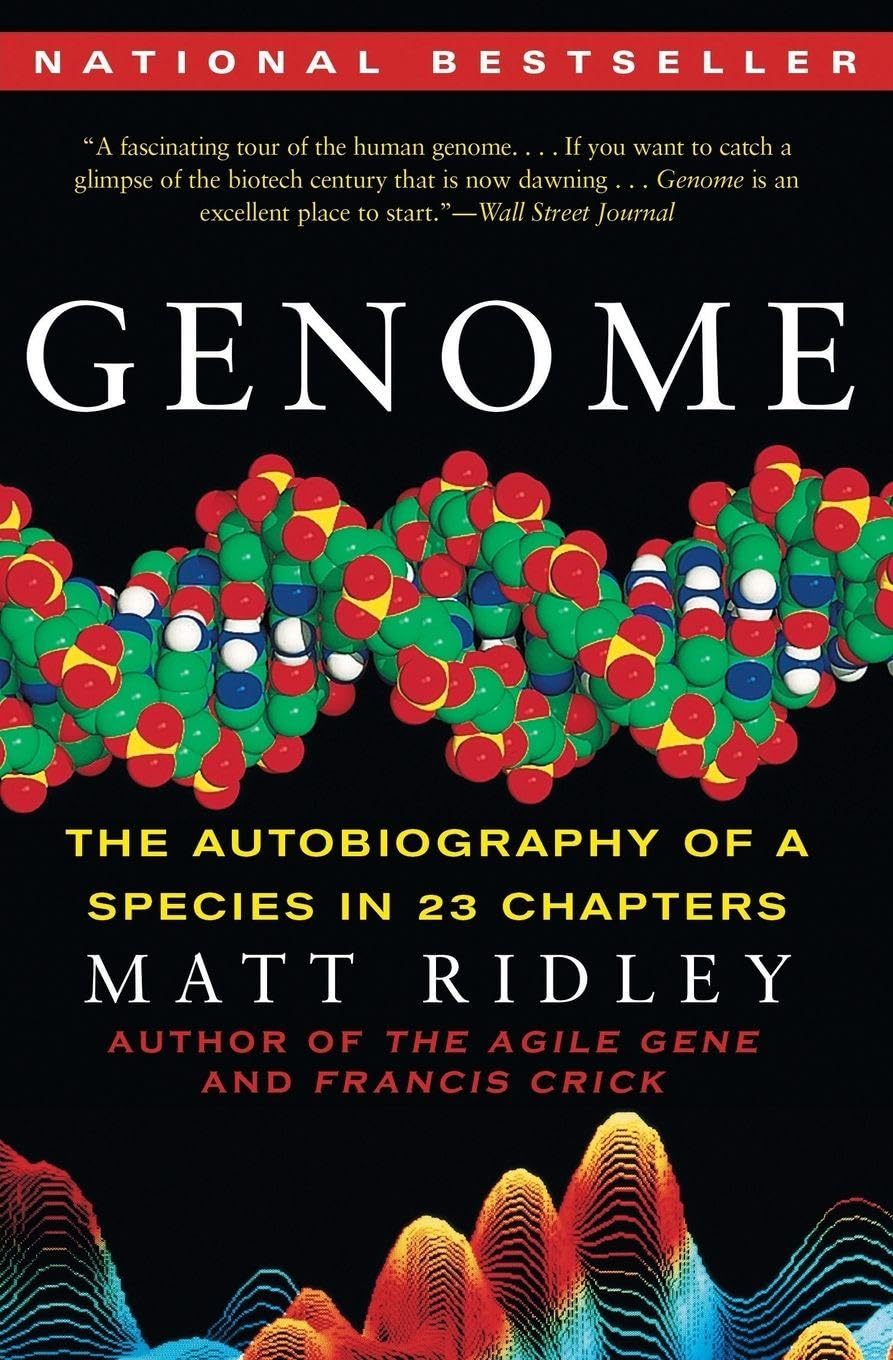
Buy Genome: The Autobiography of a Species in 23 Chapters on desertcart.com ✓ FREE SHIPPING on qualified orders Review: Great Read, Interesting Primer on Our Genes - This is a wonderful read as: science, non-fiction generally, and as a primer on our genes, what they do, and how they work. I find Ridley to be one of the best science writers for the general public and this book is no exception. Ridley leads us on an interesting and informative tour of some of the aspects of our genes. He touches on the junk DNA, mechanisms for changes in the chromosomes, how genes express them selves in proteins and the phenotype, some genetic diseases (he opines how we know most genes by the diseases that result from their malfunction and reiterates that genes are not for diseases), some of the latest ideas on how our chromosomes came to the shape they are in, and the role of RNA, among many other things. RNA is rapidly rising up as the candidate for the "original replicator" (at least for the world of nucleic acid replicators, maybe there was something before that does not survive) since it can and does act in many different roles throughout the cell including as genetic replicating code (apart from DNA) and catalysis like proteins. His discussion of junk DNA and sequence repetitions and how they occur in some cases was fascinating. His discussions of how certain gene sequences were actually discovered by scientists was too. I would note that the discoveries of modern genetics are consonant with the "Selfish Gene" view of evolution. They are not explicable by other proposed levels of evolutionary selection nor are they explicable by design (though an ad hoc application of magic certainly can give a superficial and false "explanation" for just about anything.) Ridley does let his political/social ideas come through fairly strongly in a few places (only a few places.) My recommendation is simply to take them for what they are: one man's opinion. They didn't detract from the book at all for me. One's political stance does not imply anything about the data you present. This is not an exhaustive map or discussion of our genes. Such a book would be huge and probably not readable. This is an overview with some interesting details and side trips. I strongly recommend it to you. I also recommend: Ridley's The Origins of Virtue, Dawkins' The Selfish Gene and The Ancestor's Tale, Neil Shubin's Your Inner Fish, Zimmer's Parasite Rex, Nesse and Williams' Why We Get Sick, and Diamond's The Third Chimpanzee Review: Excellent summary of the genome from a reductionist perspective - Ridley's book might almost be considered a material reductionist manifesto, as decoding the genome is undoubtedly one of the greatest accomplishments of science. In some ways, I found the descriptions of "junk DNA," and "selfish DNA," that is DNA which absorbs great amounts of energy replicating itself without making any positive contribution of the organism, rather depressing. As well as his descriptions of the war between the sexual DNA. However, I am not totally convinced that this so-called "junk DNA" does not perform some vital function that requires a holistic understanding of life rather than reductionist. Scientists, after all, really don't understand life yet. The ideas that "life is chemistry" has been around since 1648. However, chemicals cooperating to create life requires far greater specificity of information than is likely to come about by mere chance. Some simple calculations on permutations that any intelligent high school student can do demonstrates the overwhelming improbability of this occurring by mere chance. I should really appreciate a biologist addressing this question, but in none of my reading has anyone done so. Although I have been insulted often enough for insisting out that it is a genuine problem. Ridley does point out the success of the reductionist strategy in fighting cancer, and perhaps someday combating genetic diseases. He comes out positively in support of GMOs. Given that the population of the world will double in about forty years, if mankind is going to feed fourteen billion people, some great revolution in food production will be necessary. GMOs are one aspect of that revolution. But there is real reason to be concerned about how these artificial organisms will interact with the environment, and even perhaps our own bacterial microbiome. This cannot can be done effectively from a reductionist perspective. Since DNA and proteins each depend upon each other for replication, it seems most probable that RNA, which is replicable in itself, is the first molecule in the formation of life. Ridley presents lots of fascinating information in an entertaining and easy to read style. Highly recommended, but take it with a grain of salt.
| Best Sellers Rank | #39,771 in Books ( See Top 100 in Books ) #7 in Genetics (Books) #7 in Molecular Biology (Books) #114 in History & Philosophy of Science (Books) |
| Customer Reviews | 4.5 4.5 out of 5 stars (1,906) |
| Dimensions | 5.31 x 0.83 x 8 inches |
| Edition | Reprint |
| ISBN-10 | 0060894083 |
| ISBN-13 | 978-0060894085 |
| Item Weight | 2.31 pounds |
| Language | English |
| Print length | 368 pages |
| Publication date | May 30, 2006 |
| Publisher | Harper Perennial |
J**E
Great Read, Interesting Primer on Our Genes
This is a wonderful read as: science, non-fiction generally, and as a primer on our genes, what they do, and how they work. I find Ridley to be one of the best science writers for the general public and this book is no exception. Ridley leads us on an interesting and informative tour of some of the aspects of our genes. He touches on the junk DNA, mechanisms for changes in the chromosomes, how genes express them selves in proteins and the phenotype, some genetic diseases (he opines how we know most genes by the diseases that result from their malfunction and reiterates that genes are not for diseases), some of the latest ideas on how our chromosomes came to the shape they are in, and the role of RNA, among many other things. RNA is rapidly rising up as the candidate for the "original replicator" (at least for the world of nucleic acid replicators, maybe there was something before that does not survive) since it can and does act in many different roles throughout the cell including as genetic replicating code (apart from DNA) and catalysis like proteins. His discussion of junk DNA and sequence repetitions and how they occur in some cases was fascinating. His discussions of how certain gene sequences were actually discovered by scientists was too. I would note that the discoveries of modern genetics are consonant with the "Selfish Gene" view of evolution. They are not explicable by other proposed levels of evolutionary selection nor are they explicable by design (though an ad hoc application of magic certainly can give a superficial and false "explanation" for just about anything.) Ridley does let his political/social ideas come through fairly strongly in a few places (only a few places.) My recommendation is simply to take them for what they are: one man's opinion. They didn't detract from the book at all for me. One's political stance does not imply anything about the data you present. This is not an exhaustive map or discussion of our genes. Such a book would be huge and probably not readable. This is an overview with some interesting details and side trips. I strongly recommend it to you. I also recommend: Ridley's The Origins of Virtue, Dawkins' The Selfish Gene and The Ancestor's Tale, Neil Shubin's Your Inner Fish, Zimmer's Parasite Rex, Nesse and Williams' Why We Get Sick, and Diamond's The Third Chimpanzee
W**Y
Excellent summary of the genome from a reductionist perspective
Ridley's book might almost be considered a material reductionist manifesto, as decoding the genome is undoubtedly one of the greatest accomplishments of science. In some ways, I found the descriptions of "junk DNA," and "selfish DNA," that is DNA which absorbs great amounts of energy replicating itself without making any positive contribution of the organism, rather depressing. As well as his descriptions of the war between the sexual DNA. However, I am not totally convinced that this so-called "junk DNA" does not perform some vital function that requires a holistic understanding of life rather than reductionist. Scientists, after all, really don't understand life yet. The ideas that "life is chemistry" has been around since 1648. However, chemicals cooperating to create life requires far greater specificity of information than is likely to come about by mere chance. Some simple calculations on permutations that any intelligent high school student can do demonstrates the overwhelming improbability of this occurring by mere chance. I should really appreciate a biologist addressing this question, but in none of my reading has anyone done so. Although I have been insulted often enough for insisting out that it is a genuine problem. Ridley does point out the success of the reductionist strategy in fighting cancer, and perhaps someday combating genetic diseases. He comes out positively in support of GMOs. Given that the population of the world will double in about forty years, if mankind is going to feed fourteen billion people, some great revolution in food production will be necessary. GMOs are one aspect of that revolution. But there is real reason to be concerned about how these artificial organisms will interact with the environment, and even perhaps our own bacterial microbiome. This cannot can be done effectively from a reductionist perspective. Since DNA and proteins each depend upon each other for replication, it seems most probable that RNA, which is replicable in itself, is the first molecule in the formation of life. Ridley presents lots of fascinating information in an entertaining and easy to read style. Highly recommended, but take it with a grain of salt.
J**E
I've read this book cover to cover three times over the last time years. It's my go-to guide for understanding the human blueprint. What's a gene? What's a chromosome? Why does it matter? This book will answer your questions.
A**A
This fascinating account of human inheritance has an elegant structure. Various genetic phenomena are discussed, each in one of 23 chapters: each one named (= numbered) after the chromosome pair which is most relevant to that particular subject. So we are guided through the genetics of intelligence, personality, immunity, and the gene-level basis of heart disease, cancers, Alzheimers, and other `partially inherited' diseases. Ridley, as ever, does his research thoroughly, and presents it with brilliant clarity. I found the account of apoptosis (cell suicide), effected by genes `for the good of the body', to be an informative evolutionary basis for better understanding cancer. In another chapter, he discusses the biological benefits of autonomy, comparing (admittedly generalising) the high status, in control, `high serotonin' state with the anxious, impulsive, atherosclerotic, suicidal, `low serotonin' scenario. New snippets of the evolutionary story are revealed. Head-tail and back-front differentiation genes are very similar throughout the animal kingdom, implying a common ancestry. Infidelity is a highly prevalent behaviour in many species.Genes from different animals (including humans) are to a surprising extent actually interchangeable. We glean further insights into the nurture/nature interplay. Environmental triggers can actually switch genes on and off; genes in turn can make us more or less sensitive to our environment. Ridley relates how, with age, as we often become increasingly able to select our own influences, the `genetic' proportion of our intelligence thus tends to increase. In another chapter again, he explores the construction of intricate `genetic geography' which reveal some racial `characteristics'. Conundrums are explored: why do inherited diseases persist in the gene pool? Because gene mutations (changes in the base sequence) often have two separate effects, one beneficial and one harmful. What is the function of all the `junk' (seemingly useless) DNA? A lot of it is random, `phenotype-free' : `hitch-hiking' a ride from generation to generation, on the back of the genes that bother to make the survival machines(bodies)that serve to reproduce DNA so effectively. What you learn depends on what you already knew; but there'll certainly be something for everyone here. I found most gripping the sections towards the end, as we become gradually more aware of the fantastic possibilities of genetic engineering. The account of the (gene-carrying) retrovirus therapy and other genetic `engineering' tricks was riveting. The principles of what had seemed a highly esoteric field became much clearer and more straightforward. He extends his discussions into philosophical areas also. I discovered that many countries - including the US and the UK - took significant steps towards developing and supporting eugenic customs and laws in the 20's and 30's. In another section Ridley briefly discusses the relationship between behavioural genetics and the problem of free will - does chaos theory have a relevance here, explaining the smaller scale unpredictabilities in our decisions ? Overall, this is a key modern topic to obtain some kind of grasp of, and Ridley's book must be as good a way as any of achieving that.
M**A
Si quieres saber más sobre el cuerpo humano te pasanionara. Has de saber algo sobre hormonas, sistema hormonal etc...antes de leerlo.
Y**I
Se você quer saber a quantas andam as pesquisas sobre biologia molecular, recomendo este livro. Ideias claras numa linguagem fácil tornam a leitura deliciosa do comeco ao fim.
T**H
Very good book
Trustpilot
4 days ago
5 days ago