
DOWNLOAD THE APP


Customer Services
Copyright © 2025 Desertcart Holdings Limited
DOWNLOAD THE APP
Full description not available
S**D
It really is a holistic approach
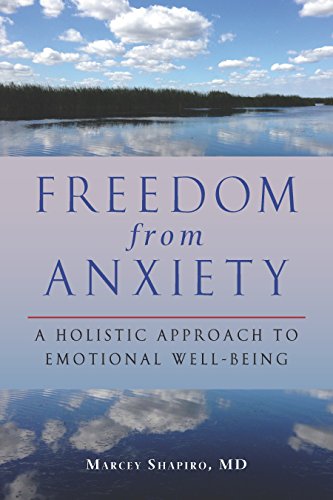
I was predisposed to like Dr. Marcey Shapiro's new book Freedom From Anxiety: A Holistic Approach to Emotional Well-Being and it has more than met my expectations. It's a great-- actually, relaxing-- read. I read it from start to finish. It's also a reference work, the kind of book one wants to keep on the shelf and consult from time to time. It's a compendium of techniques and daily life practices and potions to alleviate anxiety, and a guide for discerning which of the innumerable choices is best for you or me. Full disclosure here: Dr. Shapiro is one of my own doctors and a person I admire. Freedom From Anxiety follows on the heels of Dr. Shapiro's first book Transforming the Nature of Health. The two are companions, actually the beginning of a series as she is at work on future books about digestion, menopause, men's health, among other topics. Both of the already published books are grounded in Dr. Shapiro's holistic philosophy of medicine: We are spiritual beings in physical existence, and the bridge between the spiritual and the physical is contentment, happiness. What stands in the way of happiness and, by implication, good health, is often our deep sense of anxiety. Fear is a primal emotion that may have had its evolutionary purposes. Anxiety seems to be a deeply ingrained response to external stimuli. It also makes us miserable, and sick. I learned in this book that almost 20 percent of people in our society suffer from a diagnosable anxiety disorder. This is not the usual jitters anyone may get before a stressful event. The National Institute of Mental Health defines a diagnosable anxiety disorder -- including post-traumatic stress, obsessive compulsive disorder, panic attacks, phobias -- as "sustained feelings of fearfulness or nervousness." About three-fourths of those affected by anxiety disorders have their first episode before their 21st birthday. Anxiety disorders are implicated in other mental health problems such as substance abuse and depression, and probably in a lot of physical ailments form auto-immune diseases to cancer. Nothing, then, could be more important for our collective health and happiness, than finding freedom from anxiety. Dr. Shapiro explains for a non-scientific reader the happiness-to-health connection. "Our cells' immune system is strengthened by internal biochemical of happiness. The immune system creates many of these biochemical in response to our emotional state." Immune cells are equipped with receptors to receive information. Ninety percent of these receptors are for endogenous (made by our own bodies) opiates (endorphins) and cannabinoids. Much research shows that endorphins are key to optimal immune function, which protects us from illnesses. Research into cannabinoids is underway and has been slowed by the politics of cannabis prohibition. Dr. Shapiro writes that autoimmune diseases -- which affect millions -- "may one day be proven to be caused to a large degree by a deficiency of endorphins and cannabinoids." We need to feel good to be healthy. If anxiety and stress in general are bad for our health, what are we to do about it? Dr. Shapiro repeatedly tells us to consult our own inner guidance in choosing from a banquet of stress-reducing practices that begin and end with being kind to oneself. Certainly, she says, don't worry about worrying. From there, the book packs an amazing amount of technique into 300 pages. She discusses meditation, exercise, numerous breathing practices. She offers her non-dogmatic approach to nutrition. She's not out to convince anyone but she does introduce readers to the idea that eating adequate fat and protein, along with traditional fermented foods, goes a long way toward health. Again, her advice is: experiment and see how you feel. The medium is the message here, and a big part of her message is: have fun and enjoy. She has a page on the stress-reducing properties of chocolate followed by -- surprise -- her own recipe for a sugar-free confection made with cacao, coconut butter and nuts. There are lengthy sections on the use of nutritional supplements, herbs and traditional Chinese medicine, including acupuncture. If found these three sections to be the strongest information-wise, not surprising to me since Dr. Shapiro emphasizes these areas, along with food as medicine, in her practice. There is an invitation to the reader to try all sorts of things from aromatherapy to homeopathy to using color and light, flower essences, rocks and crystals. Yes, crystals. Some of what Dr. Shapiro suggests for reducing anxiety is way off the beaten path, and she acknowledges that. No claims for efficacy are made as she reiterates her theme of individual experimentation. What works for one may not work for others. Her agenda in this book is to present what she knows to date and what has worked in her own life and with patients. It's not about whether something has ben peer-reviewed in journals or popular with the AMA or covered by insurance. That's not how she operates. Some of the techniques she mentions may seem way out (now) because not enough research has yet been conducted, and because our culture has become dependent on pharmaceutical solutions. Emotional conditions such as anxiety may be amenable to a broad range of treatments because anxiety has a lot to do with how we think and feel about ourselves, as well as with what we eat and whether we get enough exercise and relaxation. Teasing out all the variables would not be easy to do with standard scientific tests. At the end of the book is a chapter called "Putting it All Together" which encourages readers to develop their own systems for reducing anxiety, not excluding the use of psychotherapy and medication where appropriate. This is a doctor who believes that all healing ultimately involves self-healing. Freedom From Anxiety is good medicine.
J**.
The BEST book for anxiety sufferers, with an inclusion of food and vitamins!!
Perfect quality for a gift.
P**Y
Hypothesis
Textbook material from a Dr 's professional opinion based on valid clinical trials.
H**D
Many paths to the one solution- anxiety free!
If only I had found this book 10 years ago! When my second daughter was 15 months old, I was diagnosed with postpartum anxiety disorder. It gradually became worse over the first couple of years even though I casually explored ways to reduce it. Anxiety, panic attacks, control issues, mood swings, fatigue were my top symptoms. Then I started finding little pieces to my big anxiety puzzle. I changed my nutrition, I tried supplements, fermented foods to reboot my gut, I took a course on Mindfulness Meditation, breath work, herbs, etc. Each thing helped little by little. Then three years ago I began reading books by Eckart Tolle (The Power of Now was the last piece of the puzzle for me), Wayne Dyer, Abraham, trying energy work, working on paying attention to my thoughts and emotions and BOOM! That was the last piece to my anxiety/ panic attack puzzle. I can happily say that I am anxiety free! I mentioned this journey to a friend and she recommended reading this book. I bought it and it sat on my shelf for 6 months before I read it. After all, I did not feel that I needed it anymore. Once again, only if this book was available to me 10 year ago, it would have saved me so much time and research. Not only are all the techniques in it that I have self studied for 8 years, but other ideas I had not thought of as well. Everything in one book! If you are looking for holistic solutions to your anxiety, start with this book. Your journey will likely be different than mine, but I know you will find the pieces to your puzzle. I know you are willing to give anything and everything a try. Be patient, practice the techniques and one day you can tell the world you are anxiety free too!
R**R
It might not all work for you, but there is something for everyone
This book really helped me to understand how my brain works and to approach anxiety management from a whole body/mind perspective.Some of the exercises/techniques were helpful and some weren’t but I think it’s a very personal thing and I am glad I tried them all because there were a lot of good little tips in there.The part I found most helpful was the insight into how someone with anxiety processes new information and experiences and how these queues manifest as anxiety symptoms.I really feel like I understand myself better and I recommend this book to anyone wanting to understand themselves or someone else with anxiety better.
Trustpilot
3 days ago
2 months ago