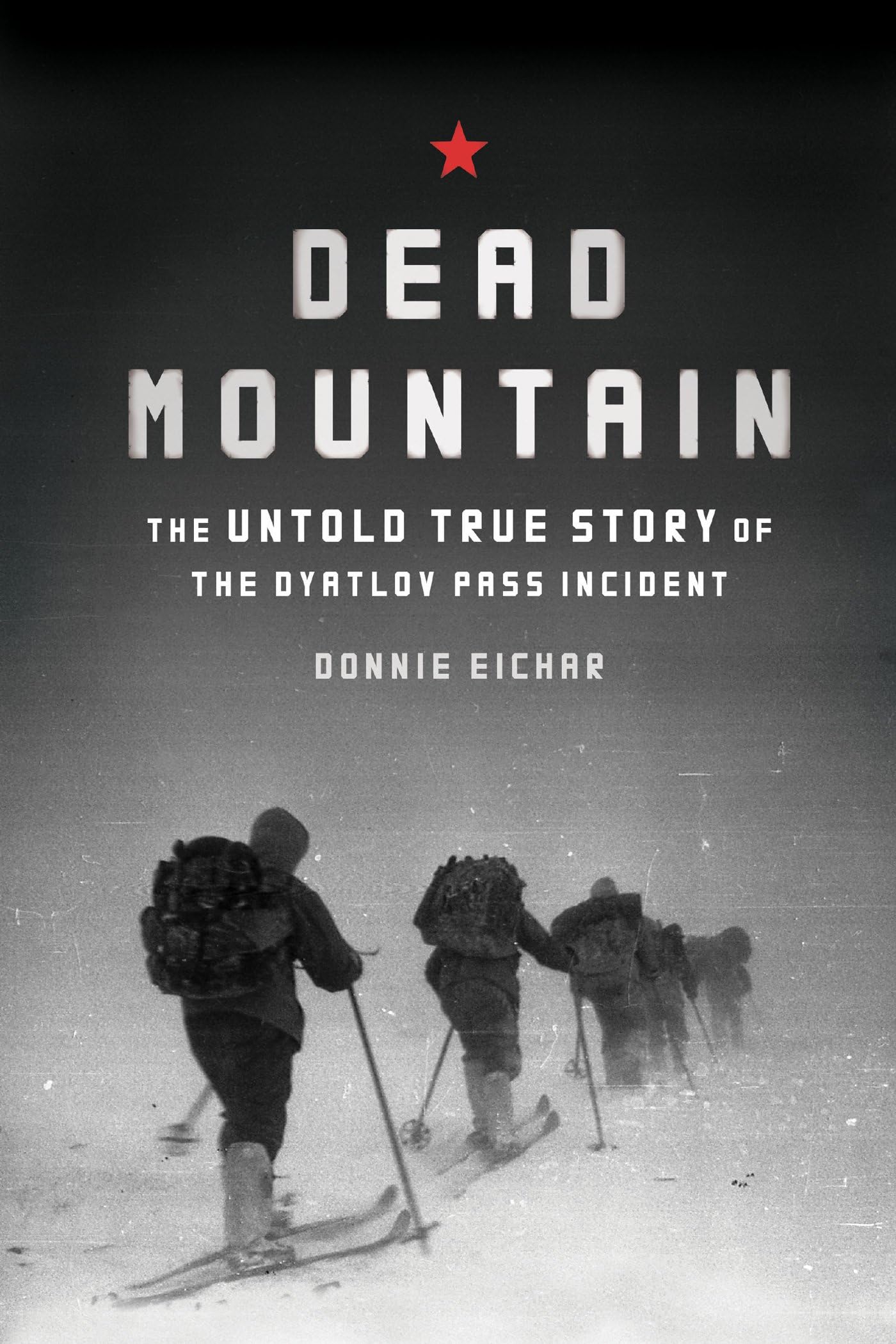
Dead Mountain: The Untold True Story of the Dyatlov Pass Incident
Product ID: 102773717
Buy anything from 5,000+ international stores. One checkout price. No surprise fees. Join 2M+ shoppers on Desertcart.
Desertcart purchases this item on your behalf and handles shipping, customs, and support to New Zealand.
Buy Dead Mountain: The Untold True Story of the Dyatlov Pass Incident: Read Kindle Store Reviews - desertcart.com Review: Deathly Hiking Trip - Book Review: Monday, March 16, 2015 Dead Mountain: The Untold True Story of the Dyatlov Pass Incident by Donnie Eichar. The Dyatlov Pass incident was an event shrouded in mystery. What caused death of nine skiers in the northern Ural Mountains on the night of February 2, 1959? And why is it still mysterious enough to have several published accounts and at least two movies that suggest reasons as diverse as natural phenomena to aliens to Government Cover-up? This book, by author Donnie Eichar may be the best researched. Not content with stories, pictures, and released government documents concerning the event, Eichar took the time to actually go to Russia. There he tracked down people most likely to have important information about the deaths. He found some of the hiker’s family and friends. He also found the only survivor of the trip, a man named Yuri Yudin. The plan had been for ten hikers, all skilled in overnight and extended stays in the terrain to hike in to Kholat Syakhl, a remote Ural mountain peak whose name means “Mountain of the Dead.” The trip was lead by Igor Dyatlov. The seven men and two women making up the rest of the party were: Alexander Kolevatov, Nicolai Thibeaux-Brignolles, Semyon (Alexander) Zolotariov Rustem Slobodin, Yuri (Georgiy) Krivonischenko, Yuri Doroshenko, Yuri Yudin, and Zinaida Kolmogorova and Lyudmila Dubinina. The party set out from Sector 41, a small woodcutting villiage, on January 27, 1959 on their march toward Otorten. On this first leg they were accompanied by a sleigh driven by Stanislav Velikyavichus, a worker going their way who agreed to haul their packs. It was on this section of the trip that Yuri Yudin was forced to leave the group due to disabling pain. He would return with the sleigh the next day. This was the last time the Dyatlov party was seen alive. From their diaries and photographs, it is known that they finally camped on the slope of the mountain on the night of February 1, 1959. Sometime in the early morning hours of February 2, something caused all nine members of the expedition to cut their way out of the tent and flee without anywhere near proper clothing and/or gear to survive in the -25 degree cold. None of them survived What made experienced hikers flee a tent in the darkness of a storm without gearing up for the trip? In fact, why had the experienced campers chosen to camp in that spot to begin with? There was absolutely no shelter from wind and storm, and no firewood to be had at all. What were investigators supposed to think when it was discovered that they had been eating and preparing for bed, the tent securely up just prior to fleeing? Mr. Eichar does a great job of sifting through the evidence in search of what really happened. As he does this, he provides a great story of the last days of these young people, who were full of life, singing often and obviously enjoying themselves. He makes a comparison to Sherlock Holmes’ statement: “When you have eliminated the impossible, whatever is left, however improbable; must be the truth.” Yet Mr. Eicher finds that elimination isn’t really working very well. When he runs out of scenarios, he still lacks an answer. He comes home, continues his search, and now believes he has found the truth about what happened in the darkness of February 1-2, 1959 in the remote Ural Mountains. Eicher’s story is easily checked against known facts. His storytelling is remarkable, allowing the reader to feel the story of these young people as well as read about their experience. In the end, I feel his account worth five out of five stars. His conclusion is based in science, and not wild speculation. Well done, sir! Quoth the Raven… Review: Thoughtful consideration of a sensationalized mystery. - Dead Mountain is a well-researched, and respectful book about the Dyatlov Pass incident that took the lives of nine young Russian university students in February of 1959. The mystery around the tragedy is an engrossing one that has been much sensationalized over the years. Film-maker Donnie Eichar cuts through the sensationalism to present a sober investigation into what really happened. At the height of the Cold War and Soviet Union power, ten students of the Ural Polytechnic Institute Hiking Club took off on an expedition to Otorten Mountain in the northern Urals. All were experienced winter hikers and mountaineers, especially their leader, Igor Dyatlov. When they failed to return after three weeks, a search was launched. The initial search party found their empty tent and no sign of the hikers. All indications were that the tent had been abandoned in panic. Then, after some weeks of searching, the bodies were found. "Their bodies were eventually found roughly a mile away from their campsite, in separate locations, half-dressed in subzero temperatures. Some were found facedown in the snow; others in fetal position; and some in a ravine clutching one another. Nearly all were without their shoes." (p 23) One of their group, Yuri Yudin, had turned back, well before the tragedy occurred, due to a bout of pain from his chronic rheumatism, making him the only survivor. So what could have happened to drive these young people out into a dark night of howling winds in below-zero temperatures? That’s the mystery that has prompted horror stories about the incident and that drives the narrative of Dead Mountain. I have to admit that the mystery as outlined in the book blurbs grabbed my imagination. I had never heard of the incident and so wanted to know what it was all about, and why it was little known in the West. The book’s author, Donnie Eichar, is a director and producer of film work for MTV. He also became enamored with the story and determined to resolve the mystery. His research led him to literally retrace the hikers’ steps into the Urals in winter. He was the first American to do so. Mr. Eichar’s prose is well-written and keeps up the tension of the mystery as he takes us with him on his investigation. The narrative alternates between his research and the story of the hikers as recorded in their group diary and photographs. These photographs are readily found on the Internet and I referred to them often as I read Dead Mountain. Many of them are included in the book. Through the diary and photos the hikers are revealed as smart, well-adjusted young people with a love for life and the outdoors. Their last hike was to earn them a certification that would allow them to teach mountain hiking. So they knew what they were doing. There was one 37 year-old among the group, but the rest were all under 24. They were interested in two-way radios (the geek equivalent of personal computers for the time), hard science (they were engineering and physics majors), and the possibilities for love and romance (especially the two young women). The photos show a lot of college-student clowning and the diary indicates their excitement for their adventure. Accounts from the people that encountered them along their way are all positive as to their demeanor and attitudes. Tension builds as Mr. Eichar recounts the groups’ final expedition. He tells us enough of the hikers’ personal lives that we get to know them as individuals. We feel their youthful friendships, hopes, and concerns. We struggle with them as they work out the logistics of their trip, and feel the pathos in Yuri’s early parting with them, expecting to reunite in a week’s time. Tension also builds in the account of Mr. Eichar’s own journey to retrace the hikers’ steps and so gain clues as to what happened to them. He has to deal with a language barrier and his own journey logistics. Being from Florida, he has little experience of mountains and none of sub-zero cold. On top of all this, he makes a search for the lone surviving member of the Dyatlov group, Yuri Yudin. I found Dead Mountain to be engrossing and hard to put down. Mr. Eichar keeps his prose moving, interesting, and relevant. Internet photos enhance the book, but I found the autopsy photos disturbing. The driving force of the book, however, is the mystery: what happened to hikers? UFOs? Yeti? Bandits? All have been proposed as solutions. After examining all the evidence he could gather, Mr. Eichar comes up with his own idea about what happened. The last chapter of Dead Mountain is Mr. Eichar’s reconstruction of the events of the hikers’ last night. The scenario he describes is, in my opinion, probably very close to the truth. I think Dead Mountain is a good exercise in how to approach and to think about a stubborn mystery, especially one with paranormal overtones. It indicates the kind of open-minded work required to get to the bottom of things (whether you think Mr. Eichar did or not). In the end, it is a reminder of the tragedies in this world, and of nine promising young people who were taken out of it much too early.




| ASIN | B00CUSQOA0 |
| Accessibility | Learn more |
| Best Sellers Rank | #31,284 in Kindle Store ( See Top 100 in Kindle Store ) #9 in History of Russia eBooks #15 in Russian History (Books) #23 in Travel Biographies & Memoirs |
| Customer Reviews | 4.3 4.3 out of 5 stars (12,214) |
| Edition | Reprint |
| Enhanced typesetting | Enabled |
| File size | 10.3 MB |
| ISBN-13 | 978-1452129563 |
| Language | English |
| Page Flip | Enabled |
| Print length | 290 pages |
| Publication date | October 22, 2013 |
| Publisher | Chronicle Books LLC |
| Screen Reader | Supported |
| Word Wise | Enabled |
| X-Ray | Enabled |
R**N
Deathly Hiking Trip
Book Review: Monday, March 16, 2015 Dead Mountain: The Untold True Story of the Dyatlov Pass Incident by Donnie Eichar. The Dyatlov Pass incident was an event shrouded in mystery. What caused death of nine skiers in the northern Ural Mountains on the night of February 2, 1959? And why is it still mysterious enough to have several published accounts and at least two movies that suggest reasons as diverse as natural phenomena to aliens to Government Cover-up? This book, by author Donnie Eichar may be the best researched. Not content with stories, pictures, and released government documents concerning the event, Eichar took the time to actually go to Russia. There he tracked down people most likely to have important information about the deaths. He found some of the hiker’s family and friends. He also found the only survivor of the trip, a man named Yuri Yudin. The plan had been for ten hikers, all skilled in overnight and extended stays in the terrain to hike in to Kholat Syakhl, a remote Ural mountain peak whose name means “Mountain of the Dead.” The trip was lead by Igor Dyatlov. The seven men and two women making up the rest of the party were: Alexander Kolevatov, Nicolai Thibeaux-Brignolles, Semyon (Alexander) Zolotariov Rustem Slobodin, Yuri (Georgiy) Krivonischenko, Yuri Doroshenko, Yuri Yudin, and Zinaida Kolmogorova and Lyudmila Dubinina. The party set out from Sector 41, a small woodcutting villiage, on January 27, 1959 on their march toward Otorten. On this first leg they were accompanied by a sleigh driven by Stanislav Velikyavichus, a worker going their way who agreed to haul their packs. It was on this section of the trip that Yuri Yudin was forced to leave the group due to disabling pain. He would return with the sleigh the next day. This was the last time the Dyatlov party was seen alive. From their diaries and photographs, it is known that they finally camped on the slope of the mountain on the night of February 1, 1959. Sometime in the early morning hours of February 2, something caused all nine members of the expedition to cut their way out of the tent and flee without anywhere near proper clothing and/or gear to survive in the -25 degree cold. None of them survived What made experienced hikers flee a tent in the darkness of a storm without gearing up for the trip? In fact, why had the experienced campers chosen to camp in that spot to begin with? There was absolutely no shelter from wind and storm, and no firewood to be had at all. What were investigators supposed to think when it was discovered that they had been eating and preparing for bed, the tent securely up just prior to fleeing? Mr. Eichar does a great job of sifting through the evidence in search of what really happened. As he does this, he provides a great story of the last days of these young people, who were full of life, singing often and obviously enjoying themselves. He makes a comparison to Sherlock Holmes’ statement: “When you have eliminated the impossible, whatever is left, however improbable; must be the truth.” Yet Mr. Eicher finds that elimination isn’t really working very well. When he runs out of scenarios, he still lacks an answer. He comes home, continues his search, and now believes he has found the truth about what happened in the darkness of February 1-2, 1959 in the remote Ural Mountains. Eicher’s story is easily checked against known facts. His storytelling is remarkable, allowing the reader to feel the story of these young people as well as read about their experience. In the end, I feel his account worth five out of five stars. His conclusion is based in science, and not wild speculation. Well done, sir! Quoth the Raven…
R**F
Thoughtful consideration of a sensationalized mystery.
Dead Mountain is a well-researched, and respectful book about the Dyatlov Pass incident that took the lives of nine young Russian university students in February of 1959. The mystery around the tragedy is an engrossing one that has been much sensationalized over the years. Film-maker Donnie Eichar cuts through the sensationalism to present a sober investigation into what really happened. At the height of the Cold War and Soviet Union power, ten students of the Ural Polytechnic Institute Hiking Club took off on an expedition to Otorten Mountain in the northern Urals. All were experienced winter hikers and mountaineers, especially their leader, Igor Dyatlov. When they failed to return after three weeks, a search was launched. The initial search party found their empty tent and no sign of the hikers. All indications were that the tent had been abandoned in panic. Then, after some weeks of searching, the bodies were found. "Their bodies were eventually found roughly a mile away from their campsite, in separate locations, half-dressed in subzero temperatures. Some were found facedown in the snow; others in fetal position; and some in a ravine clutching one another. Nearly all were without their shoes." (p 23) One of their group, Yuri Yudin, had turned back, well before the tragedy occurred, due to a bout of pain from his chronic rheumatism, making him the only survivor. So what could have happened to drive these young people out into a dark night of howling winds in below-zero temperatures? That’s the mystery that has prompted horror stories about the incident and that drives the narrative of Dead Mountain. I have to admit that the mystery as outlined in the book blurbs grabbed my imagination. I had never heard of the incident and so wanted to know what it was all about, and why it was little known in the West. The book’s author, Donnie Eichar, is a director and producer of film work for MTV. He also became enamored with the story and determined to resolve the mystery. His research led him to literally retrace the hikers’ steps into the Urals in winter. He was the first American to do so. Mr. Eichar’s prose is well-written and keeps up the tension of the mystery as he takes us with him on his investigation. The narrative alternates between his research and the story of the hikers as recorded in their group diary and photographs. These photographs are readily found on the Internet and I referred to them often as I read Dead Mountain. Many of them are included in the book. Through the diary and photos the hikers are revealed as smart, well-adjusted young people with a love for life and the outdoors. Their last hike was to earn them a certification that would allow them to teach mountain hiking. So they knew what they were doing. There was one 37 year-old among the group, but the rest were all under 24. They were interested in two-way radios (the geek equivalent of personal computers for the time), hard science (they were engineering and physics majors), and the possibilities for love and romance (especially the two young women). The photos show a lot of college-student clowning and the diary indicates their excitement for their adventure. Accounts from the people that encountered them along their way are all positive as to their demeanor and attitudes. Tension builds as Mr. Eichar recounts the groups’ final expedition. He tells us enough of the hikers’ personal lives that we get to know them as individuals. We feel their youthful friendships, hopes, and concerns. We struggle with them as they work out the logistics of their trip, and feel the pathos in Yuri’s early parting with them, expecting to reunite in a week’s time. Tension also builds in the account of Mr. Eichar’s own journey to retrace the hikers’ steps and so gain clues as to what happened to them. He has to deal with a language barrier and his own journey logistics. Being from Florida, he has little experience of mountains and none of sub-zero cold. On top of all this, he makes a search for the lone surviving member of the Dyatlov group, Yuri Yudin. I found Dead Mountain to be engrossing and hard to put down. Mr. Eichar keeps his prose moving, interesting, and relevant. Internet photos enhance the book, but I found the autopsy photos disturbing. The driving force of the book, however, is the mystery: what happened to hikers? UFOs? Yeti? Bandits? All have been proposed as solutions. After examining all the evidence he could gather, Mr. Eichar comes up with his own idea about what happened. The last chapter of Dead Mountain is Mr. Eichar’s reconstruction of the events of the hikers’ last night. The scenario he describes is, in my opinion, probably very close to the truth. I think Dead Mountain is a good exercise in how to approach and to think about a stubborn mystery, especially one with paranormal overtones. It indicates the kind of open-minded work required to get to the bottom of things (whether you think Mr. Eichar did or not). In the end, it is a reminder of the tragedies in this world, and of nine promising young people who were taken out of it much too early.
B**R
Extremely engrossing book. How many people know about the Dyatlov incident of 1959? Considering that the author himself and most of the current day readers were not even born then, it speaks highly of the book that it draws the readers in so well. It brings up a vivid picture of the final days and journey of the young hikers leading to their ultimate death. It remains a mystery till date and every account of the cause of death is but a hypothesis. By the end of the book, we feel for the young men and women who perished in the freezing cold that night. Heartily recommend this book for anyone interested in the mystery genre. You will not be able to put it down.
L**S
Vai prendê-lo do início ao fim. Mexe muito com o nosso emocional. Contudo, a formatação desta edição em eBook por parte da editora ou da Amazon é uma desgraça. Deveria ser retirado da loja até que a consertassem. As linhas terminam onde querem nos parágrafos! Inaceitável.
T**I
A page-turner mistery! An excelent read at the warm fifeside.
L**Y
I stumbled upon this incident just recently and was immediately sucked into the mystery surrounding the bizarre deaths of the Dyatlov hikers. I've enjoyed reading about the hilarious theories out there, including UFO encounter or Yeti attack. Donnie Eicher did an excellent job in laying out the final days of the hikers' lives and the subsequent efforts of the investigatiors and recovery team. Interlacing these two storylines with his own investigation made for a pretty exciting book; I had trouble putting it down. It was wise of Eicher to lay out the process of elimination before presenting his ultimate theory; failing which he might have come off as just another nut who has failed to do his or her research. His theory is a good one, and is clearly supported by our current understanding of this natural phenomenon that simply wasn't understood 45 years ago. I feel Eicher did the lead investigator justice in his inference that Tempalov did what he could with the limited power and understanding he had. What an absolutely frightening experience this must have been for these hikers. I hope friends and families are able to feel a little more at peace in knowing that the seemingly illogical actions of these young people were, ironically, the most logical ones they could have been expected to take in the circumstances.
B**R
Es ist viel gesagt worden zum Unglück am Dyatlov-Pass - 90% der Szenarien können jedoch ausgeschlossen werden, da nicht haltbar. Umso angenehmer, dass dieses Buch die Faktenlage nicht nur beachtet, sondern gleich eine Erklärung liefert, die selbige plausibel abdeckt. Fantastischer Erzählstil, die Sorte Buch, bei der man traurig ist, dass es endet.
Trustpilot
2 months ago
3 weeks ago