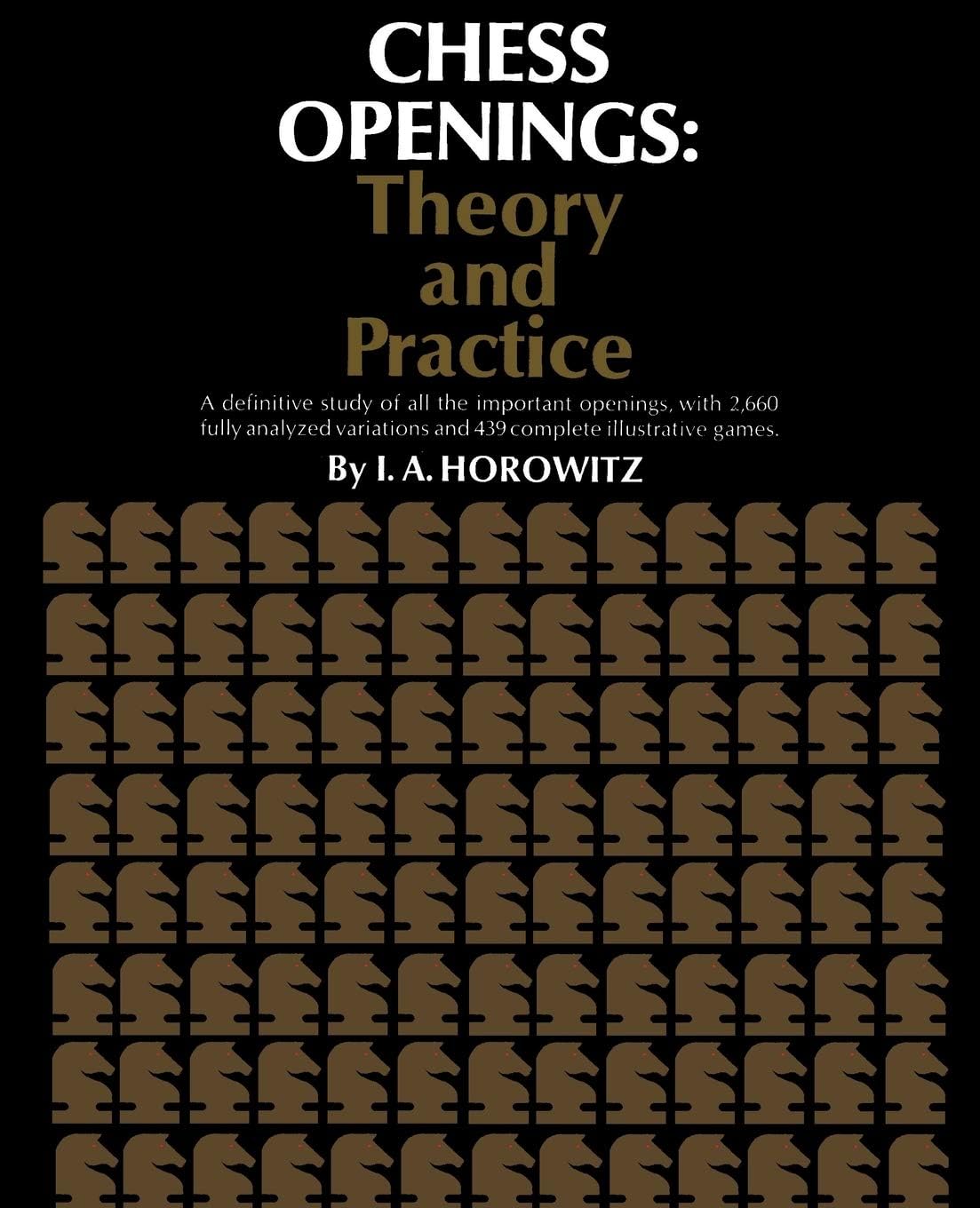
Chess Openings Theory and Practice
Product ID: 106533740
Desertcart purchases this item on your behalf and handles shipping, customs, and support to New Zealand.
“Speaking for myself and for players of my strength, Chess Openings: Theory and Practice is the greatest aid I have ever seen for preparing for a tournament. Speaking for all other players, the book is a "must." Current thinking on all important lines is meticulously presented, offering myriad, clear-cut ideas a completely new and effective arsenal of weapons. “-Samuel Reshevsky, United States Open Champion”. Chess Openings Theory and Practice is a remarkable book, unequaled by any book of that era or since. It is not a mere openings book with long columns of moves followed at the end by punctuation marks such as + -- or =. It presents opening ideas and games, often including the first game where each opening was played, plus the history of the opening, the names of famous players who played this opening and the ideas and plans on which the opening is based. It provides "idea variations". These are variations that may not actually occur in actual practice, but are what you would play if given the chance. No other book does that, at least not in English and not to this extent. Review: Descriptive Notation at its best! - I put in the headline this book uses descriptive notation because if you're not familiar with it, then you will have to learn a whole new language of chess notation; this is not algebraic notation! That being said, I found this book to be completely informative to help learn the different openings throughout history, even from when it was first used and recorded. What's more, is the description of the theory behind each of the openings, and how to put it into practice! There is a tremendous amount of hard work that went into creating this work, and I'm grateful to the author for the amount of time invested and the willingness to share his knowledge with us! Review: A Classic! - A copy of "Chess Openings: Theory and Practice" was my "go to" opening book in high school over 35 years ago. Unfortunately, I loaned my copy out (containing all my annotations) to a buddy who never returned it. Grrrrr. I'm so happy to recover this old book. Amazingly, the book apparently was printed, on demand, the very day I ordered it. It arrived in pristine, brand-new condition. Now, here is why you should buy this book today: Bobby Fischer won some of his greatest victories by studying old opening theory (e.g. See "Bobby Fischer My 60 Memorable Games," Game 44, Evans Gambit, referring to an "old analysis from Freeborough and Rankin") In fact, the preface to the book reveals this very secret. This book contains ideas that are out of vogue, but still potent to this day. Anyone looking to add spice to their game should make the investment and purchase a copy. You'll be glad you did.
| Best Sellers Rank | #197,901 in Books ( See Top 100 in Books ) #108 in Chess (Books) #181 in Board Games (Books) |
| Customer Reviews | 4.5 out of 5 stars 273 Reviews |
T**H
Descriptive Notation at its best!
I put in the headline this book uses descriptive notation because if you're not familiar with it, then you will have to learn a whole new language of chess notation; this is not algebraic notation! That being said, I found this book to be completely informative to help learn the different openings throughout history, even from when it was first used and recorded. What's more, is the description of the theory behind each of the openings, and how to put it into practice! There is a tremendous amount of hard work that went into creating this work, and I'm grateful to the author for the amount of time invested and the willingness to share his knowledge with us!
J**N
A Classic!
A copy of "Chess Openings: Theory and Practice" was my "go to" opening book in high school over 35 years ago. Unfortunately, I loaned my copy out (containing all my annotations) to a buddy who never returned it. Grrrrr. I'm so happy to recover this old book. Amazingly, the book apparently was printed, on demand, the very day I ordered it. It arrived in pristine, brand-new condition. Now, here is why you should buy this book today: Bobby Fischer won some of his greatest victories by studying old opening theory (e.g. See "Bobby Fischer My 60 Memorable Games," Game 44, Evans Gambit, referring to an "old analysis from Freeborough and Rankin") In fact, the preface to the book reveals this very secret. This book contains ideas that are out of vogue, but still potent to this day. Anyone looking to add spice to their game should make the investment and purchase a copy. You'll be glad you did.
T**M
SStunning
This text was simply stunning to me. Piles of information on openings, more than my mind can handle at once, even the amount of lifetime I have remaining before I hit my expiration date. The book is thick, over seven-hundred pages. My guess is no one will work their way all the way through this book. I would say something about the openings and etc., but the book is crammed with too much information to summarize. I guess I could if I were not so lazy. BUY THE BOOK if you are looking for this weight of information.
M**Y
Good book examining openings
This is essentially just another book on chess openings,but it stands out because it is much more reader friendly than many other openings books.The book lists the moves to get to the 'key position' of each opening examined (along with footnotes to moves varying prior to the key position),and then notes the main ideas,and what each side should strive for from that position.Generally,there will follow some of the main tries,and some sample master level games using the opening,or variation of the opening.I like this book because there is an emphasis on actual words as commentary rather than mind-numbing variations,as in some other books. The book is in descriptive notation,which may bother some,but older players are probably equally familiar with descriptive and algebraic.It certainly doesn't bother me.Also,since this is a book from the early/mid '60s,you're not going to be getting the latest cutting edge theory from the Meran,or whatever.This sort of thing is commented on frequently in older opening texts,but for any player who is not of at least master strength,it simply doesn't matter.If you mostly play blitz on the internet,or even low rated tournaments,you can easily bone up on some 'archaic' opening,such as the Scotch for example,and have a large advantage over most of your competition in the opening. I notice someone below wrote that he'd never heard a strong player recommend this book--on the back of my copy there is an endorsement from Sammy Reshevsky:"Speaking for myself,and players of my strength,'Chess Openings:Theory and Practice' is the greatest aid I have ever seen for preparing for a tournament.Speaking for all other players,this book is a must".Is Reshevsky a strong enough player for you? I find opening manuals a bit of a bore in general,but this is my favorite of the bunch.
M**C
Perfect practice requires Patience.
Sure, I wasn't expecting such a heavy book. An unreadable thick pile of paper.. but if your worth your metal in chess you'll adapt. You were looking for chess theory, right? Games followed in this manner cannot skip ONE beat. You must learn descriptive notation and not question awkward moves of today's age, but follow alongside and question those moves many turns forecasted. I recommend coinage or markers to follow each and every move made through your gameplay. This is a stellar book. P.S. Have fun!
F**N
This is the book for all of the assumed knowledge you were supposed to know in MCO, FCO, NCO etc.
I can't add much more to the reviews that are already here. I had this book first edition given to me in 1964 when I was 10, I had worn it out and finally bought another one. It's a big enough book to annotate in so you can keep it up to date, but it's also a collector's item now so if you have a first edition in your hands it's probably worth more than a 100 dollars, maybe more now I don't know (haven't checked because the knowledge inside is worth far more than any dollar value).
K**G
Somewhat Dated but Still Better Than MCO for the B Team
Based on the reviews I read here at Amazon, I was hoping for an expanded version of Horowitz's How To Win In the Chess Openings. I was somewhat disappointed in that respect. It's quite good at explaining some openings (such as the Ruy) but not so hot with others. Also, there are important lines missing that were well known in 1964, such as the Cochrane gambit in the Petroff opening. If you're going to play the Petroff, you better have a look at the Cochrane gambit first, or sooner or later you're going to be handed your @#$ on a platter! I also thought the Dilworth attack was missing from the Ruy, but it's there in some detail, in fact, just under another name. I believe 1. e4 e5 2. Nf3 Nc6 3. Bb5 Nge7 is missing, however, although I'm not entirely sure. Also, it took me quite awhile to find the one column devoted to 1. e4 e5 2. Nf3 Nc6 3. Bb5 a6 4. Ba4 Nf6 5. d3. (That gets an entire chapter in How to Win...) Which brings up two issues. Yes, it's an old book, and it's written using descriptive notation. Get over it! Unless you're dumber than a stump, it will take you five minutes to learn it. (Ever heard of Wikipedia?) The book leaves a little to be desired in terms of organization, however. I looked for quite a long time and am still not entirely certain that 1. e4 e5 2. Nf3 Nc6 3. Bb5 Nge7 is completely missing. All that being said, I really wish I'd had this book back in the '60s when I was learning to play chess. It would have done me a LOT more good than MCO ever did!
C**E
Seriously you haven't bought it yet
how accurate, and reliable with its precise measures the book doesn't disappoint! If you're seriously interested in the gameplay and observing a closer look at each line. This book is guaranteed to increase your capabilities over 20 ratings. I keep this by book personally by my nightstand.
C**A
Uncomprehensible annotations
Wonderful book BUT with non contemporary chess descripitve annotation, impossible to be used nowadays.
Trustpilot
4 days ago
1 month ago