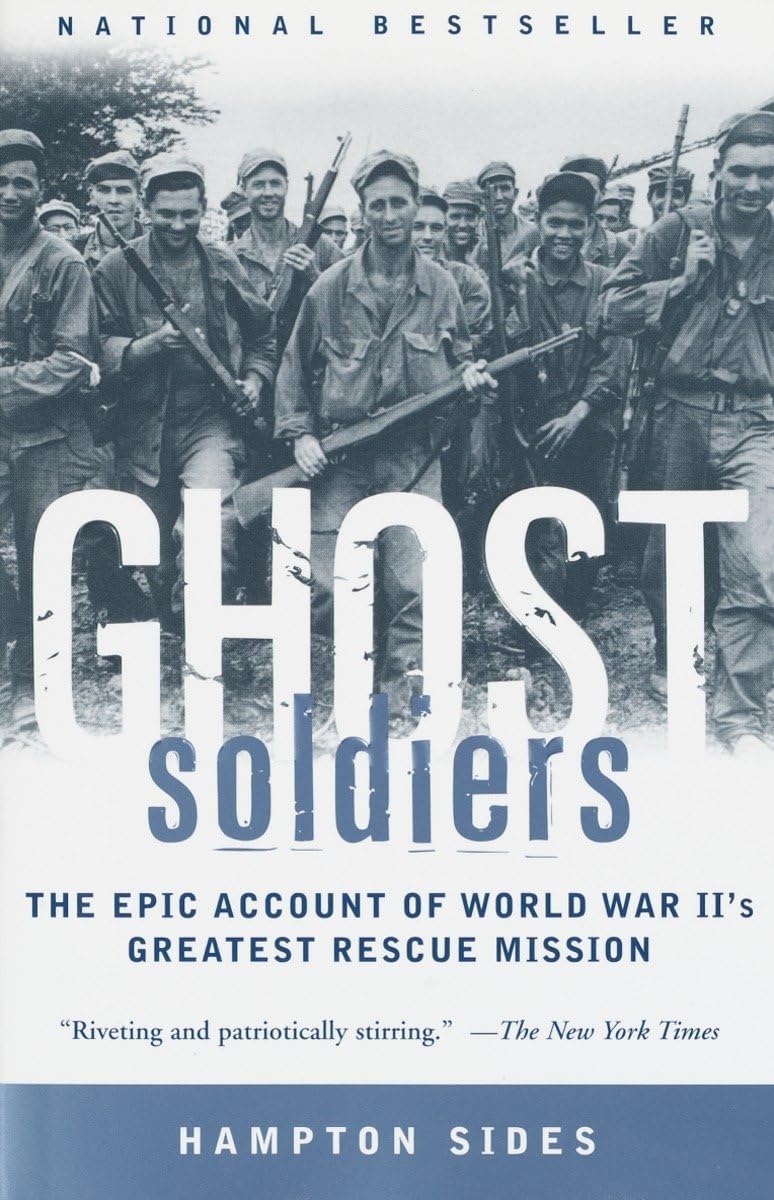
Ghost Soldiers: The Epic Account of World War II's Greatest Rescue Mission
Product ID: 1249654
Buy anything from 5,000+ international stores. One checkout price. No surprise fees. Join 2M+ shoppers on Desertcart.
Desertcart purchases this item on your behalf and handles shipping, customs, and support to New Zealand.
NATIONAL BESTSELLER • “The greatest World War II story never told” ( Esquire )—an enthralling account of the heroic mission to rescue the last survivors of the Bataan Death March—from the author of Blood and Thunder . On January 28, 1945, 121 hand-selected U.S. troops slipped behind enemy lines in the Philippines. Their mission: March thirty rugged miles to rescue 513 POWs languishing in a hellish camp, among them the last survivors of the infamous Bataan Death March. A recent prison massacre by Japanese soldiers elsewhere in the Philippines made the stakes impossibly high and left little time to plan the complex operation. In Ghost Soldiers Hampton Sides vividly re-creates this daring raid, offering a minute-by-minute narration that unfolds alongside intimate portraits of the prisoners and their lives in the camp. Sides shows how the POWs banded together to survive, defying the Japanese authorities even as they endured starvation, tropical diseases, and torture. Harrowing, poignant, and inspiring, Ghost Soldiers is the mesmerizing story of a remarkable mission. It is also a testament to the human spirit, an account of enormous bravery and self-sacrifice amid the most trying conditions. Review: Great historical rescue of POWs Bataan WW2 from Japanese prison camp. - Hampton Sides has wrote a great historical true story of the US Army Rangers, scouts and Filipino resistance fighters rescuing POWs captured at Bataan and others from the monstrous horrible Japanese prison/death camp Cabanaantuan in WW2 Philippines. The 342 page book was a page burner, exciting and extremely informative. The reader has an enjoyable learning experience that is exciting and fast paced. No boring parts. I read it in 2 days. Could not put it down. The reader learns about the Bataan death march and how the US prisoners and a few foreigners were tortured, used as slave labor, given almost no food ( a little rice now and then. They killed and ate what small animals they could ( rats, snakes etc...later they were able to grow vegetables in a garden)and allowed to get all kinds of diseases and vitamin deficiencies. Their bodies are recked with diseases from many parasites and dysentery from human and animal feces and urine contact. Almost no sanitation facilities. We see the Japanese as cruel monsters that killed some of the prisoners for pleasure and thought of them as non humans. Killing and torture are the norm. Hampton does show a very few Japanese that treated the prisoners with a slight degree of compassion. The US Army is in full swing with MacArthur and soldiers returning and taking back the Philippines with Filipino resistance fighter help. Because of this we see the Japanese taking over a thousand of the prisoners out of the prison camp to be shipped to Japan as slaves. The rest of the prisoners are non productive with many diseases and unable to work. US intelligence believes the remainder of the prisoners will be executed. We see a spy "High Pockets" an American women working at her bar/dance establishment giving US intelligence information about Japanese ship movements and troop placements. The prisoners had been in prison three years and they believed America had forgotten them, until the Rangers break into the camp to save them. A group of US Army rangers led by Lt. Colonial Mucci and Captain Prince with the help from scouts and Filipino resistance fighters storm the camp, kill the remaining Japanese there and free the prisoners. We see the firefight and the over 15 mile trip toward US lines using Philippine cattle and carts to carry the men that can not walk. Many of the saved POW weigh only 100 lbs and have lost their teeth, hair,eye sight, and have sores all over their bodies with different disabilities due to disease, parasites and vitamin deficiency. They are walking and non walking skeletons. I won't ruin the ending. Just say that the reader will get a deep empathy with the tortured prisoners and really praise the Rangers, scouts and Filipino resistance fighters for saving them. This is a true WW2 story and a history that should be shown so all will remember the atrocities committed on POWs. This has happened before and after. Will humankind ever stop the inhuman treatment of POWs, end wars forever or is it in the inner nature of humankind to kill each other? A very enlightening book. 5 stars Review: Very good book - This book is interesting, engaging, and not your typical boring, scholarly war history. In spite of having some knowledge of the Japanese during WWII, I could only read the first 2/3 of the book in 30-minute increments, because it's that disturbing. Then I couldn't put the book down for the last part and found myself crying randomly. It is definitely not a book that I'll forget any time soon.


| Best Sellers Rank | #6,775 in Books ( See Top 100 in Books ) #1 in Philippines History #12 in WWII Biographies #30 in World War II History (Books) |
| Customer Reviews | 4.7 out of 5 stars 8,642 Reviews |
T**N
Great historical rescue of POWs Bataan WW2 from Japanese prison camp.
Hampton Sides has wrote a great historical true story of the US Army Rangers, scouts and Filipino resistance fighters rescuing POWs captured at Bataan and others from the monstrous horrible Japanese prison/death camp Cabanaantuan in WW2 Philippines. The 342 page book was a page burner, exciting and extremely informative. The reader has an enjoyable learning experience that is exciting and fast paced. No boring parts. I read it in 2 days. Could not put it down. The reader learns about the Bataan death march and how the US prisoners and a few foreigners were tortured, used as slave labor, given almost no food ( a little rice now and then. They killed and ate what small animals they could ( rats, snakes etc...later they were able to grow vegetables in a garden)and allowed to get all kinds of diseases and vitamin deficiencies. Their bodies are recked with diseases from many parasites and dysentery from human and animal feces and urine contact. Almost no sanitation facilities. We see the Japanese as cruel monsters that killed some of the prisoners for pleasure and thought of them as non humans. Killing and torture are the norm. Hampton does show a very few Japanese that treated the prisoners with a slight degree of compassion. The US Army is in full swing with MacArthur and soldiers returning and taking back the Philippines with Filipino resistance fighter help. Because of this we see the Japanese taking over a thousand of the prisoners out of the prison camp to be shipped to Japan as slaves. The rest of the prisoners are non productive with many diseases and unable to work. US intelligence believes the remainder of the prisoners will be executed. We see a spy "High Pockets" an American women working at her bar/dance establishment giving US intelligence information about Japanese ship movements and troop placements. The prisoners had been in prison three years and they believed America had forgotten them, until the Rangers break into the camp to save them. A group of US Army rangers led by Lt. Colonial Mucci and Captain Prince with the help from scouts and Filipino resistance fighters storm the camp, kill the remaining Japanese there and free the prisoners. We see the firefight and the over 15 mile trip toward US lines using Philippine cattle and carts to carry the men that can not walk. Many of the saved POW weigh only 100 lbs and have lost their teeth, hair,eye sight, and have sores all over their bodies with different disabilities due to disease, parasites and vitamin deficiency. They are walking and non walking skeletons. I won't ruin the ending. Just say that the reader will get a deep empathy with the tortured prisoners and really praise the Rangers, scouts and Filipino resistance fighters for saving them. This is a true WW2 story and a history that should be shown so all will remember the atrocities committed on POWs. This has happened before and after. Will humankind ever stop the inhuman treatment of POWs, end wars forever or is it in the inner nature of humankind to kill each other? A very enlightening book. 5 stars
M**N
Very good book
This book is interesting, engaging, and not your typical boring, scholarly war history. In spite of having some knowledge of the Japanese during WWII, I could only read the first 2/3 of the book in 30-minute increments, because it's that disturbing. Then I couldn't put the book down for the last part and found myself crying randomly. It is definitely not a book that I'll forget any time soon.
W**R
Great WWII History
Ghost Soldiers is the story of the battle for the Philippines during WWII, focusing particularly on the Bataan Death March and a Japanese POW camp rescue mission. This is great WWII history; well researched, well written and easy to understand. The author covers the whole Philippine theatre of the war and explains in detail: -- the reasons for General MacArthur’s retreat from The Philippines to Australia when threatened by Japanese invasion -- the Japanese command’s strategy for Philippine invasion, particularly Manila with its American forces at Battan and the island fortress of Corregidor in Manila Bay -- the reasons for the American surrender at Battan -- the Japanese initial reasoning for marching the POWs away from Battan and why it turned into a death march -- Japanese inhumane treatment of American POWs -- the horrible conditions inside Japanese POW camps -- the formation of the first Army Special Forces Ranger unit and its successful POW camp rescue (augmented by Philippine resistance fighters) These stories (particularly the ‘death march’ stories and the POW camp rescue) are riveting and heart rendering accounts which were masterfully woven together from historical records and personal memoirs of the soldiers involved. This is an excellent book. Highly recommended for WWII history buffs.
S**H
Incredible story and incredibly well written
I cannot recommend this book enough. Truly these men were the greatest generation. I’ll be reading more by this author. World War II era Japanese were savages with an odd code of honor. Evil.
J**O
Spectacular
Having just read the author's "In the Kingdom of Ice" and enjoyed it immensely, turning to one of his earlier works, and especially one so well received, was an easy choice. "Ghost Soldiers" shows Sides at his historical and even sociological best, bringing a well beyond horrifying story that began early in WWII and lasted for years to light. This is not just a book for history buffs or war story readers, this is one for everyone who cares for America and where it has been. It is also a book for anyone who could use some additional inspiration, a reason to get up in the morning, a vision of courage and leadership and survival. The Bataan Death March has been fairly well documented over the years but what brings this book to the fore is the mesmerizing tale of the valiant rescue of several hundred survivors near the end of the war, U.S., British and others, who by most accounts should have died long before at the torturing hands of their sadistic and monstrous captors, The Imperial Japanese Army. As bad as the Germans were, the Japanese were never to be outdone in the cruelty department. It began deep in their culture and could be witnessed in their attitude toward surrender, captivity status, and even the training of their own soldiers, sailors and airmen. Fighter pilots, for example, were subject to brutal training regimens at the hands of their own Japanese instructors and woe to any student who seemed unmotivated or who missed a test question-- students were routinely bludgeoned, often to the point of unconsciousness. Allied POW's, not to mention many thousands of native Filipinos, were treated so inhumanely by the Japanese as to all but defy description, but this is precisely what Sides does so well. The rescue of the Bataan survivors very nearly came too late, but I can't imagine many of them would have said that at the time of their release from captivity. Sides' research and writing are brilliant as always. He is a national treasure who goes well beyond the boundaries of historical excellence. This is a book for the ages. If I had my way, Japanese students would all read it, too.
R**S
A superb book
The Bataan Peninsula extends southward on the Philippine island of Luzon. Directly to the south of Bataan is the island fortress of Corregidor (“the rock”) which guards the entrance to Manila Bay and the city of Manila. On April 9, 1942, Major General Edward King drove north to surrender to General Masaharu Homma of the Japanese Army. King had about 78,000 American and Philippine soldiers under his command plus 20,000 involved civilians. 24,000 were in field hospitals at southern part of Bataan. General MacArthur had been evacuated from Corregidor in March 1942 and General Jonathan Wainwright had taken his place. (This is where Mac got the nickname Dugout Doug.) After he left, 8,000 men on Corregidor continued to fight. General Homma wanted his forces to move south to Bataan and lay seige to Corregidor. They had to march 25,000 (they thought) prisoners north away from Bataan. The actual number turned out to be about 100,000. The Japanese were cruel and ruthless; it was in their interest to reduce this number of live prisoners sharply. (After the war Homma was convicted by a military tribunal of war crimes and executed by firing squad on April 3, 1946.) On January 28, 1945, well after General MacArthur’s return to the Phillipines, LtCol Henry Mucci, CO of the 6th Ranger Battlation, hand-picked 121 men for a secret and dangerous mission to rescue 513 prisoners in a Japanese camp. On their 30 mile march, they would be joined by 80 Philippine guerillas. Author Hampton Sides goes back and forth in time to describe the death march and preparations for the Rangers’ raid on the camp to free the prisoners. He tells of unspeakable horrors, a corpse about every 20 yards. Japanese soldiers beheaded many prisoners and used bayonets in order to save scarce bullets. It took 5-6 days of marching to reach Camp Donnelly, the U. S. Army’s camp before war that held about 9,000 troops. It swelled to 50,000 U. S. and Phillipino prisoners and made me sick and angry just reading all of this. Their ultimate destination was Camp Cabanatuan, 60 miles east of Camp Donnelly. Some 9000 American prisoners would be held there with about one-third buried outside. LtCol Mucci and his Rangers knew that the raid on the camp to free the prisoners would be a complex operation; all hell would break loose but on the Rangers’ terms. A cast of 1,000 would be involved: prisoners, Rangers, Philippine scouts, two guerrilla outfits, civilian natives in small villages near the camp and water buffaloes. Yes, water buffaloes; they would pull carts carrying prisoners who couldn’t march any more. Hampton Sides tells a gripping, horror-filled, but ultimately triumphant story of human courage and survival. I was close to tears by the end of it.
J**N
Ghost Soldiers - an amazing, historic accounting of survival and rescue during war with Japan.
Excellent book for the WWII history lover. Describes a brutal point in our war with Japan. Also captures the heroic introduction of the Army Rangers.
O**Y
And the beat goes on.....
First of all, this is an exceptional read, and the story is vivid and descriptive as Hampton Sides draws the reader into the inferno of the Bataan Death March, the subsequent years of captivity in the hellhole Cabanatuan POW camp, and the taut suspense of a surprise raid on Cabanatuan by Army Rangers, supported by Fillipino Guerillas and Alamo Scouts. This book has picked up where "Flags of our Fathers" left off last year, and continues a wildly sucessful run for these authors of patriotic WWII stories. Hampton Sides writes a story that can be universally enjoyed by any reader, whether they be a fan of WWII history or not. Perhaps that was intentional, as being a faithful reader of WWII history I would of liked some statisitical support of enemy forces, such as what vehicles and units were faced, manpower of these units, how this intelligence was gathered, and how they came to be in the Phillipines at this crucial juncture of the Pacific war. While the absence of hard data did not detract from the overall story, it would of certainly enhanced the strategic view of this rescue mission. But that was not the goal of this book. The author instead concentrated on personalities, both from the POW camps, and from the Ranger force command structure and enlisted personnel. He spent considerable time and effort describing the tropical jungle climate and terrain, the depravation the prisoners faced, the uncertainty of a hastily planned mission with untrained Fillipino guerillas (but exceedingly brave and loyal) as support, the isolated camp with no cover anywhere near it, and the excruciatingly slow planned escape with ox-carts pulling those too weak to walk. It all added up to a plan that could end a disastrous failure. And once you start reading this deeply personal and moving story of human bravery and endurance, you simply will not want to put it down. The Death March, and also movement by the "Hellships" to mainland Japan and other work camps is well described. Movement by steel sided boxcars with no ventilation, packed so tightly together that if one died he literally kept standing, is also related. Just imagine parking your car in the sun on a 95 degree day. Turn off the ignition. And then roll the windows up. And sit there. For a more realistic attempt make sure you are suffering from the flu when you do this. Hard to imagine what these people had to endure. I myself am fortunate to live only two blocks from a 83 yr. old survivor of the Bataan Death march, who I finally spoke to on the phone. We now have plans to meet, and I am going to present this fine book to him, and hopefully learn a first hand account of his captivity in Cabantuan (He was later shipped to Bilibid in Manila, and was gone during liberation.) Hampton Sides writes all this from a finely tuned perspective, never waving the Stars and Stripes as he relates these tales of heroism, and not dwelling on the barbarity of the Japanese captors. While this is an excellent story and makes great reading, if you are after more hard facts when you finish this book, read "Prisoners of the Japanese" by Gavan Daws, the definitive account of Allied POW's in the Pacific.
W**S
... it could B a blockbuster film it is as good a book as I hav
This book is fab it could B a blockbuster film it is as good a book as I hav read
C**S
A must read by every war history buff!
An awesome account of just one small episode of the war between the U.S. and Japan during WW2. It is probably the best written true story account of a single WW2 action I have ever read! It documents of how a relatively small group of U.S. Military Rangers, in spite of great enemy odds against them, captured an entire P.O.W. camp and rescued over 600 U.S. and allied personnell. And they did it with a bare minimum of casualties to themselves or to those being rescued while inflicting huge losses on the enemy! The story also gives full credit to those of the local population who assisted the rescuers in their mission as well as to those rescued! It should be a must read by everyone as it recounts the best of mankind in a time when mankind was at its worse! I guarantee, read the first paragraph and you'll not put the book down until you've read the last sentence of the last paragraph of the book! Yes, it is written that inspiring and that good! To the few soldiers who willingly paid the supreme price in this heroic effort I say, "Greater love hath no man than he who lays down his life for his friends!" God bless them one and all, rescuers and rescued!
P**N
Good book.
It's a good book. in the beginning it gets confusing, especially if you are not tracking dates. But overall, a good write-up on Pacific war. Worth reading
D**Y
A Great read.
Interesting read.
D**T
An exciting true life story.
The book was in mint condition and the story was very well written. I finished it in one sitting.
Trustpilot
2 weeks ago
2 weeks ago