Desertcart purchases this item on your behalf and handles shipping, customs, and support to New Zealand.
🚀 Elevate your robotics game with precision power and pro-level control!
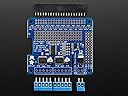
The Adafruit DC & Stepper Motor HAT Mini Kit is a compact, high-performance motor controller designed for Raspberry Pi. Featuring four TB6612 H-Bridges delivering 1.2A continuous current each with built-in thermal and kickback protection, it supports up to 4 bi-directional DC motors and 2 stepper motors with advanced microstepping. Its large terminal blocks simplify wiring, while the design preserves Pi camera port access. Ideal for robotics and automation projects, this robust HAT offers precise PWM speed control and reliable operation under demanding conditions.
| ASIN | B00TIY5JM8 |
| Best Sellers Rank | #2,474 in Single Board Computers (Computers & Accessories) |
| Brand | Adafruit |
| Brand Name | Adafruit |
| Customer Reviews | 4.3 out of 5 stars 129 Reviews |
| Item Dimensions L x W x H | 3"L x 2"W x 1"H |
| Item Weight | 85 Grams |
| Manufacturer | Adafruit |
| Model | 2348 |
| Part Number | 2348 |
| Product Dimensions | 3"L x 2"W x 1"H |
| Smart Home Compatibility | Not Smart Home Compatible |
| UPC | 711978444085 720189973154 748347527568 717520029458 |
| Unit Count | 1 Count |
M**N
Superb product for a robotic rover vehicle.
I use this motor HAT to control the two DC motors on a Kookye tank car. My application is for time lapse and videography so I needed PWM motor control using a Raspberry Pi 3. The controller works as described and the software library from Adafruit does the job just fine in Python. I like the fact that the controller operates separately from the Python code so once the motors are given a command, the code can do something else.
K**S
The speed control on this board with the provided software is excellent. Wish the developers had more language support other ...
Works well. Using it to drive two DC motors. The speed control on this board with the provided software is excellent. Wish the developers had more language support other than just Python but I suppose that gives me a reason to really get my feet wet with that language. Haven't tested on Steppers yet but I have a few laying about so I'll need to give those a whirl. Setup was fairly easy, be forwarned that you'll need a soldering iron and some solder. The boards inputs\outputs were left to the user to solder themself. You'll be making 50 solder joints on fairly small pins, so if you don't have a soldering iron I'd recommend getting one with a fine tip. The board is unpowered by the Raspberry Pi as would be expected; the specifications claim that the board can support 1.2A continous current with tolerance for 3A spikes. I haven't ran the board near it's limit yet as my motors are rated for 300mA each (so a grand total of 600mA) but from my observations thus far it appears that the board is fairly efficient. It's not getting hot from any of it's components, even the voltage regulator. This board will sit over the entire face of the Raspberry Pi 2, but has a notch cut out for the camera port which was a nice addition, my only gripe so far about the board is that it takes up all 40 of the GPIO slots and doesn't offer an extenders. There are holes made available for unused ports but you need to buy the headers yourself, or just get an expansion board. All in all though it's a good well built product. All solid state parts (no relays). I dropped it on a cement floor from standing height and the board works just fine. Other considerations: *input voltage: 5-12V (Curious to see if it will operate at lower than recommended voltages as I want to power my Pi and this board with a cell phone battery bank) *Nice bright green power LED on the board if you have any gripes with green LEDs *The screw terminals would be best installed 2 pieces at a time; the kit includes 2x 2-port screw terminals and 2x 3-port screw terminals. The terminals appear to have a mate scheme to them to allow them to sit nicely with each other, so I'd recommend inserting those together when you go to solder *The screw terminals require a pretty small phillips screw driver, consider getting on if you don't have one laying about. *Minimalistic packaging. The board came in a bubble wrap envelope inside of a anti-static bag. No box or instructions included. *I had to install the smbus library for Python to get this board to work; I followed the instructions found at http://skpang.co.uk/blog/archives/575 without a hitch. You'll need to use the command sudo i2cdetect -y 1 (on the Pi 2) in order to find which address(es) you can use in your python code. The Adafruit examples used 0x61 where as I can use 0x60/0x70.
P**E
Functions great
Amazon, what's to know what my "Warmth" rating is. I guess their AI saw "Hat" in the description and thought it was a hat you wear on your head (HAHA). Works great. Fits on a Raspberry PI 3 and 4 with no issues. I have used it to drive separate motors with no issues. I have not driven stepper motors with it however.
D**D
Super Easy to Use with minimal experience with programming.
First off let me start by saying that I have very minimal experience with programming or coding on any computer let alone a small electronic board like the Adafruit DC & Stepper Motor HAT. I bought this and a raspberry pi without knowing how any of it worked to build my own Electric Powered Longboard and it has been a great experience thus far. Adafruit has a website that you can download open source code from to make learning commands in python super easy, which has been a great tool for learning how to program. If you like to tinker and have a desire to learn about these kind of things for your own project this is for you, if you don't like to spend time tinkering around trying to get something to work, stay away from this product. Couldn't recommend this more, buying another very soon. 5 Stars
J**D
Great all-purpose motor driver
With a little soldering, this board is easy to set up and use. Probably the best thing about Adafruit are the tutorials and software packages they provide -- I went from having never used Python to being able to move my new stepper motor within an hour, which is unbelievable. The board is extremely flexible, and makes it easy to power up to 4 independent DC motors or two steppers (or a stepper and 2 DC's, etc). The breadboard space and power buses are also quite useful. I docked one star, though, because it does have some shortcomings, particularly as a stepper motor driver. For one thing, it has no current-limiting capability -- which is fine, it never claimed to. But for many applications (including mine) a current-limiting chopper drive is very useful, as it allows you to apply higher voltages, which in turn allows for higher torque at high speeds. Which brings me to the biggest problem -- high speeds. For a DC motor, this shouldn't be a problem. But I couldn't get my unloaded stepper motor to go any faster than about 20-30 rpm (using a RPi 3, 200-step motor, Adafruit's Python stepper code, full-step mode). I suspect that is because it has a dedicated PWM driver chip which talks to the RPi over I2C, which is slow and limits the switching rate. Eventually I purchased these little chopper drivers for my project: Robotlinking A4988 Stepstick Stepper Motor Driver Module + Heat Sink for 3d Printer Reprap (Pack of 5 Pcs) Because I can switch them with a simple pulse from one of the RPi's GPIO pins, I can spin the motor much, much faster. So fast that it seems to be limited by the mechanical ability of the motor rather than the switching speed of the driver. In summary: As a learning and rapid prototyping tool, the Adafruit motor hat can't be beat. If you want an easy-to-use, all-purpose motor driver to use with your Raspberry Pi, look no further. If you want a driver than can run a stepper motor at high speeds (above ~20 rpm), then you're probably better off going with a purpose-built stepper driver, like the A4988.
S**N
Great product. My 8 year old son and I ...
Great product. My 8 year old son and I built a remote control car with this, a Pi, a remote control car we found at the dump, and a blue tooth game controller. Lots of fun.
S**E
Works great but came missing parts.
Being totally new to Pi's I was a little worried I wouldn't be able to get this to work but it was pretty easy to get up and running. Soldering on the header and terminal blocks did require a fine tip soldering iron but it wasn't to hard. The instructions and examples from the Adafruit site were very easy to follow and I had both DC & Stepper motors working right from the start without any problems. The only reason I knocked of two stars was because it was missing one of the two pin terminal blocks (reading the other reviews this seems to be a common problem) so I had to solder power right to the board. This makes changing power sources a bit of a PITA and if I wasn't so excited to try this thing out I would have returned it and reordered another one. Overall its a great addition to the Pi and fun to experiment with.
A**Y
Easy to use
Easy to wire up lots of code examples online. If you know how to program a pi then you will be driving stepper motors as soon as you unpack this. I used this to drive 2 nema17 stepper motors for a moving table project.
J**H
Waste of CPU
Each step needs to be initiated from brain box. Get something like TB6612FNG instead.
真**ー
組み立てが少々めんどう
組み立てにはんだとはんだごてが必要になる為、注意が必要です。 組み立て済み版も売っている為、無い方はそちらの購入がおすすめです。 ただし、これを購入時、組み立て版は値段が高かった為、こちらを購入。 動作は確認しました。
D**X
Five Stars
good
J**.
Très bon produit
Conforme a la description !
E**Z
Sehr gut
Sehr gut
Trustpilot
4 days ago
1 month ago