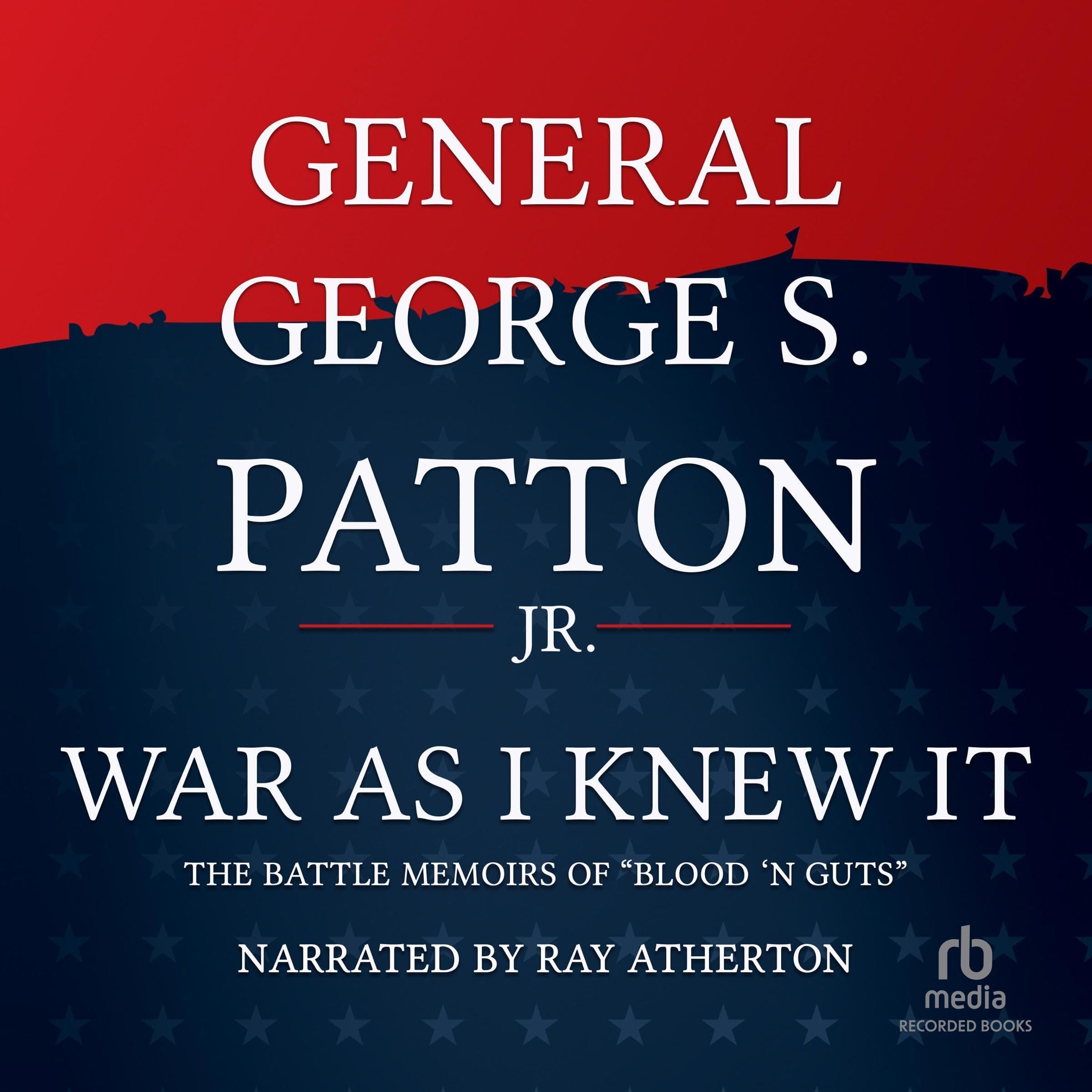
War as I Knew It
Product ID: 131548091
A military classic by a legendary American general. War as I Knew It is the personal and candid account of General George S. Patton, Jr.'s celebrated, relentless crusade across Europe during World War II. First published in 1947, this absorbing narrative draws on Patton's vivid memories of battle and his detailed diaries, from the moment the Third Army exploded onto the Brittany Peninsula to the final Allied casualty report. The result is not only a grueling, human account of daily combat but also a valuable chronicle of the strategies and fiery personality of a brilliant warrior. Review: Brains and Guts... A Heroic Leader, Military Genius and Strategist, and American Warrior - General George S. Patton Jr's., memoirs, 'WAR As I Knew It,' is an excellent, informative and enlightening historical narrative chronicling his years in the European Theatre during World War II. Throughout Patton's life, he maintained a daily journal, and retained a near fanatical belief in the importance of being mentally and physically fit, to be ready at a moments notice to fight, and to win. On the subject of leadership: "All men are timid on entering a fight, whether it is the first or the last fight... Cowards are those who let their timidity get the better of their manhood. To win battles you do not beat weapons - you beat the soul of the enemy man." Failure, to General George S. Patton Jr., a true Commander-In-Chief, was not an option. I thought it interesting, since General George S. Patton Jr., (born 11-11-1885) believed in reincarnation, that his Warrior 'spirit,' in foresight, would choose to incarnate (Free Will) back into the 'physical' on the date, 11-11. General Patton's poem, 'Through a Glass, Darkly,' is evident of his resolute belief in reincarnation: "So as through a glass and darkly, the age long strife I see, where I fought in many guises, many names, but always me." On the lower right hand corner of an interesting and informative (17) page booklet on desertcart entitled, PATTON: Many Lives, Many Battles, by Karl F. Hollenbach, reads: 'General George S. Patton, Jr. believed in reincarnation and is expected to serve his country again in a future life as a soldier.' To Patton, the date 11-11, might symbolize 'spirits' re-entering the 'physical' (Earth) by way of the top left inside 11, and eventually departing - by way of the lower right inside 11, back to the 'spirit' world, only to be reborn again (cycle) at some future date by using - Free Will. At 11:00 am, of the 11th day of the 11th month in 1918, WWI came to an end, and it was to be the war that would end all wars... Patton's Warrior 'Spirit' might have foreseen, before reincarnating on his latest birthday, 11-11-1885, that years after WWII, his birthday (November 11) would be remembered as a National Holiday and would honor all veterans, and that Armistice Day, would be eventually changed to - Veterans Day. "I'm a soldier, I fight where I am told, and I win where I fight. There is only one proper way for a professional soldier to die... the last bullet of the last battle of the last war." ---- General George S. Patton Jr. Review: Patton - Patton was a great 4 star general. a great read
D**D
Brains and Guts... A Heroic Leader, Military Genius and Strategist, and American Warrior
General George S. Patton Jr's., memoirs, 'WAR As I Knew It,' is an excellent, informative and enlightening historical narrative chronicling his years in the European Theatre during World War II. Throughout Patton's life, he maintained a daily journal, and retained a near fanatical belief in the importance of being mentally and physically fit, to be ready at a moments notice to fight, and to win. On the subject of leadership: "All men are timid on entering a fight, whether it is the first or the last fight... Cowards are those who let their timidity get the better of their manhood. To win battles you do not beat weapons - you beat the soul of the enemy man." Failure, to General George S. Patton Jr., a true Commander-In-Chief, was not an option. I thought it interesting, since General George S. Patton Jr., (born 11-11-1885) believed in reincarnation, that his Warrior 'spirit,' in foresight, would choose to incarnate (Free Will) back into the 'physical' on the date, 11-11. General Patton's poem, 'Through a Glass, Darkly,' is evident of his resolute belief in reincarnation: "So as through a glass and darkly, the age long strife I see, where I fought in many guises, many names, but always me." On the lower right hand corner of an interesting and informative (17) page booklet on amazon entitled, PATTON: Many Lives, Many Battles, by Karl F. Hollenbach, reads: 'General George S. Patton, Jr. believed in reincarnation and is expected to serve his country again in a future life as a soldier.' To Patton, the date 11-11, might symbolize 'spirits' re-entering the 'physical' (Earth) by way of the top left inside 11, and eventually departing - by way of the lower right inside 11, back to the 'spirit' world, only to be reborn again (cycle) at some future date by using - Free Will. At 11:00 am, of the 11th day of the 11th month in 1918, WWI came to an end, and it was to be the war that would end all wars... Patton's Warrior 'Spirit' might have foreseen, before reincarnating on his latest birthday, 11-11-1885, that years after WWII, his birthday (November 11) would be remembered as a National Holiday and would honor all veterans, and that Armistice Day, would be eventually changed to - Veterans Day. "I'm a soldier, I fight where I am told, and I win where I fight. There is only one proper way for a professional soldier to die... the last bullet of the last battle of the last war." ---- General George S. Patton Jr.
L**R
Patton
Patton was a great 4 star general. a great read
H**E
Patton: interesting read! But not for all!
This captivating memoir, derived from George S. Patton’s diaries and letters, recounts a front line view of his ventures from North Africa to his final resting at The American Cemetery in Hamm, Luxembourg on the far side of the airport. The materials recorded are observations and descriptions of people, events, and locations General Patton experienced over the course of three years published a few years after his death by his wife Bea. Remember, these are actual unedited documents compiled with prefaces and footnotes by Patton’s Chief of Staff throughout the war, Colonel Paul Harkins. It is not an autobiography. While reading this memoir I took the occasion to view the 1970 “Patton” and the 1986 “Last Days of Patton” films to feel the setting of the times during that period. This provoked memories of my tour of the US Army, 30th Station Hospital, Heidelberg, Germany, room Patton was treated which was sealed coupled with the view of his 3 ½ inch medical record which was held in the hospital commander’s safe at that time added to the experience. This is very easy to read, but to understand the material, you need to be an army general. Unless you are very familiar with the country of France terrain you will have much difficulty, even with the provided maps, to comprehend Part II of this book, as Third Army commander, that makes up half of it. Additionally, if you are not an army product, you will be totally lost with the movement of troop units as described. I have been to the areas covered, described, and am confused as I read the text. However, by reading his diaries the reader obtains significant insight into his thoughts regarding tactical, operational, and strategic military concepts and there execution. Along with these factors the endeavor makes it very hard to read with any confidence in the accuracy or completeness of the text. This is a view into an ideal military leader who possesses the highly unique ability to effectively manage and juggle multiple balls in the air while in combat confusion, war. The work is in three parts where all are center around “Operation Overlord.” Due to the fact the material is of autobiographic origin there is no reference section nor index. Paul D. Harkins, Patton’s Deputy Chief for Staff, appears to provide color thru maps and the text. I recommend this for military study. It is not a book to bring to the beach!
W**R
War as Patton told it!
Patton’s “War As I Knew It” is an impressive, posthumously published book (first published in 1947 after Patton's death in 1945). It's well worth the price just for Rick Atkinson’s insightful introduction (in the print book; Kindle intro by Douglas Southall Freeman) and Patton’s Letters of Instruction at the end. What follows are some quotes and commentary I gleaned from the book: Just as Lee had Stonewall Jackson, a strategist like Eisenhower had his work supplemented by a superb tactician like General George S. Patton. Patton had been a personal aide to General Pershing during WWI and had gone on to champion the use of tanks. During WWII, he was successful in the North Africa and Sicily campaigns, becoming much feared by the Germans. The Allies used Patton’s reputation to advantage during the Normandy invasion. They put Patton in charge of what amounted to a phantom army stationed near Dover, England, prompting the Germans to believe that the invasion was to come at Calais, the closest city on the other side of the Channel. This deception spread the German defense thinner at Normandy, the real target, than it otherwise would have been. Patton’s 3rd Army under General Bradley’s 12 US Army Group, became operational in Normandy on 1 August 1944 and simultaneously attacked west, east, and north, quickly trapping several hundred thousand German soldiers in an area called the Falaise (Normandy) Pocket. Aggressively employing speed, effective reconnaissance, and tactical air support, Patton’s Army moved east until it ran out of gas and halted in place. In December, the Germans took the offense with Battle of the Bulge. Resupplied and in response, Patton wheeled one part of his army north, relieved the 101st Airborne Division trapped at Bastogne, and then ran east through the frozen Ardennes, hitting the Germans in the flank. The other part of his army attacked east, with the two parts meeting to trap 60K German soldiers and 10K square miles of territory. By the time the war ended, Patton was camped in Czechoslovakia, requesting to attack Prague. Patton believed that, while there is no approved solution to any tactical situation, there is one, but only one, tactical principle which is not subject to change: “To so use the means at hand to inflict the maximum amount of wounds, death, and destruction on the enemy in the minimum time.” In battle, casualties are directly proportional to the time exposed to effective fire. One’s fire reduces the effectiveness of the enemy’s, while quickness of attack shortens the time of exposure. Battles are won by frightening the enemy, and this is best done by inflicting him with death and wounds. Fire from the rear is more deadly and three times more effective than fire from the front. To get fire behind the enemy, one must hold him by frontal fire and race around his flank. Frontal attacks against prepared positions should be avoided. One can never be too strong: one should get every man and gun possible, provided it does not unduly delay one’s attack. The larger the force and the more violence one uses in the attack, the smaller will be one’s losses. Never yield ground. Mortars and artillery are superb weapons when they are firing; when silent, they are junk – see that they keep firing! In mountain country or when forcing a pass, secure the heights first. In battle, small forces can do one of three things: go forward, halt, or run. Halting or running makes them an even easier target. There is a universal failure to repeat verbal orders back. This failure can result in grave errors. There is a tendency to overload junior officers by excessive and non-essential training and report requirements, which can be alleviated by eliminating non-essential demands. “While infantry must move to close with the enemy, it must shoot to move. When targets are not visible, infantry weapon fire must search enemy-occupied areas. Use marching fire to reduce the accuracy of enemy fire and increase one’s confidence. Shoot short. Ricochets make nastier sounds and wounds. The bayonet kills few men, but many are scared by it. Construct dummy batteries. In choosing sites for them, avoid places where fire directed at them will adversely affect other arms. The primary mission of armored units is attacking infantry and artillery. The enemy’s rear is the happy hunting ground for armor. Use every means to get it there. Against counter-attacks, the offensive use of armor striking the flank is decisive. Forward observers provide sixty-five to seventy-five percent of all artillery targets. Junior reconnaissance officers must be very inquisitive, setting an example, producing accurate reports, and not losing contact while on mission. An officer must be the last man to take shelter from fire, and the first to move forward. Similarly, he must be the last man to look after his comfort at the close of a march.” Letters of Instruction: There is only one sort of discipline – perfect discipline. Discipline can only be obtained when all officers are so imbued with the sense of their awful obligation to their men and their country that they cannot tolerate negligence. Officers who fail to correct errors or to praise excellence are valueless in peace and dangerous misfits in war. Officers must assert themselves by example and by voice. They must be pre-eminent in courage, deportment, and dress. One of the primary purposes of discipline is to produce alertness. ...ceremonies are a great help to give them that perfect discipline. Officers must possess self-confidence and the confidence of their men. Two of the best ways of producing this are meticulously conducted close-order drill, led by officers, and platoon marches...during which the platoon is wholly on its own. Combat principles: A pint of sweat will save a gallon of blood! “Catch the enemy by the nose with fire and kick him in the pants with fire emplaced through movement.” Hit hard soon; you can never be too strong. Get every man and gun you can secure, provided it does not unduly delay your attack. Officers must possess self-confidence and the confidence of their men. German prisoners over forty talk more quickly than the younger ones. To halt under fire is folly. To halt under fire and not fire back is suicide. Move forward out of fire. Officers must set an example. If you cannot see the enemy, you can at least shoot at the place where he is apt to be. Bottom line, a fascinating read from the pen of one of history’s great captains! Check out some of William J. Bahr’s books: Strategy Pure and Simple: Essential Moves for Winning in Competition and Cooperation and George Washington's Liberty Key: Mount Vernon's Bastille Key – the Mystery and Magic of Its Body, Mind, and Soul , a best-seller at Mount Vernon. “Character is Key for Liberty!”
R**S
How to Win War
The brilliant military leader and strategist General George S. Patton, Jr., presents his World War 2 autobiography with "War As I Knew It". First published in 1947, this remarkable 425-page book has often been republished (including this review's 1995 paperback). This extraordinary study recalls the Allies' efforts from its Morocco landing (1942) to victory in Germany (1945) from the Major General's eyewitness 3rd American Army command. General Patton's gives considerable advice through many memorable epigrams: * "If I do my full duty, the rest will take care of itself." * "...the fatalistic teaching of Mohammed and the utter degradation of women is the out standing cause for the arrested development of the Arab." * "One look is worth a hundred reports." * "...throughout history, wars had been lost by not crossing rivers..." * "It is useless to capture an easy place that you can't move from." * "...one does not plan and then try to make circumstances fit those plans. One tries to make plans fit the circumstances." * "...when the American Army had once put its hand to the plow, it should not let go." * "...as long as you attack them they cannot find the time to plan how to attack you." * "...every time I had been bitterly disappointed, it worked out for the best." Patton reveled in attack and "killing Germans". He was determined for Allied victory by mean of his command. He fought battles, argued strategy with fellow generals, toured corpse ridden shell falling battlefields, and pressed his army to victory. He disliked British General Montgomery, had immense respect for Eisenhower, and had profound sympathy for all fallen Allied soldiers. This book presents war-winning strategy. This book is recommended for all students World War 2 and those interested in the life of General Patton.
S**N
A smirky, arrogant piece of writing
Patton was of course one of the more successful generals of his time, and his Third Army was powerfully effective following the Normandy invasion. Don't read this book expecting a true autobiography. There is very little content about North Africa, and the ETO material, although detailed in terms of which units were assigned to which places, which divisions did a good job, those that needed better leadership, etc., lacks any sort of truly useful perspective. This diary-like rendition of Patton's part of the war was written with an arrogant, smirky attitude. The only general Patton truly approves of is himself and many of those who reported to him. Otherwise, as he sees it, just about every general, at just about every level, is described in extraordinarily judgmental terms. Patton didn't like the way that Eisenhower, Bradley and Montgomery conducted their work, and while a great deal of what he has to say about these people reads as accurate, it all is filtered through Patton's own narrow point f view. That POV, simply described, was "give me all the necessary resources, and I'll end the war, and any other use of those resources is a waste of time." After a while, that sort of analysis gets very old.
J**L
Never Take Counsel of Your Fears
General George S. Patton, Jr.'s diaries and letters were assembled into this book in 1947, two years after his death. His widow Beatrice Ayer Patton served as a capable editor. This edition has some new material and was reprinted in 1995 to commemorate the 50th anniversary of V-E day. Unfortunately with Patton's premature and unusual death in December 1945, (calm yourselves, conspiracy theorists) the post-war world lost its opportunity for the war's greatest memoir and its most unpredictable political leader. War As I Knew It is the next best thing, a full account of the leadership and strategic thinking of our greatest warrior. Readers will travel with Patton from his arrival in North Africa in 1943, through the campaigns in Sicily, Western France, Belgium, the Bulge, and ending in May 1945 in Austria. Lesser known events are related such as the initial fighting with the French in Africa. In many cases, Patton revisits towns and territory that he had first seen as a young officer in the First World War. Surprisingly, the book is also full of humorous stories such as unusual encounters with African tribal leaders, British generals, and French politicians. Cameo appearances include Marlene Dietrich, General T. Roosevelt (son of the President, who participated in the Normandy Invasion), and historical figures like William the Conquerer who influenced Patton's tactics. Patton greatly plays down the events that led to his downfall, only briefly mentioning the slapping incidents, although he does make a very forceful argument that malingerers are a great threat to morale and need to be punished with extreme measures. The press conferences in London and Boston that led to his dismissal from the Third Army are basically outside the scope of this book, as they occurred after V-E Day and receive only a footnote. On another level the book is chocked full of real insights into leadership that are probably more relevant today than in the 1940's. Patton is a clear proponent of focused planning, communication, speedy execution and offensive action. Here are some examples: It is vital to good morale that decorations get out promptly and on an equitable basis. Staff officers of inharmonious disposition, irrespective of their ability, must be removed. Time (speed) is more valuable than co-ordination. In war,the only sure defense is offense, and the efficiency of offense depends on the warlike souls of those conducting it. Successful generals make plans to fit circumstance, but do not try to create cirmcumstances to fit plans. Whenever a man gets a medal, he usually attempts to outdo himself and gets killed, whereas in order to produce a virial race, such men should be kept alive. I believe in fighting until lack of supplies forces you to stop, and then dig in.
T**C
A glimpse of the real Patton, but nothing more
Patton's "War as I Knew It" is a good but not great collection of some of General George S. Patton's diaries from World War II. At times, it is an illuminating and interesting look at Patton and his views, but probably because it was edited by his wife and others after Patton's death, many interesting parts of Patton's life are glossed over or ignored. Anyone interested in Patton's war career or World War II would find this book interesting, and any current US Army officers should read this book for many of Patton's leadership lessons. The book briefly describes parts of the North Africa and Sicily campaigns, and I found it very interesting to read about Patton's meetings with the Sultan of Morocco. Most of the rest of the North African campaign was skipped, and after a few pages about the Sicily campaign, Patton is suddenly in northern Europe as the Third Army commander. Most of his writings about the European campaign give daily updates on the condition and position of his subordinate divisions. Fortunately, the book is replete with maps of most of the Third Army's areas of operations - something too many military history books forget. For anyone hoping to find Patton's insights and feelings about the controversial incidents during his command, you won't find them in this book. Most events are completely skipped over: the soldier slapping incidents are mentioned in two paragraphs on page 381 of 390 pages of text; there is no mention of Patton's difficult months after being passed over to lead the American D-Day effort and while serving as the "diversion" for a second invasion; there is no mention of Patton's comments and insults about the Soviet Russians as allies; and there is nothing about Patton and his tepid de-Nazification of his sector in Germany. Also, when criticizing many of his subordinate commanders and discussing the relief of some commanders, this book omits the names of those being criticized and only refers to them by position; and the reader has to wonder if these criticisms were whitewashed by the editors after Patton's death. Despite these shortcomings, this book still gives many insights into Patton's persona not found in most other works. Too often, Patton is portrayed as a one-dimensional commander whose success relied on the discipline of his soldiers and his obsessiveness with the attack. Anyone reading this book will quickly discover that Patton's brilliance as a commander was based on a well-developed command philosophy. Patton understood that his role as an Army commander was to support his corps commanders and give them the moral support necessary when they grew weary. Patton's flamboyant personality was part of this philosophy as well: for instance, he would always drive to the frontlines when visiting the frontlines but fly back to his headquarters, because he wanted his soldiers to always see him going forward and never see him leaving the front. This book should be read by all current Army officers, because many of Patton's lessons are timeless. He had a thorough understanding of the functions of his staff, and insisted that representatives from each staff section visit frontline units daily. The book ends two many chapters on his personal views of the Army: a chapter called "Earning My Pay," recounting various anecdotes throughout his Army career and the lessons he learned; and "Reflections and Suggestions," with tactical advice for soldiers and commanders. This book is mostly a detailed recounting of Patton's World War II European campaign. For the casual reader wanting to learn more about the real Patton, I recommend looking elsewhere. But WWII buffs and real George S. Patton fans will get a lot of insight from this book, and all current U.S. Army officers should read it for the timeless lessons that Patton teaches.
T**E
Five Stars
Arrived in good time and good condition. Great read and insight into a fascinating man.
C**O
Great book
戦**僧
私の英語能力が低いのも原因ではありますが…
映画「パットン大戦車軍団」のノリを期待していたのですが、パットン将軍の日記を編集し直し、本にしたようです。 北アフリカ戦線やシシリーの部分は少しの記述しかなく、戦闘場面もあまりありません。 大半がETO(オーバーロード作戦)のことなのですが、「第○師団(○の部分は数字)の○○少将が云々」と言う記述がやたらに多く(←とにかく数え切れないくらいの師団等名・将校等名前がでてきますよの意味です)、はっきり言って訳がわからなくなります。よほどの戦術研究家か専門家でないと全体像を掴むのは困難です(米国人は理解できる人も多いでしょうが、日本人ではETOに関して、そこまで詳しく戦術を研究しているのは、防衛庁の防衛研究所か、かなりのオタクです)。 また、附属の地図もかなり見にくいため、余計に読む気力が萎えて来ます。 私の英語能力が低いのも原因ではありますが「Band of Brothers」のようなストーリー性を求める読者にはお薦め出来ません。
L**L
Excellent
Came promptly and well packaged. Exactly as advertised
G**A
Good Book
Good Book - Read through first few pages - has been insightful so far.
Trustpilot
1 month ago
5 days ago