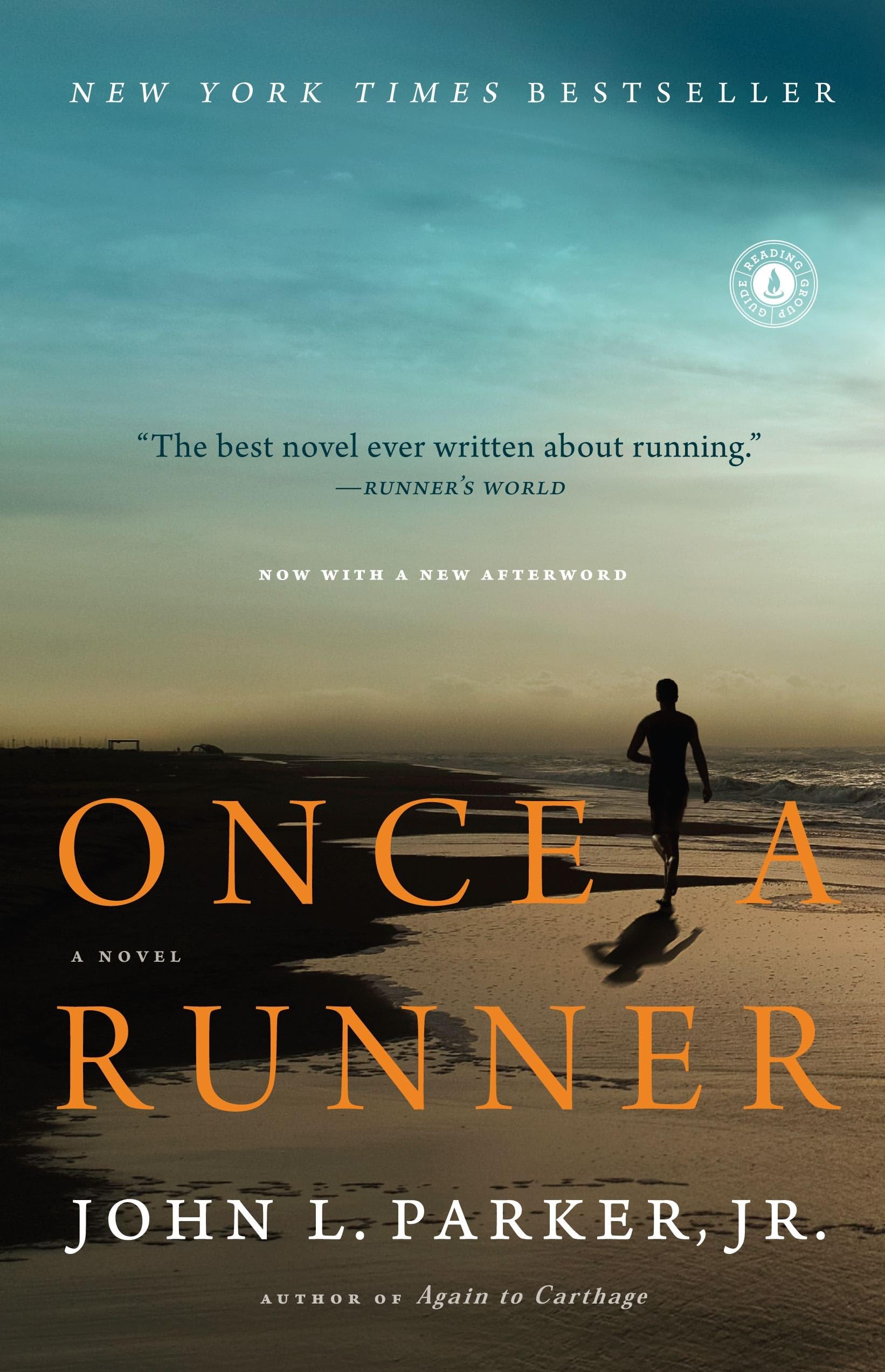
Once a Runner: A Novel
Product ID: 1548325
Buy anything from 5,000+ international stores. One checkout price. No surprise fees. Join 2M+ shoppers on Desertcart.
Desertcart purchases this item on your behalf and handles shipping, customs, and support to New Zealand.
The undisputed classic of running novels and one of the most beloved sports books ever published, Once a Runner tells the story of an athlete’s dreams amid the turmoil of the 60s and the Vietnam war. Inspired by the author’s experience as a collegiate champion, the novel follows Quenton Cassidy, a competitive runner at fictional Southeastern University whose lifelong dream is to run a four-minute mile. He is less than a second away when the turmoil of the Vietnam War era intrudes into the staid recesses of his school’s athletic department. After he becomes involved in an athletes’ protest, Cassidy is suspended from his track team. Under the tutelage of his friend and mentor, Bruce Denton, a graduate student and former Olympic gold medalist, Cassidy gives up his scholarship, his girlfriend, and possibly his future to withdraw to a monastic retreat in the countryside and begin training for the race of his life against the greatest miler in history. A rare insider’s account of the incredibly intense lives of elite distance runners, Once a Runner is an inspiring, funny, and spot-on tale of one individual’s quest to become a champion. Review: John Parker got it exactly right - I read Once a Runner in 1978 between my sophomore and junior years in high school. I was running cross-country and track. I thought it was a fantastic book and it is still one of my all-time favorites. It was a motivator for me then, pushing me toward consistent training and fewer empty squares in my training log. For someone who took up running later, in their 20s or 30s, running 10ks and half-marathons on the road, it probably would not feel as relevant, as reflected in other reviews. It is not Hemingway nor Shakespeare, does not pretend to be, and I do not think any runner who is a fan would pretend that it is. What it does, it does well. It tells the story of what it is like to be a young, competitive middle or long distance runner on a team. John Parker captures every emotion, feeling, situation, memory, motivation, and obstacle germane to that. He does it so well that anyone who has trained and competed as a distance runner on a high school or college team, would read this and say "that's it! He got it exactly right." And that is a bit ironic, since Quenton Cassidy at one point thinks to himself, “It was a good thing, he decided, not to have everything available in capsule form.” Much of the criticism I’ve seen is rather amusing. Cassidy and his teammates are labeled as arrogant. Aren’t many world class athletes? To reach that level, confidence (often masking insecurity) spilling over into arrogance is pretty much common. The book is called sexist, because Parker leans on some stereotypes (sorority girls in the South, Andrea not handling the breakup well). Hey, Cassidy’s girlfriend is premed and studying organic chemistry, this circa 1970, presumably, when not so many women entered medicine. Hardly sexist there. And because a woman tries to seduce Cassidy at a party (has no woman ever seduced a man?), and because “where are the female athletes? There are NONE in the book.” Female athletes? Parker graduated from University of Florida around 1970. The school did not field a women’s track team until 1973, so that is what he knew. Complaints about the timeline. Which Olympics did Denton compete in? Pre and Rose and Drayton and Ron Hill and others mentioned in a way that doesn’t all mesh. But, who cares? It’s a novel. If timelines and people and events are blurred, that’s OK. Read the sequel, Again to Carthage, and you can really get your knickers in a bunch over the timeline. It’s fiction. Criticism of Cassidy and Denton’s training volume (“That’s waaayy too many miles! Nobody should do that much.”) Again, it’s a novel, not a “how to” manual. There are training books out there, and websites. Go find them if that’s what you are looking for. And, that kind of mileage is what guys WERE doing in the late 1960s and 1970s, Frank Shorter included. John Parker should know, he trained and raced with Shorter, Jack Bacheler, Barry Brown, Marty Liquori, and others. (Hint: Bruce Denton is based on Jack Bacheler.) Criticism of the hermit thing (“That’s unhealthy and a bad idea and nobody should isolate themselves like that.”) Again, it’s a NOVEL. And there surely have been athletes who did that, training for the bigtime in whatever sport they were pursuing. Nobody is saying it’s healthy. But it probably got a lot of athletes to the Olympics or World Championships in their chosen sport. Scoffing at some things “just couldn’t have happened”, preposterous events like the Honor Court prank and the 60x 440 workout. But they did. John Parker did both of those things himself. Read his interview on Gary Cohen Running Interviews. Complaints that there was no backstory of Cassidy’s childhood. Heck, it’s fiction. Make up your own childhood story for him. Or read the prequel, Racing the Rain. If you’re a young person running on a team, in high school or college, read it. Review: A must-read for any competitive runner - I was told this book was a must-read for competitive runners of any level, and I maintain that stance. It's not that the book is particularly well-written or the plot is particularly well-constructed or the character development is particularly nuanced. None of those things are true, though I found the book adequate on all of those fronts. What sets this book apart is it's accurate portrayal of the lifestyle and mindset of an elite collegiate runner. It does this so perfectly that it still rings true many decades later. Which is not to say that everything in this book should be put on a pedestal as exemplary for modern runners, but it feels real and that is worth something, especially when there are so few works of fiction about distance running. That being said, this book is extremely self-gratifying. If you are in the "running" tribe, you should read it and you will probably enjoy it. If you are not in the "running" tribe, you could read it and you probably won't enjoy it.
| Best Sellers Rank | #26,484 in Books ( See Top 100 in Books ) #196 in Sports Fiction (Books) #399 in Coming of Age Fiction (Books) #1,632 in Literary Fiction (Books) |
| Customer Reviews | 4.5 out of 5 stars 1,695 Reviews |
H**N
John Parker got it exactly right
I read Once a Runner in 1978 between my sophomore and junior years in high school. I was running cross-country and track. I thought it was a fantastic book and it is still one of my all-time favorites. It was a motivator for me then, pushing me toward consistent training and fewer empty squares in my training log. For someone who took up running later, in their 20s or 30s, running 10ks and half-marathons on the road, it probably would not feel as relevant, as reflected in other reviews. It is not Hemingway nor Shakespeare, does not pretend to be, and I do not think any runner who is a fan would pretend that it is. What it does, it does well. It tells the story of what it is like to be a young, competitive middle or long distance runner on a team. John Parker captures every emotion, feeling, situation, memory, motivation, and obstacle germane to that. He does it so well that anyone who has trained and competed as a distance runner on a high school or college team, would read this and say "that's it! He got it exactly right." And that is a bit ironic, since Quenton Cassidy at one point thinks to himself, “It was a good thing, he decided, not to have everything available in capsule form.” Much of the criticism I’ve seen is rather amusing. Cassidy and his teammates are labeled as arrogant. Aren’t many world class athletes? To reach that level, confidence (often masking insecurity) spilling over into arrogance is pretty much common. The book is called sexist, because Parker leans on some stereotypes (sorority girls in the South, Andrea not handling the breakup well). Hey, Cassidy’s girlfriend is premed and studying organic chemistry, this circa 1970, presumably, when not so many women entered medicine. Hardly sexist there. And because a woman tries to seduce Cassidy at a party (has no woman ever seduced a man?), and because “where are the female athletes? There are NONE in the book.” Female athletes? Parker graduated from University of Florida around 1970. The school did not field a women’s track team until 1973, so that is what he knew. Complaints about the timeline. Which Olympics did Denton compete in? Pre and Rose and Drayton and Ron Hill and others mentioned in a way that doesn’t all mesh. But, who cares? It’s a novel. If timelines and people and events are blurred, that’s OK. Read the sequel, Again to Carthage, and you can really get your knickers in a bunch over the timeline. It’s fiction. Criticism of Cassidy and Denton’s training volume (“That’s waaayy too many miles! Nobody should do that much.”) Again, it’s a novel, not a “how to” manual. There are training books out there, and websites. Go find them if that’s what you are looking for. And, that kind of mileage is what guys WERE doing in the late 1960s and 1970s, Frank Shorter included. John Parker should know, he trained and raced with Shorter, Jack Bacheler, Barry Brown, Marty Liquori, and others. (Hint: Bruce Denton is based on Jack Bacheler.) Criticism of the hermit thing (“That’s unhealthy and a bad idea and nobody should isolate themselves like that.”) Again, it’s a NOVEL. And there surely have been athletes who did that, training for the bigtime in whatever sport they were pursuing. Nobody is saying it’s healthy. But it probably got a lot of athletes to the Olympics or World Championships in their chosen sport. Scoffing at some things “just couldn’t have happened”, preposterous events like the Honor Court prank and the 60x 440 workout. But they did. John Parker did both of those things himself. Read his interview on Gary Cohen Running Interviews. Complaints that there was no backstory of Cassidy’s childhood. Heck, it’s fiction. Make up your own childhood story for him. Or read the prequel, Racing the Rain. If you’re a young person running on a team, in high school or college, read it.
M**T
A must-read for any competitive runner
I was told this book was a must-read for competitive runners of any level, and I maintain that stance. It's not that the book is particularly well-written or the plot is particularly well-constructed or the character development is particularly nuanced. None of those things are true, though I found the book adequate on all of those fronts. What sets this book apart is it's accurate portrayal of the lifestyle and mindset of an elite collegiate runner. It does this so perfectly that it still rings true many decades later. Which is not to say that everything in this book should be put on a pedestal as exemplary for modern runners, but it feels real and that is worth something, especially when there are so few works of fiction about distance running. That being said, this book is extremely self-gratifying. If you are in the "running" tribe, you should read it and you will probably enjoy it. If you are not in the "running" tribe, you could read it and you probably won't enjoy it.
K**R
Perfect Read for Your Miles of Trials
As Quenton Cassidy trains to run the biggest race of his life, Once a Runner may look like a novel with a conventional story arc, but to the runner-in-the-know: runners (and probably most athletes at Cassidy and author Parker's level of competition) are not conventional people. There is something more lurking as Cassidy loses his girlfriend, is kicked out of school, off of the running team and out of his house. As he decamps to a friend's country cabin, he is left only with what has been the only thing in his head anyway: running. Perversely, by losing it all, he gets to focus his life on one race. He runs. He trains. He obsesses. He always has; now, he does so freely, without all the distractions. And, there is a purity and enjoyment evident that is the domain of the elite athlete alone. Parker returns again and again to that mysterious strain of human, and - in many ways - how they are ill-suited to so many of life's more mundane duties and tasks by virtue of the same skill and mind sets that make them so perfectly suited to elite performance. Quenton realizes (or at least his girlfriend does, and he runs his way to the realization through the book) that a guy who can turn it on the way he can in competition is not suited to turning it off in the rest of his life. This is the famous Michael Jordan, Kobe Bryant, "they have to beat you at checkers" conceit. But, parker does it in fiction and does it very well. He surrounds his reflections on running with a healthy cast of characters. Admittedly, they recede as "Cass" sequesters himself in the woods to wrestle with the demon (running) that he can only conquer by using his one coping mechanism (running). Nonetheless, there is genuine humor in the early phases of the book as Parker introduces town father Sidecar Doobey, of his mythical town (adapted from the Gainesville, Florida locale where Parker himself was an SEC mile champion). For runners - even weekend road racers - Parker does an admirable job of evoking the running subculture: down to the equipment, the obsession over seconds, the constant brain-rattling focus on training, etc. He writes, "in the waking world his whole being centered around covering ground quickly on foot. At this he really had no equals save a few dozen others scattered about the country and world who also woke to such disquieting dreams. Quenton Cassidy knew every one of them by name." Talk about subculture! Every runner shares some sense, however limited, of the bonds that form in the "Miles of Trials" that help Cass define himself and his friendships. And, as Parker beautifully portrays in the person of Bruce Denton, Cass' Olympic gold medalist confidante, every runner knows the feeling that while only few people may know the difference between the and a near competitor, it is there. Of course not every revelation will resonate with the weekend runner as it does with a champion miler. But, the book is packed with the kind of running mysticism that will have avid runners locked in to what is otherwise a very solid novel.
E**D
True to life (to a point...)
A great description of the mindset (if not the circumstances) of serious collegiate runners. Top notch!
A**S
Classic
Great book. But you already know that.
C**N
The best running novel beyond the shadow of a doubt
As many people have noted in earlier comments, if you're not an athlete or somewhat dedicated runner, you won't get this book. You simply won't. It would be equal to explaining color to someone that was born blind. As someone that had been averaging over half a marathon a day in mileage, I can relate to the stories and inner monologue of Quentin. I'll be honest, of this entire incredible book, two scenes do it for me; Quentin's drunk demon speech at the bar and Quentin's run in the rain to see his ex-gf. The drunken demon speech still gives me shivers even though I've read the book a dozen times. The speech provided a glimpse into the mind and driving factors as to why some people take the plunge into elite fitness. The simple idea that the elite have been forced to make a choice between a common happy life and a life on the edge of human ability. Specifically, the idea that you can't have both. Quentin's run in the rain to see his ex-gf is powerful on a whole different level. Every elite-level athlete has had a moment when they've stated a simple athletic feat and the common person can't even begin to parallel that feat. For Quentin, running an absurd distance in the rain to see his ex-gf didn't even cross his mind as being an achievement, but his ex-gf is immediately taken back by the distance surrounding such a trip. The scene makes me remember all of the times when people have responded with "You ran where?!" when asked about that day's run. In summary, this is the single greatest running novel ever made and should be a staple in the library of any athlete.
S**L
Best book about running ever written?
Reader's Digest dubs this book as "best book ever written about running!" I would have to respectfully disagree. Can it be the best "novel" ever written about running? Maybe! The story as a whole, in my opinion, is a little dry; it lacks the "kick" that every "good" book has in the story. I don't want to give anything away, but overall this book is Decent. The last few chapter are amazing; besides that it's just your average book. Maybe, I expected a lot from this book after reading numerous reviews about it. But pick a copy and decide for yourself. On a side note, if you looking for a good book on running; I would recommend Born to Run and My Life on the Run. Two great books on running, that can motivate even the laziest individual to get out and run. Believe me, I was that individual...
A**R
Once a Runner, Always a Runner!
In Once a Runner, John Parker, Jr. has gifted us the quintessential short distance (1 mile) running novel. As the publication story goes, he self-published it in the 1970s and many years later it got picked up by a major publisher and became a smash hit. Now, in 2015, with "can you run a 5 minute mile" on every serious runner's bucket list, the novel is experiencing something of a resurgence. Parker does a fine job capturing the drama that unfolds in races of the serious running-kind. Words can never do it full justice, but Parker comes pretty darn close. I am, however, more interested in the literary merits of the novel, which no great novel can be without. From the opening chapter with the title Once . . . to the closing chapter with the title A Runner, and all the pages in between, Parker creates excellent characters and shiny prose. The novel sets the stage even before the first chapter with its literary title. It's one thing to tell a straight up running story and quite another to put it on the page in a literary way. That's what sets Once a Runner apart. If there is any fault in this novel it is from the dictionary words the author frequently uses in the first half of the book. Parker is not the only first time novelist to err in this direction. He is also an attorney and perhaps the BIG WORDS are in his natural vocabulary. Who knows and who cares? Once a Runner is not a book about running. It is a literary novel of very high regard that just happens to include runners among its pages. People who never get off the sofa will love it just as much as the googley-eyed beanpole runner (of which I count myself). That is why Once a Runner has withstood 4-5 decades and is likely to withstand that many more.
J**H
Great inspiration for runners
Even though I dont often read fiction,it was a great read for me and shone a light on seeing what it takes to really get the most out of any unning aspiration. Would recommend to any runner who sets goals for themselves
C**N
Great read for runners era particularly
Excellent book for runners, feels like the writer has the experience
A**D
A must read for all competitive track athletes and a great read for any runner
One of the very few fictions based on a runner and a definite read for anyone who likes running. The author (being a competitive runner himself in his days) captures the life of a competitive college runner from America really well. But so many things he talks rings true for many of us amateur runners. Quenton Cassidy is a very loveable character with his talent on the track and wit of it. He trains hard with his team mates and 'runs through' everything (the little hub caps life rolls into your lane) life throws at him. By end of the book you feel like training for one of the most historic and beautiful distance events there is - the mile. The book definitely leaves you inspired to get you through your trials of miles. You also get a glimpse of high school and college running scene the US used to have, with special appearance from Frank Shorter - the american olympian and legend. And you wonder how things would have been if you had something similar here. Now on to the sequel of the book "Again to Carthage".
R**N
The inside life of a runner
As a modest runner myself who is chasing my own goal, this book is inspiring. It truely captures the sacrifices that are required to achieve your goal.
Ó**R
Clásico
Un clásico de la literatura del atletismo
Trustpilot
1 week ago
1 week ago