Desert Online General Trading LLC
Dubai, United Arab Emirates
Desert Online General Trading LLC
Dubai, United Arab Emirates
Full description not available
A**S
Perfect Introduction to Continuum mechanics
This is the perfect introduction to continuum mechanics. I've looked at many other options and kept coming back to this book as it is written in a very methodical manner and doesn't try to hide details or skip fundamentals.For example, this book is superior to Chadwick's, which tries to be concise and instead ends up burying the reader in formalism rather than concrete understanding.That said, some parts of the book have some holes in their derivations but that's no barrier as you can readily derive the steps in between on your own with what is provided. The exercises are not optional in this book, you need to carry them out to understand the material and in some cases, in order to obtain a result you will use to apply the material.At a leisurely rate, it should take you about a month to get through everything but the last two chapters of the book, the last two which need a month on their own. Be prepared to take down notes summarising each of the physical quantities and tensor rules as you learn them, it will help so you don't have to keep going back and forth in the book.
L**R
Pretty good for an introductory mechanics book
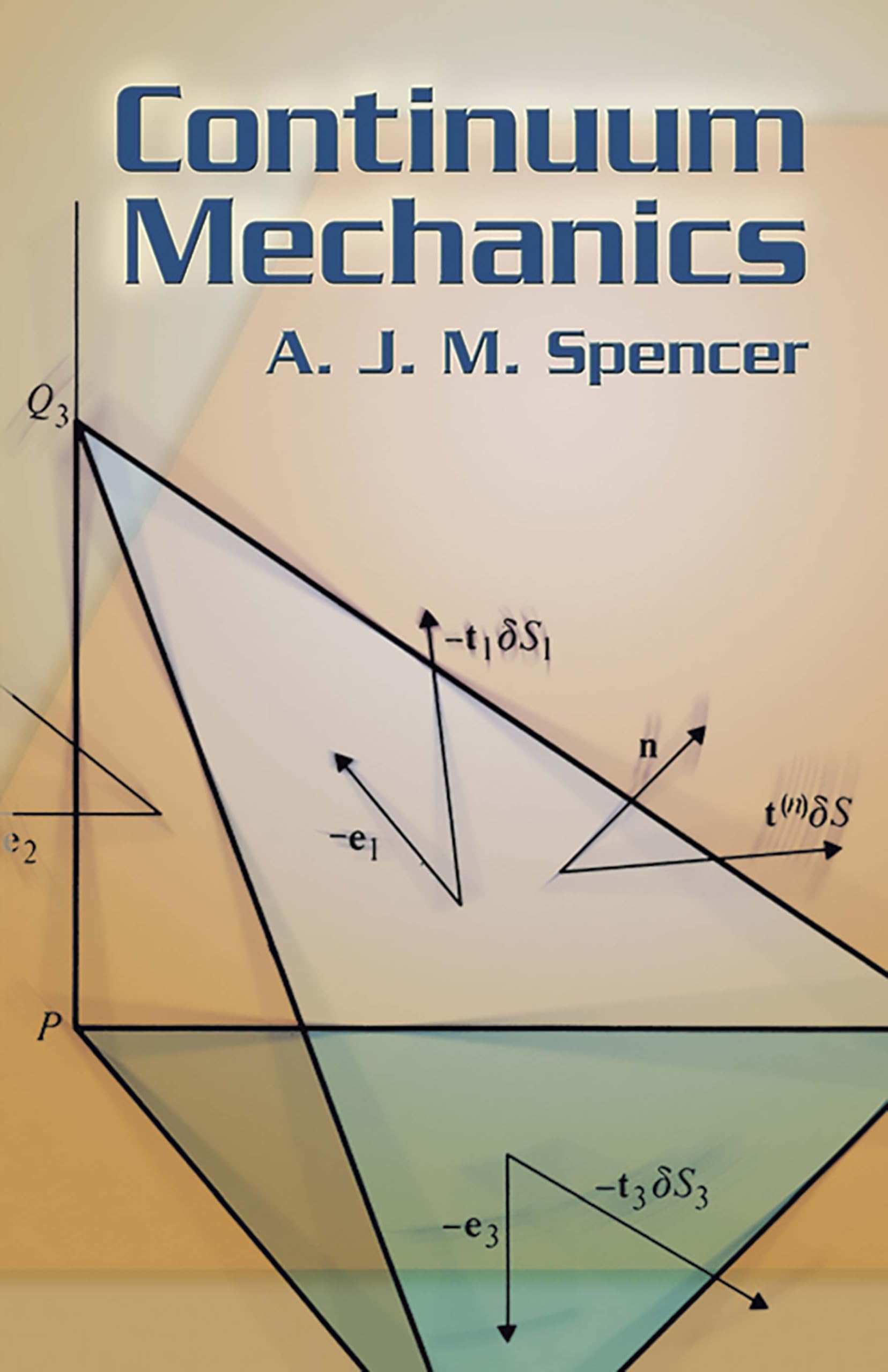
Continuum mechanics (CM) is a beautiful and infinitely useful branch of mathematics, but the learning curve is relatively steep. Once you scale the cliff, you are able to do simply amazing things and gain a deeper appreciation for the deformation of materials. However, most textbooks do not make for decent guides- you need a competent professor to show you the ropes (which I fortunately had). CM is just one of those subjects where you need a lot of practice and study to get good at it.My perspective and experience might make me slightly biased, so keep that in mind. Spencer's book is not like most. While not perfect, he does a remarkable job of explaining all of the basics of what you need to know to do CM, and then teases with things more complicated (the rabbit hole goes very deep- I promise). Rather than obstinately sticking to either Gibbs notation (boldface vectors and tensors) or indicial notation, he moves between both, and sometimes presents equations in both forms. The figures are as simple as they need to be to get the point across (and no simpler). The important high points are in the book- vector/tensor analysis, kinematics, balance laws, and constitutive equations. The most fleshed out examples come from Spencer's own research, finite elasticity, which is a great demonstration of all of the important concepts.The length and price certainly are right. Until something better comes along, I would recommend this as a good introductory book, probably supplemented with the Schaum's Outline. The book by Chadwick, also cheap and thin, isn't a good starter book- it's outstanding for quick reference once you know how to talk the talk.
B**J
Clear, concise introduction
This is probably one of the most concise, easy-to-follow introductions to continuum mechanics out there, especially if you have a working knowledge of linear algebra. It is a relatively modern treatment that uses nice matrix notation for the deformation gradient and strain that you will immediately recognize if you have read some of the popular SIGGRAPH papers on deformable model simulation. There is even a brief chapter on nonlinear constitutive laws. I had this book sitting on my desk in my lab at one point, and a random visiting scholar from France came up and said that the book is amazing. So it is also a nice way to make friends.
A**R
This is a good book for reader who learns continuum mechanics for the ...
This is a good book for reader who learns continuum mechanics for the first time. It provides basic knowledge of the subject.
D**Z
Horrible book
I do not like this continuum mechanics book. It is a non-intuitive book with a lot of formulas and not so many physical intuition behind the procedure.
D**C
Five Stars
Excellent text! It explains the fundamentals clearly and succinctly.
K**M
Not for a beginner
I purchased Continuum Mechanics by Spencer as a reference material for the first year gradate class on continuum mechanics. I got this book a month ahead just to get ready for the class. I think the book is wonderful particularly in regard to the intellectual depth of the author on the subject and his proficiency on the mathematics involved. But the very strength of the book may also be a huge drawback for particular audiences. The development of the concepts and the mathematics behind it virtually lacks consideration for beginners. Although I could follow significant portion of the mathematics and language presented, I could not form a coherent understanding of the broader concept. Fortunately, as I now actually get lectures in class, things start falling onto the big picture. Once I'm done with the class, I think this book will serve me better. But as of now, I'm going to stick with Schaum's Outline, which I purchased also from Amazon just after getting this book, as a reference and source of problem sets. If you are an undergrad or first year grad student getting ready for your first continuum mechanics class, get Schaum's Outline instead. You might also want to consider purchasing Schaum's Outline on Linear Algebra for review.
C**G
excellent primer for continuum mechanics
This is an excellent primer and introduction to continuum mechanics. I use it quite frequently for just quickly looking up concepts and equations that I can't remember off the top of my head.
Trustpilot
2 months ago
2 days ago