Buy anything from 5,000+ international stores. One checkout price. No surprise fees. Join 2M+ shoppers on Desertcart.
Desertcart purchases this item on your behalf and handles shipping, customs, and support to New Zealand.
โก Power up your Pi Zero with wired speed and zero clutter!
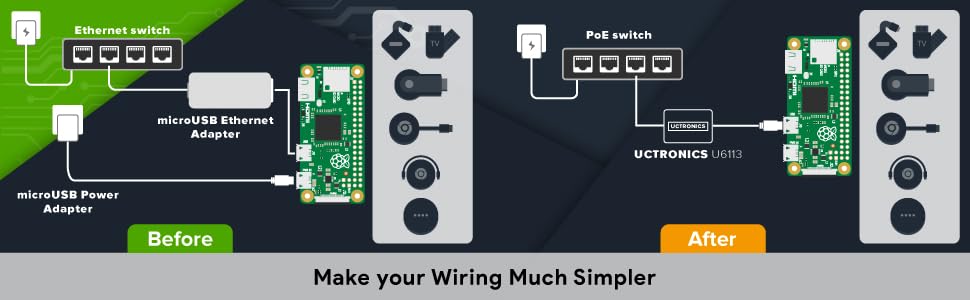
The UCTRONICS Micro USB Ethernet/PoE Adapter is a compact, IEEE 802.3af compliant device that delivers both power and wired network connectivity through a single Micro-USB port. Designed for Raspberry Pi Zero and compatible with popular streaming devices like Fire TV Stick and Chromecast, it enables stable, long-distance power and data transmission up to 300 feet, eliminating the need for multiple cables and wall plugs.


| ASIN | B0876N3PMZ |
| Best Sellers Rank | #426 in USB Computer Network Adapters |
| Brand | UCTRONICS |
| Color | white |
| Compatible Devices | raspberry pi zero, Chromecast, Google Mini |
| Customer Reviews | 3.9 out of 5 stars 108 Reviews |
| Data Link Protocol | USB |
| Hardware Interface | Micro USB Type B |
| Item Weight | 0.07 Kilograms |
| Manufacturer | UCTRONICS |
| Unit Count | 1.0 Count |
A**S
works great for the price
works great for the price, it has been working ok 24/7 for like 20 months, so I could say the product is great
P**O
Mine Works Perfectly with Wyze Cam V3
Contrary to other reviews, this device DOES provide both power and data simultaneously via the ethernet port to the USB connector -- POE. It works as it's advertised to work. Power can also be injected via the secondary USB port using a conventional USB brick if POE is not available. Data can still be provided via ethernet. It's a great solution for Wyze cameras that are using third party firmware for ethernet connectivity and RTSP streaming. It does NOT provide ethernet capability to stock Wyze Cam firmware, though it will still power them via POE for long distance locations. If you understand how poe works, this should work for you. Good luck with yours!
L**R
Not reliable or durable? I really want this to work...
I bought five of these things to hardwire our Google Home Minis into the ceiling, powered and data'd through our Ubiquiti USW-24POE. I pulled the cables and tested them, then plugged this thing into the Home Mini and then into the Cat6a cable. Both lights lit up, and the Home Mini booted. I factory reset it using the bottom button and started setup, but could not get the Home Mini to see the ethernet adapter. The switch did not show the device plugged in, in fact didn't see the Mini at all until I added it to the wifi, where it stayed connected even with the adapter plugged in. In the process of installing it, the MicroUSB connector bent slightly. It still provided power, but thinking it was the cause of the issues I crawled back up in the attic and swapped it for another of the 5 I ordered. Went back into the house, plugged in the Min and repeated the process, but still no Ethernet. Maybe I broke the first and replaced it with a faulty unit? Maybe they're both faulty? I took the first unit and plugged it into a 1st gen Chromecast, which took power instantly and booted up but again never joined the wired network. It is entirely possible that this is all Google's fault for their idiotic setup procedure that seems to require you to set up WiFi, or it's possible I got a faulty unit and broke one. I'll keep trying and they'll keep 3 stars for doing 1/2 of what they say they'll do.
N**Y
Great idea, but power has not been stable
TL;DR: Power is unstable and device reboots every 2-3mins without network load. I've been building out my home automation system using microcontrollers and SBCs, and I've been looking for a way to power everything over PoE and avoid wireless. Using a $5 RPi0 + a $20 USB PoE adapter is cheaper than a wESP32 solution and gives you a lot more room for a network stack and a lot more power/versatility. Building PoE relay/sensor hubs like this seems just about perfect for me. This device saves a lot of space inside an enclosure when you don't have to make room for a PoE splitter/power supply and a USB ethernet adaptor. These things are a great idea and I'm surprised there aren't more vendors that make similar. I really wanted this to work and probably buy a bunch of em. The issue I'm having with this PoE adaptor is pretty weird tbh... I've got a fresh, working RPi0 (v1.3) running the newest RPiOS/Raspbian powered by this PoE adaptor, which is plugged into a 10/100 8port PoE+ unmanaged switch. There are no other peripherals, USB(OTG) hubs, nothing connected to the GPIO pins, or any additional draw on the power rails -- just the Pi0. The Pi0 boots without power warnings and I can ssh into it. Looking through syslog / persistent journal / dmesg, I can see the kernel (5.10) finds and brings up the eth0 interface for the RTL8152 without issue. There are no errors, warnings or any signs of a problem anywhere in the logs. Device looks fine over USB with nothing anomalous. There is no packet loss or net errors. Temps are fine (33c with sink). Core voltage is normal. So far, so good... But, after 2-3 minutes of just sitting there idle, the Pi0 loses power and goes into a reboot cycle. Here's the strange part: It only happens after the network has been idle / low utilization for 2+ mins. It will constantly reboot with an open ssh connection, but NOT if I run top or glances that generates non-ACK traffic over eth0. Also, if I constantly ping the device from another machine it never reboots / loses power. I've tested this up to 15+ hours of constant pinging, and every time the ping / traffic stops, the Pi loses power within 2-3 mins. I've enabled persistent logging and there's nothing in the logs at all to indicate what the problem might be. It's clearly an unclean shutdown with no warnings. Monitoring the voltage on the 5v USB rails just shows the power dropping out and coming back up within around ~0.75 seconds. I can run a high cpu load (stress) on the Pi, but it will always reboot unless there is ALSO a significant network load (i.e. constant pinging from another device.) I suspected a low-power-state condition. I've tried disabling automatic power management of the device via sysfs config, and using ethtool to disable EEE (Energy Efficient Ethernet) but no love. I've even tested on a different (working, unmanaged) PoE switch. Same thing. The PoE device just keeps suddenly powering off without enough network load. Now if I power the same Pi0 with a standard 1.0a PSU and use a non-PoE network switch, it stays rock solid and never generates any errors regarding the RTL8152. The device seems to work fine as a ethernet adaptor alone, but the PoE function has been completely unreliable for me. Not sure if I've got a defective unit, or if there's some design flaw at fault here. I've reached out to UCTRONICS and I'll request a replacement. I'll update my review if this gets resolved.
M**N
Helps clean up the clutter and free up WiFi bandwidth
I'm using this to both power and feed data to a Chromecast. It's nice to get these devices off of my 2.4 GHz spectrum and the fact that this also uses POE frees up outlets and reduces wire clutter. I'll be ordering more of these for various other devices behind my TVs. Edit: I've ordered more of these and now all of my Chromecasts are now using these for both power and ethernet. For anyone wondering, the switch they're connected to a US-48-500. The switch shows they're only drawing 2-4 watts each depending on utilization, and they've been very reliable.
E**R
Power pi zero over POE _AND_ provide networking!
Finally someone has produced this. Connect cat6 from a POE power sourcing equipment (PSE) like a POE switch to this adapter and then connect the usb to the usb port on a raspberry pi zero. You get power for the zero and a ethernet interface to connect to pi over. Previously I would need cat6 to a POE splitter, cat5 from the splitter to a usb ethernet device, then connect the power from the splitter and the data from the usb ethernet device into a usb OTG adapter that would take both power and data. Finally that mess could be connected to the pi zero. Now you can replace the POE splitter, the cat6 from the splitter to the usb ethernet adapter, the usb eithernet adapter and the OTG adapter with this one device. Thank you!
D**N
Awesome product
Does what it says, powers my raspberry pi zero w without any issues and provides a USB 100M NIC via the OTG connector. The only thing I wish was different would be the size and shape. It's boxy and bulky. I wish it were elongated to match the pi, or better yet, was the same footprint as the board so I could take the case off and solder it directly to my pi. I'm nitpicking though, this thing is a gem. I will be buying more to build POE powered sensors and cameras.
M**M
Almost...
Pros: Cheap, PoE 802.3af active support, convenient package Con #1: So far, I've only been able to see it "link" at 100Mbps on my gigabit switches. Probably not a big deal for the things it would be used on, but be aware it may not actually be gigabit-capable as advertised. Con #2: Seems to not have the "id" pin on micro-B connected for USB-OTG mode so the devices I've tried so far (tablet/phone, MiFi) that I know support OTG Ethernet don't recognize it as a device. This probably doesn't matter for a Raspberry Pi but other Android based devices need it to know to switch into OTG mode. Given how cheap I will likely keep it to toy with, it looks like the case could be popped apart and I could probably solder in a spare "proper" OTG pigtail so it can work correctly with my hotspot device for backup Internet.
S**C
Works perfectly
Does exactly what it says on the box -- powers and provides a wired connection to a Raspberry Pi Zero.
P**R
Flexible and easily fitted
Product is as described and I would buy again if needed.
Trustpilot
3 days ago
5 days ago