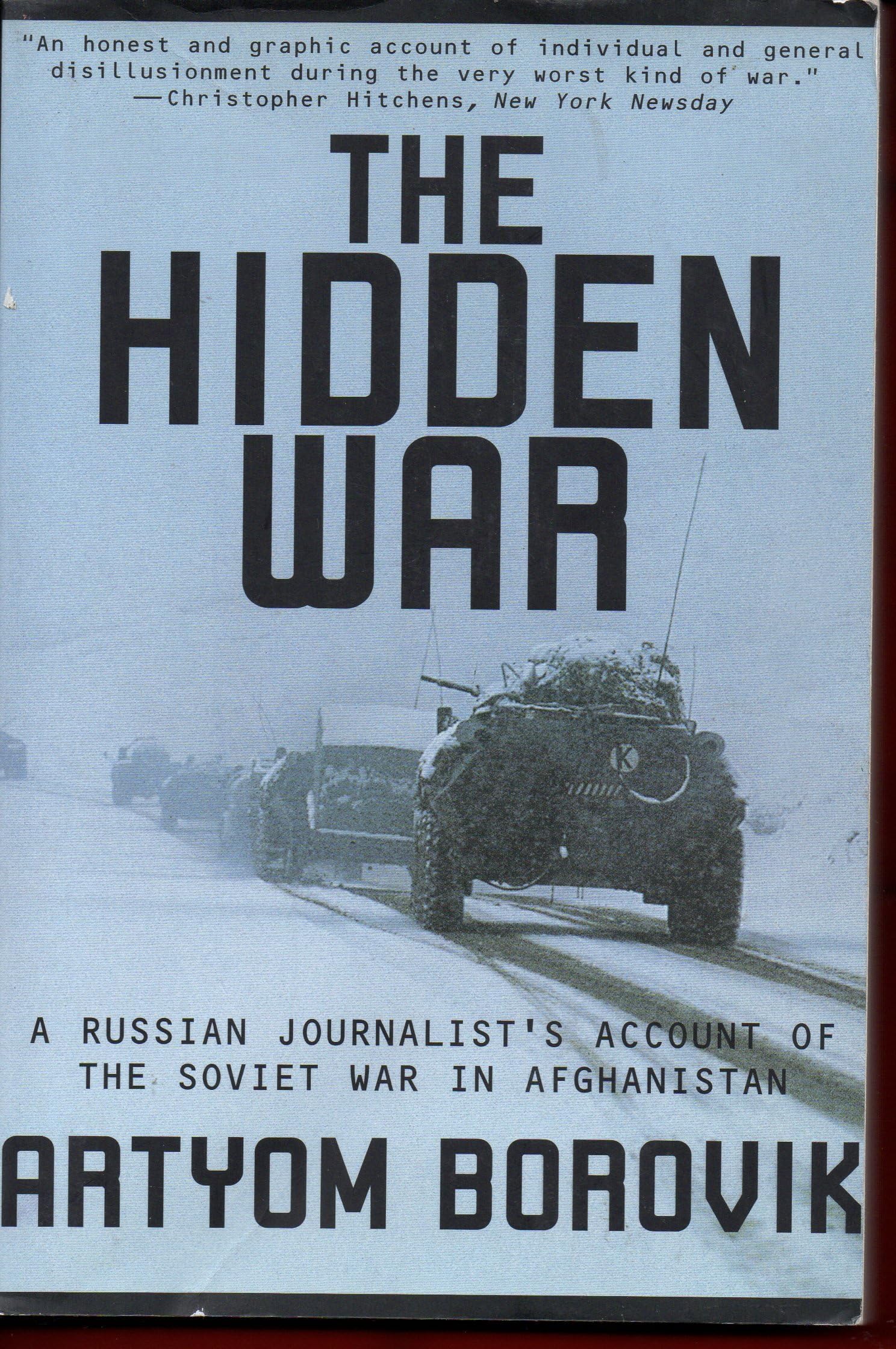
The Hidden War: A Russian Journalist's Account of the Soviet War in Afghanistan
Product ID: 23243685
Buy anything from 5,000+ international stores. One checkout price. No surprise fees. Join 2M+ shoppers on Desertcart.
Desertcart purchases this item on your behalf and handles shipping, customs, and support to New Zealand.
The Hidden War: A Russian Journalist's Account of the Soviet War in Afghanistan [Borovik, Artyom] on desertcart.com. *FREE* shipping on qualifying offers. The Hidden War: A Russian Journalist's Account of the Soviet War in Afghanistan Review: A valuable look at how not to fight a war - The "The Hidden War" is a remarkably powerful work about the physical and mental scars that war can leave. What it is not is a detailed history of the Soviet invasion of Afghanistan. That's not to say that one can't find lessons for our current situation, but they aren't the ones you might expect. There aren't any clues as to how to fight the Afghans in this book, and the Soviet Army bears essentially no resemblance to our current force structure. They were fighting a war of aggression, were ill led and were provided with almost negligent training. However, "The Hidden War" provides tremendous insight into the Afghan mindset: why they fight (or don't), why their country lies and ruins, and why they have such conflicted feelings towards the West. More than anything this book teaches us what we shouldn't do: We shouldn't try to hold large areas of territory, we shouldn't alienate the average Afghan with our superiority, we shouldn't disrespect their culture, however alien it may be to us. If you're looking for a parallel to this work, I personally found myself time and time again thinking of Michael Herr's "Dispatches". In the same way that he captured the nightmare maelstrom of drugs, violence and disillusionment that was the Vietnam War, so too does Borovik paint a picture of a hopelessly misguided Soviet effort. He leaves no doubt as to the futility of fighting a conflict with no strategy (let alone tactics), no goals, and no support at home. ... Review: Battle Scars in Ink - As a Vietnam combat veteran I found Artyom Borovik's book, THE HIDDEN WAR, to ring so clear, true and familiar that I didn't mind the puzzle-like story pieces that made up this remarkable and historic account. As a journalist Borovik covered many aspects of the Soviet War in Afghanistan during the years and accurately and vividly reported what he found. From the lowly infantryman, the elite airborne soldiers, helicopter and MiG pilots, field and political officers, and various mid and high level commanders we get more pieces of the puzzle to slowly put into place as we read. And too there were the rebel dukhi, the 'Black Tulip' casualty flights, the deserters and traitors who fled or fought against their own, the ever present dust and harsh cold of the mountain campaigns, the criticism or resentment the war veterans received at home afterwards, and so many other interesting bits that by the end of the book a better overall picture of the war emerged to contemplate. I have new respect for the Soviet veterans of Afghanistan and salute their service, sacrifice, and courage in their hidden war. Is Borovik's book the definitive history of the Soviet war in Afghanistan? No. But it is nonetheless a remarkable achievement.
| Best Sellers Rank | #361,162 in Books ( See Top 100 in Books ) #85 in War & Peace (Books) #403 in Russian History (Books) |
| Customer Reviews | 4.5 4.5 out of 5 stars (66) |
| Dimensions | 5.5 x 0.75 x 8.5 inches |
| ISBN-10 | 080213775X |
| ISBN-13 | 978-0802137753 |
| Item Weight | 12.8 ounces |
| Language | English |
| Print length | 304 pages |
| Publication date | April 10, 2001 |
| Publisher | Grove Press |
J**N
A valuable look at how not to fight a war
The "The Hidden War" is a remarkably powerful work about the physical and mental scars that war can leave. What it is not is a detailed history of the Soviet invasion of Afghanistan. That's not to say that one can't find lessons for our current situation, but they aren't the ones you might expect. There aren't any clues as to how to fight the Afghans in this book, and the Soviet Army bears essentially no resemblance to our current force structure. They were fighting a war of aggression, were ill led and were provided with almost negligent training. However, "The Hidden War" provides tremendous insight into the Afghan mindset: why they fight (or don't), why their country lies and ruins, and why they have such conflicted feelings towards the West. More than anything this book teaches us what we shouldn't do: We shouldn't try to hold large areas of territory, we shouldn't alienate the average Afghan with our superiority, we shouldn't disrespect their culture, however alien it may be to us. If you're looking for a parallel to this work, I personally found myself time and time again thinking of Michael Herr's "Dispatches". In the same way that he captured the nightmare maelstrom of drugs, violence and disillusionment that was the Vietnam War, so too does Borovik paint a picture of a hopelessly misguided Soviet effort. He leaves no doubt as to the futility of fighting a conflict with no strategy (let alone tactics), no goals, and no support at home. ...
W**K
Battle Scars in Ink
As a Vietnam combat veteran I found Artyom Borovik's book, THE HIDDEN WAR, to ring so clear, true and familiar that I didn't mind the puzzle-like story pieces that made up this remarkable and historic account. As a journalist Borovik covered many aspects of the Soviet War in Afghanistan during the years and accurately and vividly reported what he found. From the lowly infantryman, the elite airborne soldiers, helicopter and MiG pilots, field and political officers, and various mid and high level commanders we get more pieces of the puzzle to slowly put into place as we read. And too there were the rebel dukhi, the 'Black Tulip' casualty flights, the deserters and traitors who fled or fought against their own, the ever present dust and harsh cold of the mountain campaigns, the criticism or resentment the war veterans received at home afterwards, and so many other interesting bits that by the end of the book a better overall picture of the war emerged to contemplate. I have new respect for the Soviet veterans of Afghanistan and salute their service, sacrifice, and courage in their hidden war. Is Borovik's book the definitive history of the Soviet war in Afghanistan? No. But it is nonetheless a remarkable achievement.
S**D
The Soviet Endless War
This is a fascinating book, as much a document of the social upheaval of the Soviet Union in the 80s as a narrative about the Soviet Afghan War. It seemed to me to be a Soviet equivalent of Dexter Filkins' recent book on America's war on terror, The Endless War. Filkins, also a reporter, knit together his reportage and personal experiences throughout Af-Pak and the Middle East to give a more personal and intimate sense of the struggle the US in engaged in. Borovik does something similar, cobbling together his own reports for Soviet publications dating from the early and late years of the war. Other reviewers have noted the stylistic and reportorial disconnect between the first and second halves of the book, the former seeming more gung-ho, while the latter is pessimistic in tone. However this must be seen in context: it is attributable to the huge and unimaginable changes that were taking place in the USSR. In the first years of the war, almost nothing was publicly said about it, other than vague references about helping a comrade socialist state with their "socialist revolution". Many Russians were under the impression that their soldiers were mostly building schools and irrigation canals. There were no announcements when a soldier's body was shipped home in one of the notorious sealed zinc coffins. Borovik's early reporting was, therefore, already pushing the official limits in terms of its honesty about the conflict; but as Gorbachev's Perestroika gained steam it became possible, even fashionable, to openly criticize the war and the corruption of the Soviet Army. It's not entirely clear from the narrative how much actual combat Borovik personally witnessed, although he does seem to have been present during a successful night-time Soviet platoon's ambush of a mujahidin mission; he also describes embarking on a long-range reconnaissance patrol, but then shipping back early to base with several soldiers whom he describes as malingerers. Borovik leaves unsaid why he decided to desert the patrol but one imagines that fear played a role! Perhaps the most gripping part is the description of the final Russian pullout, which Borovik narrates through a conflict between two Russian officers, the stuttering but compassionate Lt Col Ushakov and his superior, the corrupt and cruel Col Antonenko. After a soldier is shot, Antonenko orders the massacre of an entire Afghan village in retaliation and later tries to bully Ushakov for not using such heavy-handed tactics. Ushakov, in turn, sees Antonenko's behavior as indicative of the rot and corruption plaguing the whole Soviet system, and a symptom of the failure of the Soviet project in Afghanistan. Finally, Borovik tells the sad story of Igor Liakhovich, the last Russian casualty in Afghanistan. Sadly, Borovik himself died in 2000 at age 39 in an airplane crash that some deemed suspicious, as he was openly critical of Vladimir Putin in his reporting. The Hidden War is a riveting document from a unique writer and reporter.
R**R
Great book!!
Having spent more than a couple of years fighting in Afghanistan, this book is a must read. Some of the problems that the US is having were mirrored by the Soviets during their "adventure". Very well written and good to see hear the stories of the individual Soviet soldiers.
A**R
Really gives a great understanding of what happened to the Russians in Afghanistan ...
Really gives a great understanding of what happened to the Russians in Afghanistan and it foreshadows what then happened to the Americans a few years later.
O**I
L'autore riferisce dei suoi soggiorni come giornalista al seguito delle forze sovietiche durante l'ultimo periodo della guerra. E' particolarmente interessante per la descrizione dello stato d'animo estremamente depresso e per il senso di abbandono e mancanza di guida che attanagliava le truppe. Descrive anche il modo in cui i sovietici hanno poi abbandonato a se stessi gli "alleati" afgani, destinati a venire letteralmente piallati dai ribelli nel giro di poco tempo, con relative sofferenza che si sono sommate a quelle orrende già sofferte, e che hanno posto le basi per il disastro attuale!
R**2
As a starting point in understanding the Soviet-Afghan war; one can do no worse than read this book. The author does not try to put his "spin" on this war; he basically walks the battlefield talking to Soviet officers and soldiers and writing what they have to say. This is a very good insight into understanding their psyche. This book is very easy to read and at times it seems to read like a story-book as opposed to an account of fact. But I believe this adds to its appeal. Highly recommended!
A**C
...and this book is a good example of their tedious ramblings. Maybe it's the translation?? Anyway, don't bother with this book.
Trustpilot
1 month ago
2 months ago