Buy anything from 5,000+ international stores. One checkout price. No surprise fees. Join 2M+ shoppers on Desertcart.
Desertcart purchases this item on your behalf and handles shipping, customs, and support to New Zealand.
📡 Cut the noise, keep the signal — watch TV like a pro!
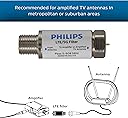
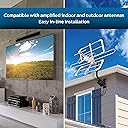
The Philips LTE Filter SDW1520/27 enhances your TV antenna’s performance by blocking disruptive 4G and 5G LTE signals within 5-608 MHz frequency range. Designed for easy, power-free installation, its weatherproof build supports both indoor and outdoor use. Ideal for metropolitan and suburban areas crowded with cell towers, this compact filter ensures crisp, uninterrupted HD TV reception while being backed by reliable U.S.-based support and a limited-lifetime warranty.


| ASIN | B08HVT59F5 |
| Antenna | Television |
| AntennaDescription | Television |
| Best Sellers Rank | #25 in Audio & Video Antennas |
| Brand | Philips |
| Color | Silver |
| Customer Reviews | 4.0 out of 5 stars 5,896 Reviews |
| Global Trade Identification Number | 00030878531955 |
| Impedance | 75 Ohms |
| Item Type Name | Philips LTE Filter for TV Antenna, Filters 4G 5G LTE Signal to Reduce Interference and Pixilation for Clear Digital HD TV Reception, Frequency Range 5-608 MHz, Indoor Outdoor Installation, SDW1520/27 |
| Manufacturer | Jasco Products Company, LLC |
| Maximum Range | 400 Feet |
| Mfr Part Number | SDW1520/27 |
| Model Number | SDW1520/27 |
| Number of Channels | 100 |
| Number of Items | 1 |
| UPC | 030878531955 |
| Unit Count | 1.0 Count |
| Warranty Description | Limited-Lifetime Warranty |
C**R
This is essential for OTA if by 5g towers
I looked online, there is 1 5g tower about a half mile from me and 2 about 1 mile, I use one of those 30$ motorized directional antennas with the amp, and for years I thought the interference I got was from the wind blowing the trees around and disrupting the signal, which it probably does, but recently noticed interference with no wind and starting investigating and yeah I didn't even know cell signal or whatever else could be an issue which it is especially when using an amp, so anyway I've been using this now for like 20 minutes and it works great! Stabilized almost all the channels of the like 73 it picks up and it would seem that I don't really need to move the antenna direction anymore I used to have to move it between two places to get my channels but this I mean it's not really boosting the signal it's reducing the congestion so the signal can be read better or whatever and it works for me, I put the filter right before the amp on the antenna cable, I read putting it other places could have reduced effect, also I read somebody said the 20$ is better but only a little and this is the best value, so see how close you are to towers just Google it and try one of these if you are, great investment for 10$
J**S
It worked!
I live in Chicago, and I'm pretty close to one of those cell phone towers, (less than a mile) and since its started warming up here again, my tvs have started acting up again, as they do every year at this time. It's a combination of the big trees on my street getting their leaves again, the cell phone tower thing and an increase in the humidity, at least that's my theory. I put this on one of my tv just to see what happened, and as God is my witness, it stopped the picture pixelation, and NBC, CBS and WGN, which wouldn't come in at all during the mornings, now come in at a higher signal quality. Some of the channels actually come in at the same signal quality as the signal strength, which is 100%, which has never happened before. The signal strength was always 100% on all of my channels, but the signal quality would vary from channel to channel and most times it would jump around to different percentages on that specific channel, but never reach a steady level, much less 100%. During the cooler months things would improve, but certain channels still wouldn't act right completely. All that I can say is that I'm impressed, because I bought an open box one, just in case it didn't work, I wouldn't sweat it too much, but the dog gone thing works, so I'll be purchasing a couple more for my other two TVs soon.
M**G
Seems to work.
My picture improved after installing this. Easy to install.
D**E
Throwing the baby out with the bathwater
This product purports to filter out 4G and 5G LTE "noise" that interferes with over-the-air digital television broadcast signals. Here's my experience with it. I live in an urban area, and I have an antenna in my attic, which I purchased and installed last year, along with a signal amplifier at the antenna site, and all new shielded coax cable leading from the antenna to the television. With this setup, I am able to receive 116 channels from the local TV stations in my area. I've noticed, however, that a handful of channels are subject to video break-up from time to time, and, given my location in the city (as well as the fact that my signals are already amplified), I thought that the situation might be improved by adding this filter to my setup. I initially installed the product right at the television set, as this was the easiest approach. Once installed, a new channel scan reduced my number of stations from 116 to 74. Certainly, that was not what I was looking for, so I went up into the attic and installed the filter right at the antenna. This reduced my channel count to 68. When I removed the device entirely, I was back up to 116 channels. Now, I'm not a novice here, as my OTA setup should indicate, so I feel pretty confident that I am installing this thing properly (it's not exactly rocket science). I think that my reduced channel counts with the device attached speaks for itself. In attempting to filter out cellular phone noise, it seems that this product throws the baby out with the bathwater. I find this both surprising and disappointing, as the Philips name has been a leader in electronics for decades (we're talking about the people who invented the cassette tape, among other innovations). Accordingly, I cannot recommend this product.
T**D
Cheap and works as promised
For those who don't know what this product is about, a quick (simplified) summary of major changes to Over-the-Air Television in the United States. UHF TV reception in the US originally consisted of channels 14 to 83 (460 to 890 MHz) introduced through FCC regulation in 4/11/1952. The 800 MHz portion (channels 70 to 83) of the UHF TV band were reallocated already back in 1983 for other services (including but not exclusively to mobile telephone service). Effective 6/12/2010 (immediately following the Analog to Digital TV conversion) the 700 MHz portion of the UHF TV band (channels 52 to 69) were auctioned off by the FCC of which AT&T (band 12, 699 to 746 MHz) and Verizon (band 13, 746 to 787 MHz) were the major winners. Since then the FCC conducted a "repack" requiring TV broadcasters to move from upper UHF channels to lower UHF channels or back to VHF (were many stations were broadcasting prior to the Analog to Digital TV conversion), including to the low-VHF band that was originally deemed unsuitable for digital television. In 2017 the FCC then auctioned off the 600 MHz portion of the UHF TV band (channels 38 to 51) of which T-Mobile was a significant winner (band n71, 617 to 698 MHz). TV broadcasters had until June 2020 to complete their relocation and to free up the 600 MHz spectrum. TV channel 37 has been and continues to be a reserved channel for radio astronomy which means that the usable UHF TV band has shrunk to channels 14 to 36 (460 to 608 MHz). All of the above refers to the actual RF channels on which your local stations really transmit (which has absolutely nothing to do with the channel numbers your TV will display). Depending on how old your TV tuner is, it will be designed to receive signals from the 600, 700 and possibly (so less likely) 800 MHz ranges which no longer contain any TV programming. The mostly mobile phone transmissions on those bands can interfere with the TV programming you are actually interested in. To prevent nearby cell towers and even your own cellphones from interfering with your TV reception, a number of companies make filters to block the unwanted signals from getting into your TV. This product (Philips SDM1520/27) is one of those products. It was half as expensive as a similar product (ChannelMaster CM-3201 also here at Amazon) which I also purchased. Needless to say, I was curious whether or not the higher price of the CM-3201 was worth it and I wanted to rely on science instead of subjective testing (e.g. how many times a particular channel pixelates within an hour). I therefore used a NanoVNA-H4 to measure the filter characteristics. I'll state upfront that using test equipment for 50 Ohm impedance with 75 Ohm impedance filters does introduce some errors into the measurements, however since this is the same impedance mismatch in both cases it still results in a valid comparison. An ideal (impossible) filter would have no attenuation below the cut-off frequency and infinity attenuation for any frequency above it (meaning that there would be no transition band at all). Real filters reveal their quality by how much they attenuate unwanted signals and how wide the transition range is (the frequencies between start of attenuation and full attenuation). Both filters showed a start of attenuation at 606 MHz (first visible sign of attenuation in the LogMag trace, not the 3dB attenuation commonly used to characterize filters) which is still within the frequency range for TV channel 36 (I subsequently tested the filters on a local station that uses RF channel 36 and the reception was fine). Also both filters showed reasonably low figures for insertion loss (the attenuation of a good signal just because the filter is being added). The ChannelMaster CM-3201 showed a transition band of 36 MHz (less is better) and attenuation of nearly 60dB (more is better, but 60dB is already excellent). The Philips SDM1520/27 (this product) showed a transition band of 72 MHz (a bit disappointing that it is so wide) and attenuation of about 30dB (which is good, but higher would be better). In-line filters are often symmetrical and can be used in either direction. Both the CM-3201 and the SDM1520/27 have explicit input and output markings but I did not test whether the filters behave any different when used backwards. The Philips SDM1520/27 is significantly smaller in diameter which may be an advantage on some TVs with recessed antenna connectors. Bottom line, this filter does work and while it is not as impressive as the more expensive one I compared it with, keep in mind that it only costs half as much. I don't see any reason to deduct a star in rating just because a more expensive product has better test results. Not everybody may need these filters (locations of TV and cell transmitters play a big role) and if you do, you may get satisfactory results from this cheaper filter. If you are concerned about getting the best results spend the extra money on the ChannelMaster CM-3201. However beware of any filters that are still sold which are based on the 2010 elimination of the 700 MHz band since those are not blocking cell transmissions in the 600 MHz range.
B**S
Did Not work
Did not work on my application
J**Y
absolutely worth trying if you have reception issues
I have struggled for years to get decent antenna reception in my home. I have several stations within 35 miles of me, but could never find an antenna or any positioning of antennas that would give me reliable reception. I always had excess noise and artifacts in the broadcast, and channels would drop out mid-view constantly. I've tried all kinds of different antennas ranging in price from $20 to $75, and figured it was just some odd quirk of where my house was, or that it's because the home was built in 1926, or how I am forced to situate my antennas that meant I could never get a clear signal. I had completely given up on trying to get OTA TV working until I decided to take an $8 gamble on this filter and am so glad that I did. The TV room is below ground level, so plugging an antenna directly into that would never give the best results. I could get 1 or 2 of the closest stations by doing that, but not cleanly. My cable modem is in the attic, where the single coaxial access is, so I use an HD Homerun that is connected via ethernet, and the filter screws directly into that and then a small $20 omnidirectional mast antenna into the filter. It could not have been easier to set this up. If you can screw in an antenna (and you would not be looking at this if you couldn't), you can install this filter. It is barely over an inch long so the size of the filter is meaningless. Everything being in the attic is actually good because it allows the antenna to be as high as possible without putting something on the roof, and it also means I don't have to look at it or all the internet equipment. Out of sight, out of mind. I now get all the local stations coming through crystal clear, with no distortion or loss of signal. This had never been possible before. It used to be impossible to watch anything for more than 10 minutes but now it is like having cable again. Everything is perfect. If you can never seem to get an antenna to work, it's probably worth it to try a filter before you throw in the towel. If I knew more about how the signals work I might have come to this conclusion a long time ago, but you can also be a complete idiot like me and throw less than $10 at a problem and get the same results.
A**S
Useful in high-interference areas, ensuring a clearer, more enjoyable TV viewing experience
Review: Philips LTE Filter for TV Antenna The Philips LTE Filter is a valuable tool for anyone experiencing interference or pixelation in their digital TV reception due to 4G or 5G LTE signals. This device is designed to improve the clarity of your TV signal by filtering out unwanted frequencies like those from cellphone towers, and it delivers on its promises. Key Features Effective Filtering: The filter blocks 4G and 5G LTE signals that can interfere with over-the-air TV reception. Its frequency range (5-608 MHz) ensures it focuses solely on the broadcast spectrum for digital HD TV. Versatile Installation: Suitable for both indoor and outdoor use, it can be easily attached to your antenna or TV setup without the need for specialized tools. Performance The Philips LTE Filter noticeably reduces interference and improves picture quality, especially in areas with strong LTE signals. It effectively minimizes pixelation and audio disruptions, ensuring a smoother viewing experience. The improvement is most evident in areas with densely packed cell towers or heavy mobile device usage. Ease of Installation Installation is straightforward. The filter comes with F-type connectors that are compatible with most antennas and coaxial cables. Simply attach the filter between your antenna and TV or receiver, and you’re good to go. Its durable construction makes it reliable for outdoor installations as well. Pros Improved Signal Quality: Dramatically reduces interference, providing clearer TV reception. Universal Compatibility: Works with most TV antennas and coaxial connections. Easy to Install: Quick setup with no additional tools required. Durable: Designed for both indoor and outdoor use, with sturdy materials that withstand various weather conditions. Cons Limited Benefit for Strong Signals: If your TV reception is already strong and interference-free, the filter may not make a noticeable difference. Potential Loss of Marginal Channels: In rare cases, extremely weak signals near the cutoff range might also be filtered out. Overall Impression The Philips LTE Filter for TV Antennas is an excellent solution for anyone dealing with interference or signal quality issues caused by LTE networks. It’s easy to install, effective, and durable, making it a valuable addition to any TV antenna setup. Whether you’re in a city with heavy mobile network usage or simply want to optimize your viewing experience, this filter is a worthwhile investment. It is most useful in urban or high-interference areas, helping to bring about a clearer, more enjoyable TV viewing experience. I have many cell towers in my neighborhood, and my signal from my over the air antenna was filled with pixelation and cut-out issues. This filter made my viewing better.
ع**ه
جيد
جيد
D**D
Eliminates a lot of interference!!!
Plug it directly into the TV to eliminate interference picked up by the cable. When I did this, I eliminated interference from nearby street traffic! I bought one for the upstairs TV as well. Both help considerably!!!
A**R
Perfect
Installed on my setup and hope it work as expected
M**5
Worked like a charm
We have moved into a rental property while waiting for our new home to be completed; the property only has an older style analogue antenna and we were constantly getting 4g and 5g signal interference making free to air TV stations unwatchable. We purchased the filter, Amazon delivered it less than a week, it took 2 minutes to install and our reception is interference free. We are very happy.
G**O
Excelente producto
Estoy muy contento con está compra, no sabía que existía este tipo de producto, me lo recomendó un amigo. Súper fácil de instalar y eliminó el pixelado que tenía en algunos canales de TV abierta.
Trustpilot
1 week ago
3 weeks ago