Illuminate Your Creativity! 💡
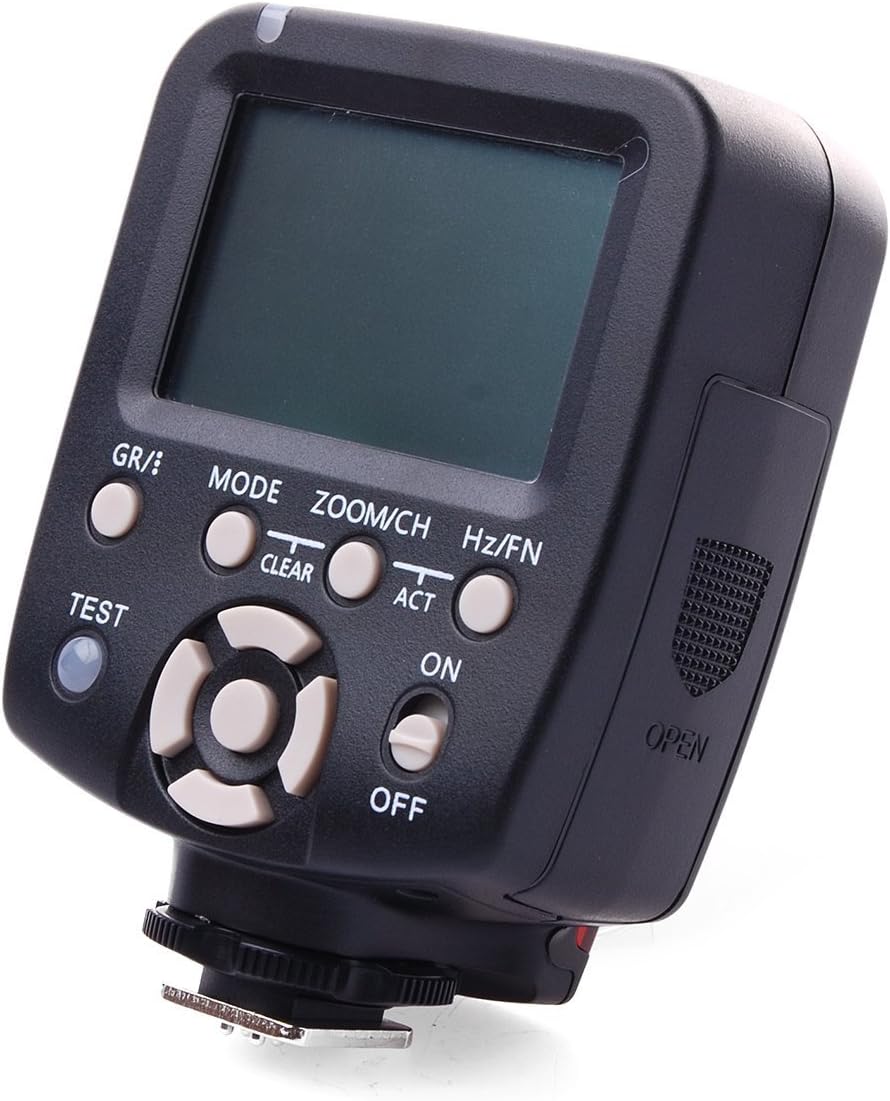
The Yongnuo CA-63YN-560TXC YN560-TX Wireless Flash Controller is designed for Canon DSLR cameras, offering seamless wireless triggering and control over multiple flash groups. With a transmission range of 100 meters and compatibility with popular RF systems, this device is perfect for professional photographers seeking flexibility and precision in their lighting setups.
| ASIN | B00KM1QZRY |
| Audio Recording | No |
| Best Sellers Rank | #1,954 in Shoe-Mount Flashes |
| Brand | YONGNUO |
| Built-In Media | Flash |
| Camera Flash | Slave |
| Color | Daylight |
| Compatible Devices | Canon DSLR and Powershot cameras |
| Compatible Mountings | Canon |
| Connectivity Technology | Wired, Wireless |
| Customer Reviews | 4.6 out of 5 stars 716 Reviews |
| Exposure Control Type | Manual, Multi |
| Flash Sync Speed | 1/250 |
| Global Trade Identification Number | 00708022604250 |
| Hardware Interface | Radio Frequency |
| Has Self-Timer | No |
| Included Components | Flash |
| Item Weight | 650 Grams |
| Manufacturer | EverTrust |
| Manufacturer Part Number | CA-63YN-560TXC |
| Model Name | CA-63YN-560TXC |
| Model Number | YN560TX Canon |
| Mount Type | Hot Shoe Mount |
| Number of Batteries | 2 AA batteries required. |
| UPC | 708022604250 711463938204 700358477409 701413913382 796389758990 711463954471 701203776173 552252191598 711463943215 702411239924 702865254740 702411239931 700355534129 701203780323 754235385349 712994321695 702685415673 |
| Warranty Description | 1 year |
| Water Resistance Level | Not Water Resistant |
| Wireless Technology | RF |
R**N
A Must have for YN 560 III Owners - Mostly
I'm a long time Yongnuo fan and a "Strobist" (Sorry David Hobby, but the term is here to stay). I use a variety of flashes, both Yongnuo (460, 560, 560 III) and Canon (430 II, 580 II), as well as RF-602 and RF-622 Triggers. I mostly use manual flash, so I don't actually use my RF-622 all that often. I admit I largely got this because it sounded cool and was so cheap that I didn’t flinch at an unnecessary purchase. Most of my off-camera flash work is done in the studio, where it’s not really that difficult to reach over and adjust the power on a flash. But I have two uses where it’s really useful: soft boxes where the flash is internally contained, and in architectural/real estate work where I’ll put a flash in another room or even outside a window. The trigger works great, as well as my RF-602 or RF-622 units. I use it to trigger my YN-560 III flashes directly, and it will also trigger any flash on a RF-602 receiver (can also work with RF-603), but it’s just a dummy trigger; it can’t adjust power/zoom. I haven’t had any issues with reliability yet, but I’ll report back after some heavier use. The locking mechanism is the same screw type that Yongnuo uses, not as nice as Canon’s latch, but not a big deal. The display is quite nice and is backlit. The unit feels really large, but I’m used to the tiny RF-602 transmitter. It’s a nice size for reading the display and the control buttons, but it feels bulky on the hotshoe. But if you’re used to having a flash on the hotshoe then you won’t even notice. I only one issue with it: There’s just one button for selecting groups, so you have to scroll down. I wish they used the up and down arrow for selecting groups instead of fine tuning (1/3 stop increments) the power. I select groups far more often then I fine tune. In summary: it’s a great unit that does exactly what it says: it’ll fully control (power and zoom) YN 560 III units without additional triggers, plus activate either RF-602 or RF-603 triggers that you have. Given the ridiculously cheap price I’d say get it anyway. But just how much you’ll use the remote power/zoom control depends on what type of work you do. For outdoor work, or real estate photography, I’ll take full advantage of it. But in a small studio I’ll probably still just use my RF-602 since it’s just as easy to reach over and adjust flash power directly.
S**E
Central Nervous System of a compact lighting kit
My goal was to build an inexpensive, portable lighting solution for carry-on travel in a small pack. What I discovered was essentially an entry to studio lighting that would give professional results within certain limits. Consider an Alien Bees B800 for about $280 gives you a maximum of 320 Ws output. Four 560 iiis will cost the same and give you similar power, but you have the added benefit of being able to split them up for smaller tasks. The cost of this controller plus a bracket is still far cheaper than similar triggers and receivers for the Alien Bees setup, so right out of the gate, you're ahead. Where this setup falls short are the ability to use eTTL/iTTL, recycle time, and number of steps to setup. However, all of these things can be mitigated to some extent. For example, if you are only using one or two modifiers (soft boxes for example) , setup time isn't that different, and many of us are familiar with full manual control for lighting, anyway. Some prefer it. Recycle time can be reduced by using external battery packs. I know not all of this relates to the trigger itself, but I wanted to share a little of the thought process I went through when considering heads versus speedlights. The speedlight option is very flexible, and I can work around the power limitations pretty well. So, on to the trigger. It's very simple and has everything you need for manual control over up to six groups. That's more than most people will ever need, but it's great to have as an option. Group assignment and selection is pretty easy once you've done it the first time, and you can keep track of your lighting ratios by glancing at the back of the LCD - something you can't do easily with some other non-display systems. I was surprised to see how useful the zoom control is when working at distances. I sometimes mount flashes to my backdrop's cross bar, and using a combination of zoom and power lets me gain some measure of control over spill and distribution without having to resort to snoots. It's of course not perfect, but for firing at 30'-50', you can get a measurable change in edge falloff. Sweet. Finally, the form factor is large enough to be easily handled, but doesn't get too obtrusive. Any smaller and it might be difficult to work with, but I can appreciate smaller, side-mounted triggers. One thing I wish it had built in was a remote shutter receiver. Right now, you have to hang another unit from your camera body, but if you could just drop a cord from this unit to your remote release port, that would be seriously handy. I've not used this unit extensively, but it seems reasonably well built, and so far has not failed at distances of up to 25m (75'). At this price, just get it and a couple of 560 iii flashes if for nothing else than having a portable lighting solution.
R**S
This controller works with with the Yongnuo YN560-III flash units...
I purchased this unit and two Yongnuo YN560-III flash units and have found that they work very nicely together. I'm tempted to deduct a star for the users manual because the Chinese to English translation isn't very good, but I am tech savvy enough that I was able to figure out how to pair the flash units to this remote unit. (For those who might be struggling with this, I found the trick is to understand that the flash unit needs to be set to whatever group you want to use. The control unit has several different groups available, but it's just a dumb broadcaster - the flash itself is where you choose which group settings to "listen" to.) I found that the transmitting range was plenty good for what I have tried to do and actually changing the settings on each flash group is fairly easy once you've worked through it a few times. I can't really speak to the durability of the unit yet as I've only used it a few times, but it appears to be well made and I don't have any reason to doubt that it will continue to work well for some time to come. One other thing to note: This flash control system is considered a "dumb" system in that the only thing it knows about the camera is that the camera asked for the flash to fire. The power settings are all set manually, so it may involve more work than a fully automatic flash system. I can't reduce the star rating for that, however, because at this price point I don't think you will be able to find a fully automatic flash system, and if you do, I doubt it will be built with the apparent quality of this system. I have not tried this controller with any other flash units, but I believe this is meant to work only with the YN56-III flash units.
S**W
Simple, reliable, and cheap, but didn't fit in my camera at first until...
This is perfect for triggering my Yongnuo YN560-IV flash and Panasonic Lumix FL360L flash (with Yongnuo RF-605 attached). Set-up is extremely easy. From the YN560-TX (attached to my camera), I can adjust the power output and zoom of the YN560-IV flash, but not of the Lumix FL360L flash (these must be adjusted manually on the flash unit itself). Radiofrequency triggers like this are extremely reliable (no misfires at all, and does not require line-of-sight to the flashes) and much better than infrared or optical slave mode. When I first tried to attach the YN560-TX to the hot-shoe of my camera (Panasonic Lumix G85), it didn't fit and did not trigger the flashes when I pressed the shutter. I thought it was defective and was about to return it when I looked closely and realized the problem: The YN560-TX has 1 central pin through which the camera's hot-shoe triggers the YN560-TX which subsequently triggers the remote flashes. In addition, there are 4 other pins which have something to do with sleep mode on a Canon camera; in my case, these are not only completely unnecessary but prevents the YN560-TX from being pushed in all the way into the camera hot-shoe and thus prevents the central firing pin from making correct contact. I overcame this obstacle by using a small blade to lift up the 4 interfering pins before pushing the YN560-TX into the hot-shoe.
P**R
Works Flawlessly to Control and Trigger Multiple YN560 IV Speedlights
I'm using the Yongnuo YN560-TX flash commander to trigger and adjust multiple Yongnuo YN560 IV speedlight strobes with built-in receivers and they work flawlessly. Since the speedlights have the receivers built in, you don’t need separate receivers and cables for each flash. It makes for a very compact and powerful flash setup with the ability to make critical adjustments to all your Yongnuo strobes at a long distance from your camera position without having to move. I also have the Yongnuo YN560-TX which triggers the same strobes. Those do not allow you to make any adjustments to the strobes, but are considerably smaller. Since the Yongnuo YN560-TX flash commander can make all the flash adjustments even if it's not mounted on your camera, I find it useful to make the adjustments using the YN560-TX which I can keep in my pocket and put the RF-603 II on the camera to do the actual triggering when I want to keep the camera streamlined. The Yongnuo YN560-TX uses two AA batteries. I'd give it five stars if it came with a padded protective case. It does not come with the shoe-mount stand that it's pictured on.
T**D
Dial those flashes in like a pro!
I shoot with Fujifilm gear so I don't have much available in the way of flash gear like Canon or Nikon users do. Because of this, I have been using a three-flash setup of Yongnuo strobes for the past year. The first photo shoot I had after I received my YN560-TX was for "Baby's First Christmas" in a cramped apartment with poor lighting. I set up two umbrellas and put the controller on my XT1 and proceeded to dial in the flash levels perfectly. The outcome couldn't have been better: not only was the flash always spot on, but I was able to dial things in with a more professional appearance, instead of running back and forth between the speedlites pushing buttons on them. For the price, this controller and a set of Yongnuo flashes is a boon to folks who aren't ready to spend several hundred dollars on higher end gear but want to have great control. The quality is good, fit and finish are in line with other Yongnuo gear. The controls are adequate, though I wish they had put a rocker next to the D-pad to select the flash: you have to press the top left button repeatedly to switch channels. Also, the pairing process is poorly documented, but a bit of searching online gives the magic handshake needed to get things going. This flash controller works with my Fujifilm XT1, XPro1, and X100s. I put big labels on the three strobes, "A", "B", and "C", to make things easier when working with the controller. Because of the quirky pairing process, I don't want to do it again, so if one strobe breaks at a shoot, I'll simply grab another from the bag and use its letter instead.
T**!
Cost conscious solution when combined up with the Yongnuo YN560-III speedlight!
I gave this 5 stars, but my experience with my FIRST transmitter was less than stellar. I purchased this transmitter along with several Yongnuo YN560-III speed lights that have the integrated receiver. They work together and allow you to manually control the output of the speed lights remotely. The first transmitter I received would NOT fit in ANY of my cameras hot shoe the way it was SUPPOSED to fit (I have a Nikon D600, a Nikon D7000, a Nikon D90 and a Nikon D80). Strangely enough, it DID fit into the hot shoe backwards which was a big problem. Facing the opposite direction, and working properly, the screen to make adjustments to flash output was facing forward – i.e. the subject I was shooting. If I wanted to change the output of one of the speed lights, I had to turn the camera around, make a change and then continue shooting. So, using Amazon’s awesome return policy, I sent it back for a refund and ordered another one; hoping this was just a fluke. The second one arrived and fits perfectly, with the adjustment screen facing the back of the camera, as it’s supposed to, making speed light output adjustments a breeze! This works VERY well when combined with the Yongnuo YN560-III speed lights. A very effective and cost conscious solution.
M**C
INFORMATION FOR THE MANUAL FLASH NEWBIE
I want to give some specific information on the Yongnuo YN560-TX for Canon or the Yongnuo YN560-TX for Nikon with the Yongnuo YN560 IV manual flash for first time users of off camera flash. I use these two flash controllers/triggers with the Yongnuo YN560 IV manual flash. It’s a great combination. The main reason for getting these flash controller/triggers is so you don’t have to walk back and forth to each flash to change the flash settings. I also had an incident when the person I was working with (who was shorter in height than me), could not change the settings on the back of the flash because the flash was too high on the stand and couldn’t see the LCD display! This controller/trigger eliminates this problem. Also, this controller/trigger uses two AA batteries which are easy to find and replace. I use the Eneloop batteries. I only need to carry one type of battery with me. If you check on the Interent, many people are rewiring their Yongnuo triggers (Canon version) to work with Panasonic and Olympus cameras. For those of you who use Panasonic cameras, the Yongnuo YN560-TX for Nikon WILL WORK WITHOUT ANY MODIFICATIONS. I have used it with a Panasonic GH4. The Canon version must be rewired and is very difficult to slide on to the hot shoe. If you’re not careful, the Canon version can get stuck in the Panasonic hot shoe! So just use the Yongnuo YN560-TX for Nikon controller/trigger instead. I use this flash setup for any lighting situation where flash fill is needed. A quick way to determine this is to look at the subjects eye sockets. If the sockets are dark, which I call “Raccoon Eyes”, you need to fill it with flash. If you are outside, the main light is from the sun and the Yongnuo flash will provide the fill. I usually put the Yongnuo YN560 IV flash on a light stand, 10 feet away, set at the widest flash setting 24mm. A good starting point is to have the flash contribute 30% of the total light to the picture. The other 70% would be from the sun. You can do this by “chimping”, that is, change settings-shoot-view LCD until the picture looks correct. Or you can use a light meter that can calculate the flash plus main light ratio for you and give you the camera settings. I use a light meter since I can usually lock in the correct settings with two test shots. Some of the Sekonic light meters have the ability to calculate flash fill percentages. Examples are the Sekonic L-358 and Sekonic L478D. NOT ALL METERS CAN DO THIS. If the light meter is too expensive, just rent one for a week until you get the feel of calculating the settings yourself. However, I really recommend using a meter since you can lock in the settings quickly and spend more time shooting and less time fiddling with camera settings. You’ll actually save money if you’re shooting a paid model. One last comment regarding the Yongnuo YN560 IV manual flash. I purchased this one because it can accept an external battery pack such as the Canon CP-E3 and CPE4. But, I do not recommend the Canon packs since the clips that hold the batteries in place always break. You can buy a cheaper 3rd party external pack instead. This will dramatically cut down the recycle time of the flash, especially when using the flash at full power. Although the Yongnuo flash has a beep tone to let you know when the flash is fully recycled, you may not be able to hear it unless you are in a quiet place. If you are a fast shooter, the flash might not be recycled on the next shot resulting in underexposure.
J**S
Me encanto
Es un transmisor muy bueno y muy muy económico, tiene muchas funciones y es una excelente opción para fotógrafos que apenas comienzan a comprar su equipo o que buscan equipo de calidad pero económico. Lo probé con un flash de la misma marca en una cámara Nikon D5200, no me dió ningún problema y fue tan sencillo de usar como simplemente ponerlo en la cámara y poner el flash en el modo correcto y en menos de 5 min ya estaba sacando fotos. Muy buena calidad y buena vida de baterías, no he tenido ningún contratiempo, y la pantalla iluminada es bastante útil, en mi opinión de las mejores opciones en equipo económico.
V**I
Its fast n reliable
Its fast and reliable
H**N
Great for manual everything.
Just what I was waiting for to drive my Yongnuo flashes. I would have liked that a Yongnuo 603 transceiver sitting on hot shoe able to trigger my Yongnuo flashes when I set up with my TX on my person while I work in front of my flashes to measure my flash strength. I might add that my Sekonic meter does not have RF capability. My solution for this, mainly studio work, is to replace a cabled 603 on my camera, and walk back to the camera after light adjustments to secure the TX to the hot shoe on the 603. In this way I can interact with my subjects for more candid shots, and trigger all with another 603 in my hand. Still works, but that additional time to walk back to camera and back to subjects (kids do not sit still for long) to take shot often means lost opportunity. However, I am strictly manual, and in general the TX gives me far more control than I had before, so I am still really happy with it. Easy to set up, easy to read, backlit and large text, seems well built and so far works every time. Really just what I asked for. Oh I forgot affordable.
M**N
Value for money.
Working as expected, nothing to complain.
D**D
Excelente!
La construccion es ligera pero se siente de calidad, todos los botones hacen bien click asi que nunca tienes que adivinar si lo presionaste bien o no. Es facil de configurar pero el manual no viene tan bien explicado como hacer la conexion por primera vez con tu flash, asi que eso lo tuve que investigar en youtube, pero fue muy sencillo. Funciona muy bien!
Trustpilot
1 month ago
1 month ago