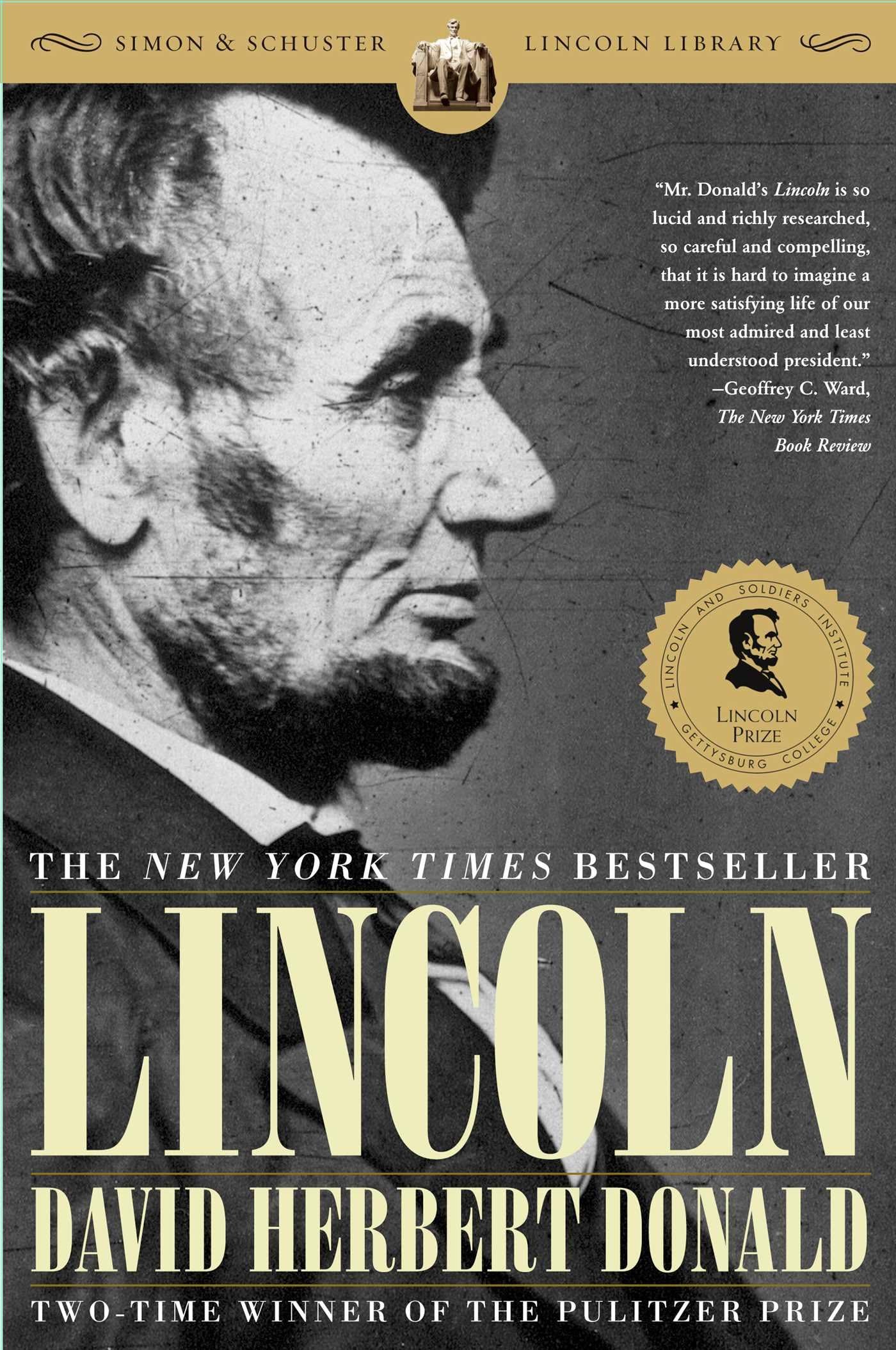
Lincoln
Desertcart purchases this item on your behalf and handles shipping, customs, and support to New Zealand.
Description
📖 Unlock the real Lincoln: leadership, legacy, and lessons that shaped a nation.
- RICH PERSONAL PORTRAIT - Discover the man behind the myth—his struggles, losses, and growth.
- MASTERCLASS IN LEADERSHIP - Explore Lincoln’s evolution from humble origins to moral presidency.
- COMPLEX POLITICAL NAVIGATION - Witness the art of balancing factions in a divided nation.
- UNFILTERED HISTORICAL INSIGHT - Experience Lincoln’s decisions as he faced them—no hindsight bias.
- CRITICALLY ACCLAIMED BESTSELLER - Join thousands who rate this definitive Lincoln biography 4.6/5 stars.
David Herbert Donald’s Pulitzer Prize-winning biography 'Lincoln' offers a masterful, nuanced portrait of America’s 16th president. Combining rigorous historical research with vivid storytelling, it reveals Lincoln’s personal growth, political challenges, and moral leadership during the Civil War. Praised for its clarity and depth, this bestseller ranks top in Civil War and political history categories, making it essential reading for history enthusiasts and professionals alike.
Specifications
| Dimensions | 6.13 x 1.3 x 9.25 inches |
| Edition | First Edition |
| Isbn 10 | 068482535X |
| Isbn 13 | 978-0684825359 |
| Item Weight | 1.85 pounds |
| Language | English |
| Print Length | 720 pages |
| Publication Date | November 5, 1996 |
| Publisher | Simon & Schuster |
Reviews
User
Donald's biography is a masterful telling of the life of one of our greatest presidents
David Herbert Donald's 1996 biography Lincoln has been called the best single volume Lincoln biography of the period. Though this is my first Lincoln bio, I'd be surprised to read a better. Donald does a fantastic job of making Lincoln come alive and allowing the reader to join the 16th president on the amazing journey that was his life.Donald's framing device is that the reader is presented with the information Lincoln knew at the time. This reduces the frequent historical tendency to second guess the subject, and allows you to more easily see things from Lincoln's point of view when he was weighing his decisions. A significant example of this is that the reader is not taken to any Civil War battlefields as bullets fly, but instead joins Lincoln in pacing the War Department telegraph office waiting for news, writing to McClellan urging him to make a move, or visiting Grant as he makes his plans for the final push. It's a simple but powerful biographical technique, and Donald does it very well.The book is split roughly evenly between Lincoln's pre-presidential life and his presidential service. Donald's coverage of Lincoln's early life is very interesting, effectively conveying Lincoln's poor origins and his varied early careers. His legal career is particularly well-covered, with interesting examples from his law practice demonstrated by specific cases he argued. His private life is also chronicled well, with his early romantic interests and courtship of Mary Todd all receiving their due attention. Lincoln's early political career is fascinating, as he moves from the disintegrating Whig party in helping form the new Republican party.Once the presidential years begin, the focus naturally shifts to Lincoln's execution of his public duties. As expected based on his premise, Donald doesn't focus on the battlefields or the goings on of the South, instead doing an excellent job of showing the juggling act Lincoln had to perform with the various Northern factions - Radical Republicans, Conservative Republicans, War Democrats, Peace Democrats; abolitionists, western states, border slave-holding states; incompetent generals, more incompetent generals, and finally Grant. Donald's presentation of Lincoln's masterful navigating of these difficult waters truly gives the reader a great appreciation for the challenges Lincoln overcame in holding the Union together. Donald does still touch upon Lincoln's personal life during these years, including difficulties regarding Mary, and the devastating loss of their son Willie.As I finished the book, I realized that, even knowing all along how it sadly must end, Donald had brought me so close to Lincoln that it touched me personally, as if I myself had lost a friend or mentor. I can only thank Donald for making that possible for someone almost a century and a half gone.I absolutely recommend Donald's Lincoln to anyone with an interest in American history. It is simply a masterfully told story of one of the most important people in American history at the most important Post-Revolution crossroads in American history.I was so impressed with this book that I plan to read Donald's Charles Sumner and the Coming of the American Civil War, which won the Pulitzer Prize and covers the radical abolitionist senator that was a leading voice during the Civil War, and who makes many appearances in Lincoln. I also plan to read other well-regarded single volume biographies of Lincoln, including Abraham Lincoln: A Biography by Benjamin P. Thomas (1952), With Malice Towards None: A Life of Abraham Lincoln by Stephen B. Oates (1977), and A. Lincoln: A Biography by Ronald C. White, Jr. (2009), each of which was heralded as the best Lincoln biography of their time. While I can't expect them to top Donald, I am eager to learn more about Lincoln, including how he's been viewed over the years.
User
Lincoln the man, not the myth
David Herbert Donald accomplishes with this biography the difficult goal of presenting Lincoln as a character at once thoroughly ordinary and exceptional. Although millions of words have been written about his subject, Lincoln remains shrouded in myth for many of us, but a reading of this fine biography parts those mists and reveals that the sixteenth president is not difficult to understand or relate to, onerous as his burdens may have been to bear.Donald's prose is as plain-spoken as the words favored by Lincoln, but that is not to say that it is ordinary. On the contrary: Donald's mastery of his subject allows him to write with exceptional clarity and admirable dispassion.While it is clear that on balance Donald greatly admires Lincoln, he never glorifies him. He is critical, for example, of Lincoln the Whig's occasional taste for demagogery in his partisan attacks on the rival Democratic Party early in his political career. In analyzing Lincoln's writings and speeches, he doesn't shy away from pointing out flaws and speciousness in their reasoning.The book is also valuable for its ability to present landmarks in Lincoln's career in a clearer light. The best example of this is the recounting of the famous series of debates in pursuit of a Senate seat between Lincoln and his primary rival of the time, Stephen Douglas. History, particularly as it is taught in high school, often presents these debates as lofty philosophical interchanges between the two on slavery, individual rights and the nature of liberty. Donald's careful analysis of each of the seven debates shows that while they contained moments of high drama and keen insight, they were all dragged down by petty attacks -- on both sides -- repetitive arguments and occasional poorly prepared remarks.Similarly, Donald points out a fact that is often forgotten: while Lincoln deplored slavery on moral grounds, he never believed that African-Americans were the equal of whites on any level. In fact, the author is quite critical of Lincoln's stubborn adherence to the idea that blacks could be relocated to Africa -- one that he held on to far longer than it merited, if indeed it ever did.The most intriguing and insightful portions of the book center on Lincoln's presidency, for which he was wholly unprepared, by his own admission. While many of us are aware in a general sense that Lincoln was under great pressure during his first term as a wartime president, Donald dramatizes the difficulties in great detail, bringing to life the nearly unbearable weight that Lincoln bore in trying to juggle the demands of a highly disputatious cabinet, a stubbornly unresponsive military leadership, and a Republican Party that was in many cases more hostile to him than were the Democrats.Lincoln's final success in bringing the war to a successful conclusion -- albeit at staggering human and financial cost -- is all the more satisfying and poignant for Donald's attention to the four years of disappointments. With the description of his death and the knowledge of the unfinished business that awaited his second term in rebuilding the nation, one is left to ponder more than ever what might have been had he not been assassinated.As a finely drawn portrait reveals something of its subject's inner life, "Lincoln," through its meticulous attention to detail, gives the reader a greater understanding of the man than any mere collection of facts could ever provide. Highly recommended.
User
Good but details don’t discriminate
There’s a lot in there, but when you give nearly the same page cover to the Gettysburg address as you do to Lincoln’s struggle to find a good postmaster general, you’re raising (or lowering) all details to have a similar value; for me, too much on the minutia and not enough on the on the value of certain aspects of his life. It warns you in the introduction that there’s not a clear value placed on things, and it delivered on that promise. Valuable from the details perspective, but not my favorite bio.
User
A Sweeping Panoramic Biography of America's Most Beloved President
This book captures the essence of this beloved American and one of history's giants. How fortunate America was to be graced by his guidance and leadership. After reading Ronald C. White's "The Eloquent President" and Gabor Barritt's "The Gettysburg Gospel" and Shelby Foote's encyclopedic 3 volume history (The Civil War) I found this book to be a beautifully rendered view of Lincoln's life through a wide lens and would be a great read for anyone who is looking to read one work that encompasses the key elements of this great American's life.This Lincoln biography gives a masterful sweep of Lincoln's life, describing how early in his life he demonstrated an enormous capacity for work and an intellectual superiority.These character attributes were key to his life as he rose from a poor family who eked out a living clearing virgin forest to establish a homestead, to a man who established himself as a successful lawyer, married the daughter of a successful Kentucky businessman, went on to serve in the Illinois legislature and made a national name for himself as he debated Stephen Douglas while campaigning for the U.S. Senate. Donald describes how Lincoln's political prowess led him to guide the fledgling Republican party in Illinois and how this catapulted him to the Presidency - the first Western man and Republican elected to that office.As Donald describes Lincoln's career up to the point of achieving the Presidency, he paints of a picture of a man who is confident of his intellectual abilities, is a leading citizen in the state of Illinois and has built a strong political organization. When elected to the presidency, Donald describes how Lincoln, who held no previous government executive office, grew into the role of the Presidency. He managed his talented and more educated but contentious cabinet with skill. He wrestled with the continual failings of the Union military leadership in the early battles of the Civil War,desperately looking for competent generals who could win battles as the Confederate armies won victory after victory while citizens of the North grew impatient with what everyone thought would be a short war. Lincoln also tested the Constitutional limits of the Executive branch when he suspended the writ of habeas corpus and instituted a military draft when not enough volunteered for the army.Donald describes the tremendous burden and toll on Lincoln as he steered the country through uncharted waters of rebellion while dealing with the the loss of a son (Willie) and the subsequent unraveling of Mary Todd Lincoln in her grief over Wilie's death. Lincoln endured this and more to save the Union, but the toll it took show starkly in the last photo of him taken in April of 1865, shortly before his assassination.
User
Excellently written. Not a hagiography but one can't help but admire the subject.
Donald's biography of Lincoln is considered among the best for good reason. It is enjoyable to read and one gets a sense that Lincoln is treated objectively.I found it remarkable just how severely Lincoln was opposed at times. Many of the Republicans wanted a new candidate instead of putting Lincoln forward for a second term! His honesty and integrity was never doubted, but his resolve and manliness was. How incredible. Lincoln's own humble ability to cope with all this criticism (though it of course took a heavy toll on him) is part of what makes him such a tremendous leader.I practically had chills as I finished the book. It ends the only way a Lincoln biography should. Read it (after you've read the rest, of course), and you will see what I mean. Brilliant writing. It simply let's the better-than-Shakespeare, real-life story tell itself.The one thing I found lacking about this book was a fuller and more accurate description of Lincoln's religious life. True, Donald does include an important encounter Lincoln had with his old friend, Joshua Speed, along with discussion of his thoughts on the doctrine of necessity. We don't, however, hear a word about the minister, Rev. Gurley, who had a significant impact on Lincoln until the very end, as he gives a prayer over the mortally wounded President.To make up for this lack, I recommend Ronald White's "Lincoln's Greatest Speech." White gives Lincoln's religious devotion its due. Even if some might think he takes such devotion a little bit further than it was in actuality, I think it serves as a good corrective to some treatments where that aspect of Lincoln's life is under-treated. White also has a biography of his own on Lincoln (A. Lincoln), though I have not read it.In spite of this one slightly under-treated element of Lincoln's life, I can only give the highest praise for what Donald has accomplished here.
User
An excellent resource on Lincoln with emphasis on subtlities of Lincoln
With over 4000 books, notes and pamphlets on Lincoln already in print, one would think what would this book add? Let me point out somethings that the author brings forward but was lost on majority of Americans then and even now! For example, Lincoln never recognized the "Cessation" since it was illegal under the Constitution. The book points out that Lincoln refers to them as "rebels" in nearly 400+ times in his speeches, articles and letters. In his view they were traitors and law breaking criminals. Under the law captured rebels could have been tried in criminal courts but due the generosity of Lincoln they were treated as POWs. This subtlety is lost on present day Southern politicians who put up statues of such traitors and criminals! Author points out one more subtle point that Lincoln's own military commanders missed. A general telegraphs Lincoln with "We have driven the enemy from our soil" To which Lincoln points out that "it is all our soil!" Since it was still one country after all!Throughout the book, reputation of Lincoln as "Honest Abe" and fair minded person comes through again and again. One particular item I was not aware of during my years of reading on Lincoln is his handling of American Indian uprising in Minnesota. The book revels that military tribunal had condemned 303 captured Sioux to die. Lincoln tries to delegate state judicial system to takeover but is advised that power cannot be delegated. He asks for the entire list with detailed charges. He goes through each name in detail. He comes up with names of 39 of the 303 that should die. He writes each of their names in his own handwriting and telegraphs them to military. He warns the telegraph operator to be extra careful since a slight error can send the wrong man to his death. This illustrates a noble man with best of the human instincts.Some minor suggestions for future edition. And epilogue covering may be 5 to 10 years after Lincoln's death would have been nice. As is the book abruptly ends with his death.An appendix of may be 4 or 5 of the major Lincoln speeches or correspondences would complete the book.
User
Lincoln
This meticulously researched book gives insight into the life and mind of Abraham Lincoln. I've always admired Lincoln; he's always been my favorite president. This book, for me, humanized him, and in so doing made me admire him even more.I'd never realized the political tightrope he navigated during his first presidential term as he struggled to hold the union together while at the same time balancing the differing political priorities of his senior advisors and members of his cabinet.For those today who insist that the Civil War was about state's rights, this book makes it absolutely clear that the root cause of the war was slavery.It's fascinating to see how Lincoln's beliefs about African Americans evolved over the years. From his early years when he supported settling the freed slaves in their own independent country, to the end of his life when he came to believe that the freed men deserved to be fully franchised citizens of the United States, Herbert does an excellent job of showing how and why his beliefs evolved.This is not a fast read, but it is a very interesting book. I strongly recommend it for anyone who is interested in the history of the USA or who follows national politics. It is very relevant today in light of all the political debate about Black Lives Matter.This book will stay with me for a long time and has made me even more of an admirer of Lincoln, the president and the man.
User
You can always tell a good biography by how you feel
You can always tell a good biography by how you feel. If you feel like you are in the action, maybe sitting in the corner watching the events unfold, then that's a great biography. Well, this book is a great in that sense. It makes you feel like you are part of Lincoln's personal and professional life and it's an absolute page turner. With the volume of books written about Lincoln you can go as deep as you want, this book isn't deep. It is rather complete though.
User
Buen producto
Buena calidad, buen aspecto, llegó impecable
User
Nice
Nice, very informative thick book
User
The great Lincoln
This came amazingly quickly considering it travelled all the way from America. It was in very good condition, just as described by the seller. A useful book, if you are interested in Lincoln and the politics of the day. In fact, even if you are not particularly interested in American history, this book in necessary to teach, and prolong general interest in this great man. Very well written. The author managed to create a successful balance between an honest factual account (such as is possible) and a pleasurable book to read.This deserves five stars for all aspects of this transaction.
User
Großartige und gut lesbare Darstellung
Das vorliegende Werk nimmt sich viel Zeit, die Entwicklung der Persönlichkeit Lincolns nachzuzeichnen. Im Vorwort nimmt der Verfasser den Leser schon dadurch für sich ein, dass er sich vor allem auf Originalquellen und nicht auf andere Biographien stützt. So nimmt die Zeit bis zur Präsidentschaft ungefähr 25 % des Umfangs (Kindle-Zählung) ein. Dem Leser wird dabei in keiner Weise langweilig. Zunächst ist man bestürzt über die einfachen und rohen Verhältnisse, aus denen Lincoln stammt. Er wird in einer Blockhütte in Kentucky geboren, die kein Fenster hat und kaum größer als 15 qm ist. Weil der Vater nicht erfolgreich ist, zieht die Familie nach Indiana weiter, wo man in ähnlichen Verhältnissen lebt, bis die Mutter an einer Vergiftung von Kuhmilch stirbt (die Kühe streiften damals frei herum und fraßen auch giftige Kräuter). Die Familie zieht weiter nach Illinois, wo die neue Stiefmutter Lincoln einige schöne Jahre bereitet (er hat ihr dies nie vergessen). Insgesamt besucht er in seinem Leben ganz verschiedene, improvisiert und nicht sonderlich professionell wirkende Schulen. Seine gesamte Schulzeit liegt bei einem Jahr. Jura bringt er sich selbst bei, nachdem er mit 21 Jahren das Elternhaus verlassen hat. Er studiert den Blackstone und wird von einem Richter in Springfield ohne Schul- oder Universitätsabschluss als Rechtsanwalt zugelassen. In diese frühe Zeit fällt auch sein Engagement für die Partei der Whigs, aus der später die von ihm mitbegründeten Republikaner entstehen. Der Autor zeichnet ein sehr lebensnahes Bild, scheut auch vor einer kritischen, aber gut begründeten Charakterisierung der Ehegattin Lincolns nicht zurück. Dieser selbst kam nicht als eine Art Heiliger in seine Ämter, sondern kämpfte selbst - häufig in der Sache auch erfolglos - gegen seine politischen Gegner mit harten Bandagen. Das berühmte Rededuelle mit Douglas wird sehr sorgfältig nachgezeichnet. Die Wahl in das Präsidentenamt erschien - gemessen an Lincolns Bemühungen um das Senatsamt - fast ein Kinderspiel. Die darauffolgenden Jahre werden differenziert und spannend dargestellt. Vor allem wird deutlich, wie es Lincoln in dieser Zeit gelang, durch sein Verhalten den bis heute bestehenden Ausnahmestatus zu erringen.Die Lektüre dieses Werks ist äußerst spannend und lehrreich. Man erfährt auf plastische Weise viel von den Zeitumständen. Der Circuit Court(!) etwa reiste als Gericht in einer festgelegten Tournee aus Richtern und Rechtsanwälten durch die Lande. Oft übernachteten alle Beteiligten im selben Raum. Lincoln unterhielt die Gesellschaft mit kleinen Anekdoten und Scherzen. Auf keinem überlieferten Portrait kommen sein Schalk und Humor zum Ausdruck. Dies gelingt dem Verfasser vorliegend umso mehr. Klare Empfehlung!
User
Even handed and thorough.
A very good telling of a man who is in my mind the most historically significant figure in American history. Easy to read, and very much a "just the facts" book. The United States cannot be sufficiently understood without studying Lincoln and the civil war.
Common Questions
Trustpilot