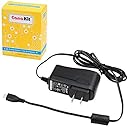
⚡ Power up your Pi with confidence — stability that keeps you ahead!
The CanaKit 5V 2.5A Power Supply is a UL Listed, high-quality adapter designed specifically for Raspberry Pi 2, 3, and 3 B+. Featuring a 5-foot cable with an integrated noise filter, it delivers a stable 5V DC output at 2.5A, ensuring reliable operation even under full load or overclocking conditions. Its robust build and certified safety standards make it the trusted choice for professionals and enthusiasts who demand uninterrupted performance.


| ASIN | B00MARDJZ4 |
| Brand | CanaKit |
| Color | black |
| Customer Reviews | 4.8 4.8 out of 5 stars (4,922) |
| Date First Available | July 31, 2014 |
| Is Discontinued By Manufacturer | No |
| Item Dimensions LxWxH | 3.75 x 2.75 x 1.25 inches |
| Item Weight | 0.01 ounces |
| Item model number | DCAR-RSP-2A5 |
| Manufacturer | Cana Kit Corporation |
| Power Source | Corded Electric |
| Product Dimensions | 3.75 x 2.75 x 1.25 inches |
T**C
Little expensive, works great
I recently purchased the Raspberry Pi 3 B+ Power Supply and I have to say that it has exceeded my expectations. While it was a bit more expensive than some other options on the market, the quality and reliability of this product make it well worth the investment. The power supply was easy to install and works flawlessly with my Raspberry Pi 3 B+. I haven't experienced any power issues or interruptions since I started using this product, which has given me peace of mind knowing that my Raspberry Pi is receiving the consistent power it needs to function properly. The build quality of the power supply is impressive, with sturdy construction and a sleek design that looks great alongside my other tech equipment. It's clear that a lot of care and attention to detail went into the manufacturing of this product. While it might be a bit more expensive than other options out there, the peace of mind and reliability it provides make it worth the extra cost. If you're looking for a high-quality power supply that you can rely on to keep your Raspberry Pi running smoothly, this is definitely a product worth considering.
M**S
Powers my favorite pi
Years later still going strong. Needed a few more pis, and looked for the same original canakit power supply I've been using for years, I mean why not, they are darn reliable even if they aren't exactly the cheapest option.
W**M
It's just right for my application as a DAC/preamp power supply
I wanted a power supply for a modest DAC that was a bit more power than the 10w supply I had at hand, and that [maybe] had a lower noise profile than some used in lighting applications. This appears to meet my requirements since I still can't hear any noise using this device, but I'm getting [I think] a small increase in DAC preamp volume.
A**Y
Appears to work -- Using with Raspberry Pi
Note: if laying the board on a desk, the circuit board should be at the top (where you can see the LED flash from time to time). There's a brief manual at the manufacturers (Nova) site. The recent smoke events in the NE US got me researching air quality sensors. My research lead me to learning about sensor components and then on to researching if I could use a sensor with a Raspberry Pi. I own a Raspberry Pi 3 which has been "resting" in a drawer for a few years... More research and I learned how I could use the Pi with this sensor. So, I ordered the sensor. I followed the directions I found and was able to get the system to work. I wasn't sure it was accurate, so last evening, as the AQI was rising, I put it all on my front porch and the initial reading just so happened to match the EPA sensor a few miles away. Good sign. The readings bounced around a bit, as I would expect and I brought it back inside. My purpose is to measure my inside air especially during outside smoke "events" to know what is happening and to measure if countermeasures (air cleaners, their location, etc) are working. As a test, I did run my vacuum cleaner near the sensor and it detected an increase in PM10. The increase in PM2.5 could have been a "rounding error." Finally, a comment about accuracy in more humid environments. As humidity increases, the amount of dust that can be suspended in air increases. Turn on the A/C, the dust in the air decreases because there's less water molecules in the air to support that dust. That this device is detecting less dust in the air after the A/C is turned on is a sign that this device is working.
C**S
IV Curve
The attached image shows measured IV curves for this power supply compared to a 2.0A power supply (Kootek). I generated these with a RPi-based IV curve tracer that I built for solar panels (search for "IV Swinger" on YouTube and/or GitHub if you're interested in knowing more about it). It's not intended for such small voltages, but it worked pretty well. The IV curves show the current (I) and voltage (V) for different resistances (R). This tells the story about how the supply delivers power for different loads (power = I * V). You can see that both supplies have an open-circuit voltage of 5.3V. That is the lower rightmost point. R = ∞Ω, I = 0A, P = 0W. The upper left points of each curve are the closest to R = 0 (short circuit) that we can measure (R = 0.94Ω due to wiring resistance). You can see that the Kootek delivers just about 3A of current and the Canakit delivers about 3.8A. But at this point both are way below 5V (below 3V, in fact.). An interesting point is where the curves cross their rated current values. The Kootek 2.0A supply crosses 2.0A at about 4.6V (2.0*4.6 = 9.2W). The Canakit 2.5A supply crosses 2.5A at about 4.5V (2.5*4.5 = 11.25W). Both of these are well below 5V. Probably high enough that the RPi won't crash, but cutting it close. Another interesting point is where the curves cross 5.0V. The Kootek 2.0A supply crosses 5.0V at about 0.8A (0.8*5.0 = 4.0W). The Canakit 2.5A supply crosses 5.0V at about 1.0A (1.0*5.0 = 5.0W). People who are claiming that this supply doesn't deliver 2.5A are correct - if they are expecting it to deliver 2.5A at 5.0V. But what is important is whether the supply is sufficient for the RPi 3. All I can say for sure is that it does deliver proportionally more power than a 2.0A-rated power supply that has worked fine for me with the Gen 1 RPi B+. For that reason, I'm giving it four stars. For anyone with specific voltage requirements at the rated (or other) current, you can read the values off the IV curve in my attachment.
A**R
the only raspberry pi power supply I use.
I use a lot of raspberry pi B for personal projects. this is the only power supply that doesn't under-deliver power. this one keeps up with whatever I do whether it is my radio hotspot or my streaming tv box. great little guys right here.
G**R
Works as expected
This power supply is good for the Pi Zero through the Pi 3B computers. Be aware that it does not provide enough power to run the Pi 4 or 5 as it only puts out 2.5 amps. The bigger Pi models take 3 or more amps to run properly.
C**N
Realmente no hay mucho que decir, cumple su función, a penas lo he tenido por una semana y en ese tiempo no he notado que se sobrecaliente.
C**N
Conforme à la description et rapidité de livraison
A**R
Wrong one I order
C**N
Para mi fue el adecuado, se dice que se puede utilizar cualquiera hasta el de un teléfono celular, mejor utilizar uno propio para la Pi.
T**A
El cable no es la gran cosa, lso materiales son normales y el desempeño, de a cuerdo a lo esperado, la parte imoortante a resaltar es que funciona correctamente el diapositivo, es decir, el raspberry tequiere de este voltaje para operar de manera correcta; y eso es lo que se obtiene. Me parece un poco costoso para la naturaleza y uso del accesorio, sin embargo comprendo que cumple unrequerimiento por demás específico. Llegó en tiempo y forma, Amazon Prime siempre ha sido confiable.
Trustpilot
4 days ago
2 months ago