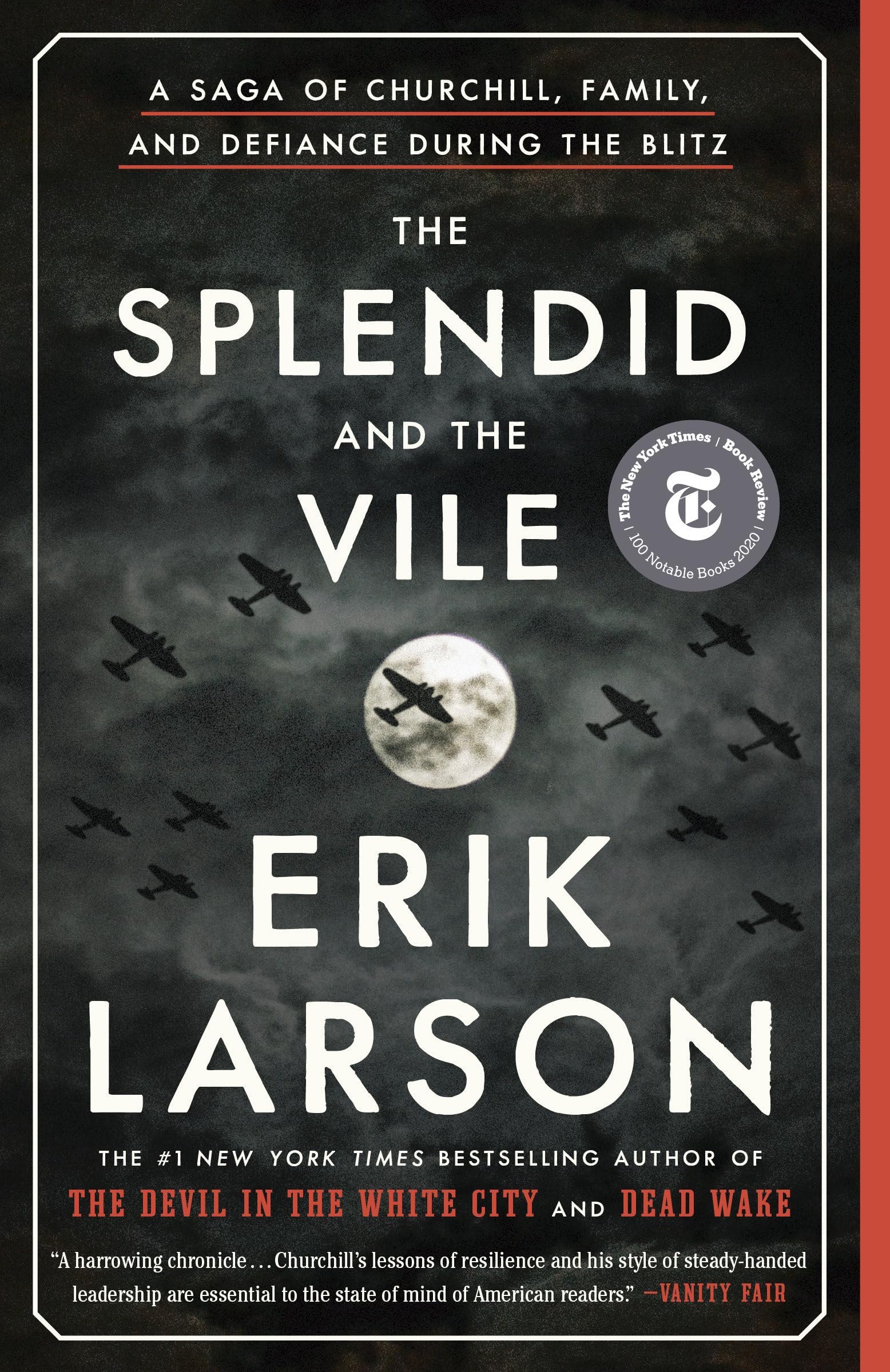
The Splendid and the Vile: A Saga of Churchill, Family, and Defiance During the Blitz
Product ID: 408376576
Buy anything from 5,000+ international stores. One checkout price. No surprise fees. Join 2M+ shoppers on Desertcart.
Desertcart purchases this item on your behalf and handles shipping, customs, and support to New Zealand.
#1 NEW YORK TIMES BESTSELLER • The author of The Devil in the White City and Dead Wake delivers an intimate chronicle of Winston Churchill and London during the Blitz—an inspiring portrait of courage and leadership in a time of unprecedented crisis “One of [Erik Larson’s] best books yet . . . perfectly timed for the moment.”— Time • “A bravura performance by one of America’s greatest storytellers.”—NPR NAMED ONE OF THE BEST BOOKS OF THE YEAR BY The New York Times Book Review • Time • Vogue • NPR • The Washington Post • Chicago Tribune • The Globe & Mail • Fortune • Bloomberg • New York Post • The New York Public Library • Kirkus Reviews • LibraryReads • PopMatters On Winston Churchill’s first day as prime minister, Adolf Hitler invaded Holland and Belgium. Poland and Czechoslovakia had already fallen, and the Dunkirk evacuation was just two weeks away. For the next twelve months, Hitler would wage a relentless bombing campaign, killing 45,000 Britons. It was up to Churchill to hold his country together and persuade President Franklin Roosevelt that Britain was a worthy ally—and willing to fight to the end. In The Splendid and the Vile , Erik Larson shows, in cinematic detail, how Churchill taught the British people “the art of being fearless.” It is a story of political brinkmanship, but it’s also an intimate domestic drama, set against the backdrop of Churchill’s prime-ministerial country home, Chequers; his wartime retreat, Ditchley, where he and his entourage go when the moon is brightest and the bombing threat is highest; and of course 10 Downing Street in London. Drawing on diaries, original archival documents, and once-secret intelligence reports—some released only recently—Larson provides a new lens on London’s darkest year through the day-to-day experience of Churchill and his family: his wife, Clementine; their youngest daughter, Mary, who chafes against her parents’ wartime protectiveness; their son, Randolph, and his beautiful, unhappy wife, Pamela; Pamela’s illicit lover, a dashing American emissary; and the advisers in Churchill’s “Secret Circle,” to whom he turns in the hardest moments. The Splendid and the Vile takes readers out of today’s political dysfunction and back to a time of true leadership, when, in the face of unrelenting horror, Churchill’s eloquence, courage, and perseverance bound a country, and a family, together. Review: Phenomenal Book - I found this book riveting and loved the multiple perspectives provided by the sources (letters, speeches, diaries). It is so well written and I learned so much I didn’t know about England in World War II. Highly recommend. Review: One Year in a Life - Winston Churchill was, arguably, one of the more extraordinary figures of modern British history. His life covered parts of two centuries wherein he was, variously, a journalist, politician, soldier, author and prime minister. Erik Larson’s “The Splendid and the Vile” focusses on a brief but compelling period of Churchill’s long life; namely, the first year of his prime ministership. By and large, this was a period of many failures as Britain (and its empire) stood alone against the Nazi threat. It was also the period when Churchill was at his most pugnacious. He was the man for the occasion. Perhaps no other Briton could have stood in his place. As a work of history, the book reads almost as a thriller. It certainly captured this reader’s attention…and held it! The book is an intimate portrayal of Churchill’s life. We are introduced to his family, his daily troubles, his failures and his (comparatively few) triumphs. If I was to find one criticism of the book it’s that the politics of the time was largely ignored. Clement Atlee receives only one mention and that on the book’s penultimate page. But this aside, the book is a riveting read and a significant addition to the seemingly endless library of Churchill books. Recommended.


| Best Sellers Rank | #7,724 in Books ( See Top 100 in Books ) #1 in U.K. Prime Minister Biographies #8 in World War II History (Books) #11 in WWII Biographies |
| Customer Reviews | 4.7 out of 5 stars 45,711 Reviews |
K**T
Phenomenal Book
I found this book riveting and loved the multiple perspectives provided by the sources (letters, speeches, diaries). It is so well written and I learned so much I didn’t know about England in World War II. Highly recommend.
A**D
One Year in a Life
Winston Churchill was, arguably, one of the more extraordinary figures of modern British history. His life covered parts of two centuries wherein he was, variously, a journalist, politician, soldier, author and prime minister. Erik Larson’s “The Splendid and the Vile” focusses on a brief but compelling period of Churchill’s long life; namely, the first year of his prime ministership. By and large, this was a period of many failures as Britain (and its empire) stood alone against the Nazi threat. It was also the period when Churchill was at his most pugnacious. He was the man for the occasion. Perhaps no other Briton could have stood in his place. As a work of history, the book reads almost as a thriller. It certainly captured this reader’s attention…and held it! The book is an intimate portrayal of Churchill’s life. We are introduced to his family, his daily troubles, his failures and his (comparatively few) triumphs. If I was to find one criticism of the book it’s that the politics of the time was largely ignored. Clement Atlee receives only one mention and that on the book’s penultimate page. But this aside, the book is a riveting read and a significant addition to the seemingly endless library of Churchill books. Recommended.
P**F
A Man in the Midst of War
This book traces a year, week by week, in the life of Winston Churchill. It begins when Churchill takes the mantle of Prime Minister and shoulders the burden of England’s war effort. As the year progresses, Larson traces the lives of Churchill’s family, closest advisors, and assistants while also keeping an eye on the actions of Goebbels, Goring, and Hitler. A primary focus is the bombing program against London. Larson keeps an eye on the logistics of Churchill’s life as well as those of the British war effort. He also invests a lot of attention toward the personal and social lives of these key players and makes extensive use of personal journals to keep the focus on the human impact of the war. The book helped to explain the development of technologies, ideas, and various conflicts. One thread that I found particularly helpful to trace was America’s involvement in offering aid to Great Britain. While week by week hundreds of civilians are being bombarded and dying, American aloofness must have been agonizing to Churchill and the British populace. Also agonizing must have been the wait for the Lend Lease Act to be passed. This act, which I had only known in name prior to my reading, allowed America to leverage its resources with repayment assured only for damaged property. Larson used the analogy of lending a neighbor a hose when his house is on fire. You don’t sit down and negotiate the terms and cost of hose usage, you give him the hose. Then, if it is burned up in the firefight, you can talk remuneration after the fire has been doused. So too would the Lend Lease Act make some of America’s resources available to our British allies. In reading the book, aside from specific actions on specific days, I didn’t learn much new information about Churchill. A great orator, indefatigable, an embracer of life, a drinker, a man with a temper, stalwart, a bit of an eccentric. Some interesting tidbits were sprinkled throughout such as his proclivity for working from the bathtub and the bed, but no deeper, heretofore unknown depths of character were uncovered. Having read two other books by Larson, Devil in the White City and Thunderstruck, I was glad to find a better organized story in this book. Chronology was clear and themes developed slowly but organically. Overall, I am left with a clearer understanding of Churchill as a man and military leader and a greater appreciation for the human impact of war. In the midst of truly prodigious bombing, the citizens of Great Britain carried on with their lives, withstood, endured. It seemed that every person, in one way or another, paid a terrible price and yet the result was triumph in the face of evil. GRADE: B+
J**Y
The bombing of England in the days leading up to United States entering the war!
As an American, I really didn't recall school history teachers talking about England prior to the U.S. entering WWII. Rightfully so I suspect because after all it was American History. But then again, World History classes didn't discuss the subject either. Erick Larson however with his very detailed style of writing, did a masterful job of describing the dire consequences England was facing during this period. Winston Churchill had just become Prime Minister and his army was fleeing for their lives at Dunkirk. The only good news was, not as many British Soldiers were killed in this evacuation as predicted. If one may call that good news. Mr. Larson really has the reader feeling how alone England really was in their efforts of defending democracy from the German Empire. Germany's Blitzkrieg rolled over Europeans with great ease and the soon realized vulnerable French, were now the only defense between them and the German army. The French had prepared for the invasion by building a massive line of impenetrable connected bunkers. Who knew the German army would just go around them. Shortly, the French negotiated a surrender with Germany and now there was no protection from being invaded. For the 1st year of Churchill's administration each and every day the British people were unnerved at the prospect of be invaded. The only thought Hitler and his staff didn't consider was resistance. Hitler mistakenly took the entire British Empire as nothing to be concerned about and with his advisors were convinced they could take England with their air bombardment followed up by a ground invasion. What i learned from this book is more about the resolve of the British people. For many days, several in a row, the clouds over England at night were full of bombers applying massive destruction to a historic empire. And yet, people went out to dinner, attended movies, plays and actually danced many nights away at local and regional night clubs. I'm sure there were people that stayed in bunkers, basements or what have you, but for the most part, people seem to treat the bombs as an inconvenience as they went about their work days. I really enjoyed the description by Mr. Larsen of Joseph Goebbels, one of the most powerful leaders of the Nazi party, as he painted his fingernails and dressed up in lavish outfits to attend public parties. There seems to be no denying that Churchill had is idiosyncrasies as well. Mr. Larson described how he enjoyed putting on his uni suit and marching around in front of his dinner guests to military marching tunes until way into the early hours of the following day. There were at times I thought perhaps too much ink was spent on Mary Churchill but then again, it sets the tone for what all British citizens were up to as well. I have read all of Erick Larson's books and as soon as I saw this one offered for a pre purchase via Amazon I clicked the order button with out even reading the bibliography. It's not my favorite Larson book, but by far not my least favorite. Very entertaining and causes one to reflect on some of the similarities we are all facing with this deadly Covid19 Virus. Treat yourself and buy this book.
A**Y
A Great Piece of History
"The Splendid and the Vile" has an ambitious goal: tell the story of "The Blitz," a period in which Germany bombed Great Britain with reckless abandon in a year that coincides with Winston Churchill's first 365 days as Prime Minister. Of course, a well-read person would know many facts dispensed, but the wide range of points dealing with family, personal finances, and military technology should provide some new insight. Based on the 1940 timeline, the reader receives an in-depth analysis of Hitler's rhetorical skills, FDR's immense popularity, and the alcoholism of Hitler's son-in-law, Randolph. Those who enjoy fiction more than nonfiction realize that Churchill's life comes off as too crazy to be accurate. People compare Winston's bold nature to rationalize the actions of some of today's aggressive and foolhardy leaders, but I doubt that history will be as kind to the recent crowd. The book accomplishes the impossible by desensitizing you to bombs as you hear of them dropping all over Great Britain. Since it has a specific timeline starting on May 10th, 1940, you experience the ebbs and flows of the Great War as the seasons change. You also learn a great deal about the United States as foreign policy dictates action and inaction in a time during which they more clearly defined allies and enemies. What attracts some to wartime biographers differs from person to person. Any trauma could frame a story. Those who condemn violence in any form would not enjoy a celebration of someone like Churchill, but one needs to consider him in the context of his time. The world knew that stopping Hitler would save our way of life as we knew it and needed a voice like his: confident, brave, and decisive. He made tough decisions at a time when we could not see alternatives. Francois Truffaut said that you could not make an antiwar film since filmmakers make the violence and combat seem fun. Here, you see a man, Churchill, who seems to thrive on the hustle and bustle of warfare to keep his people calm in a time of great strife. Author Erik Larson does a great job framing the bombing in the context of one man's first year on the job, providing a British perspective to stories of Hitler that we have never heard that way.
J**D
A Personal Account
The Splendid and the Vile is a recounting of the hectic first year of Winston Churchill's Prime Ministership, from May 1940 to May 1941. As I hope most readers already know, Churchill took office at a moment of extreme challenge for the British Empire, when Nazi Germany had conquered most of Europe. Over the next year Churchill guided his nation through innumerable perils, as bombs flattened cities and killed thousands while a badly outnumbered but valiant air force fought back against a seemingly all powerful foe. This is a tale which has been told many times before, but it always bears recounting, especially at the hands of such a masterly story teller as Erik Larson, who is well known for creating works of history that read like the most sensational fiction. Here Larson portrays Churchill not only as the indomitable war leader but also as a harried husband and father, dealing with a wayward son and daughter in law, a teenage daughter, a loving but mercurial wife, and a lifetime habit of lavish spending that his income could not support. Churchill the crafty diplomat and Machiavellian is also well depicted, especially in Larson's recountings of the Prime Minister's efforts to convince the US President (another Machiavellian) to bring his country into the war. We also get personal views of what life was like during the Blitz and the Battle of Britain from the memoirs and other accounts of countless numbers of ordinary Londoners, along with asides from the German leadership's own point of view. Larson's research is thorough, making use of archives in the US and Europe as well as many published accounts. His writing is vivid and colorful, with a keen eye for anecdotes like those recounting the amount of work Churchill did while soaking in bathtubs or when, shortly after Pearl Harbor during a visit to the White House, he had a lengthy conversation with FDR while nude. If after reading The Splendid and the Vile you would like to learn more about Churchill, Roosevelt, and the period,I can do no better than to recommend Doris Kearns Goodwin's No Ordinary Time and Lynne Olson's Citizens of London, Last Hope Island, and Those Angry Days.
K**H
bombs as aphrodisiacs
I’m such a fan of Larson’s books that I pre-ordered this one, and was not disappointed. It could be considered a companion to In the Garden of Beasts. Whereas that volume covered the lead-up to WWII from the perspective of the US ambassador to Germany, in this one we are immersed in the Battle of Britain as experienced by Churchill, his family and entourage. The author seems to have developed an admiration for Churchill while researching the WWI saga of the Lusitania for Dead Wake, and here he gives full vent to it. This bias is not a weakness of Larson’s work, it is part of his genius: he brings history to life with the character development, drama, and pacing of a novel. As usual, the detail is astoundingly meticulous, as is the footnoting. Wisely, he collects these at the end, referenced by page number so as no to distract form the narrative flow in the text. But as he hints in the Acknowledgements, these notes sometimes amount to a bonus with juicy easter eggs hidden within. The other device that makes this story, like the others, such a page-turner, is that it uses a chronological, diarized format. It follows events throughout the first year that Churchill is Prime Minister, and we are hearing the voices of those who were at the centre of it all. In case you are worried that all the death and destruction will be to too much to bear, it is interwoven and leavened by the romantic carryings-on of many in the cast, particularly Mary Churchill, Winston’s youngest daughter. Some of this can border on salacious, as no extra-marital affair seems to go unmentioned. Who knew there was so much shagging going on as the bombs dropped? In the end, that is part of what makes this whole saga inspiring: how ordinary people were able to cope with extraordinary, relentless adversity, and embrace life.
D**E
Churchill revealed
We all know how this turns out, but still hurry from chapter to chapter to see what happens next. The portrayal of Roosevelt is less than complementary, makes you want more to see where the truth lies. A worthwhile read.
S**O
masterpiece
A well written, interesting, and complete recount of Churchill’s first year as PM during the war. Erik Larkson goes into lots of very interesting detail, with s splash of humour that the novel enjoyable to read!
J**O
A so delightful book to read
I enjoyed so much to read. It has been a pleasure time to invest in this reading, I personally believe W.Churchill was a true leader that saves England to be defeated.
F**N
A Saga of Churchill, Family, and Defiance During the Blitz
May, 1940. Already weakened by failures in Norway, the successful blitzkrieg in Holland and Belgium sounded the death knell for Chamberlain as Prime Minister. Reluctantly King George VI offered the position to Winston Churchill, a man adored by the public although many of his colleagues thought him too erratic for the role. Larson sets out to tell of Churchill’s first year in power: holding British morale together during the Blitz; desperately working to build up British forces to defend against the expected invasion; battling to get America, even if they weren’t willing to put boots on the ground, to at least assist with money and equipment while Britain stood alone against the overpowering forces of the Nazi war machine. Larson is brilliant at bringing historical events to life so that it feels as if the reader is there in the room rather than reading a dry recital of historical facts years afterwards. Here he uses a variety of personal accounts to paint a vivid picture of Churchill through this dramatic period – primarily the diaries of his daughter, Mary, and his private secretary, Jock Colville, supplemented by various letters and memos between Churchill and members of his inner team. Larson also turns to contemporaneous reports in the newspapers and on radio, to show what people knew and how they felt at the time rather than through the lens of hindsight. It’s probably true to say there’s nothing startlingly new in the book, but Larson brings out the drama and emotion of the time without sacrificing factual accuracy and detail. Names from the history books become living, breathing people – Beaverbrook, Lindemann, Goering, Hess, et al – and we see their weaknesses and vanities along with their passion and commitment, whichever side they were on. The use of the word “saga” in the subtitle made me fear this might be too geared towards gossip about Churchill’s family, but in fact we learn just enough about them to get a feel for Churchill as a family man, and through Mary’s diary extracts we also get a picture of how the young upper-classes lived and played during this early part of the war, and how their attitudes changed and hardened as the dark realities of modern air-led warfare became clear. What Larson does so well, though, is to bring the lives of the mass of ordinary working people into the story, not simply as a kind of audience for the great and the good, but as real participants in their own fate. For this, he uses extensively the records of the Mass Observation project, where many volunteer observers kept diaries in which they recorded not just their own lives but their impressions of what was happening in their localities. We see London reeling and terrified after the first air-raids, but the Londoners gradually realising that they were brave enough to take it, and showing the resilience and defiance for which they are remembered. He shows a kind of euphoria developing, and a good deal of sexual licence on display, due to a growing eat, drink and be merry attitude. Larson takes us to Coventry to see the devastating raid there and its aftermath, and his description of this piece of history I already knew well is so vivid that he reduced me to tears and roused my rage anew at this mindless death and destruction. Back with Churchill, we get to know the people in his smallish inner circle and how they interacted. We are critical of all government ministers and of course they should not be above criticism, but we perhaps don’t cut them enough slack for the enormous responsibilities we expect them to deal with on our behalf. Churchill lived a life of comparative luxury, and rationing, which hit the general public hard, didn’t seem to make his table any less lavish, or his brandy to run out. But he worked such long hours his staff were permanently exhausted and he himself became ill (and worked through it), he had to tolerate and soothe the ruffled feelings of those to whom he delegated the impossible while still driving them to get it done yesterday, he regularly put himself in danger to show the public that he understood and shared what they were going through, he had to cajole and flatter the American president endlessly for very little return in the way of practical assistance; and frankly I didn’t begrudge him his smuggled cigars and chocolate, his extensive cellar, his extra meat provided by grateful landowning Dukes, even the money that was raised by supporters to help pay his household expenses. I suspect his poor entourage regularly wanted to beat him over the head with a brick, especially when he would put on records and start dancing round the dining room at 1 a.m. after a twenty-hour working day, but I’m glad they didn’t. Another excellent book from Larson, his trademark blending of historical facts with the personal building to give an intimate and affectionate portrait of Churchill’s personality and daily life as he led Britain through its darkest hour. Highly recommended.
C**A
A different perspective
This is a well told story with some new aspects that I haven't seen before. This is a story that has been told many times, of the events to knock Great Britain out of WW II using air power - The Blitz as it has been described. I've read a good number of books on this topic as well as most of the major sources around Winston Churchill. I was pleased to see a new view of the historic events described from a different perspective with several story arcs tying the facts to what people were experiencing. The story mostly focuses on those close to Churchill with some additional material from diarists and minor embellishment to the facts around some of the many lives lost - much more interesting to get some minor feel for a person than to learn of their death as another number. I enjoyed finding that the title comes from paraphrasing a diarist's entry and it was fun to find it and remember reading their memoirs many years ago. It builds on works previously published, using first source material and keeping the major events in place while adding a new look at some of the more mundane aspects of life to deliver a story that shows the ordinary and extraordinary coexisting against the backdrop of war. The sources, bibliography and index were excellent. Despite the many story arcs presented, I had no problem keeping it straight over the intermittent reading of the story. A very satisfying read.
J**K
戦争の本質を理解していたチャーチル首相と、戦争をヤクザの出入りと勘違いしてた東条首相
チャーチル首相が就任した1940年(昭和15年)から一年間のバトルオブブリテンを主題にしたドキュメンタリー。ヒトラー総統、ゲーリング元帥の元、猛威を振るったドイツ軍にただ一人最後まで抵抗したチャーチル首相。彼は戦争の本質を見抜き、米国を味方に付ければ、その工業力、資源力、そして国民数によってナチスドイツに勝利するとの確信を持っていたのです。翌年の日本軍による真珠湾攻撃の後、時のルーズベルト大統領からの知らせで翌日、米国は日本に宣戦布告をすると聞き、第二次世界大戦の勝利を確信し、喜びを抑えきれぬまま就寝したのです。当時の英政権、ドイツ政権の内情と戦況観が的確に描かれ興味深いです。一方で英国の貴族階級の常軌を逸した行動も描かれ英国王室を見る参考にも成りました。
Trustpilot
2 months ago
5 days ago