

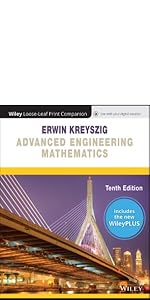
Advanced Engineering Mathematics
Product ID: 443703967
📈Includes advanced topics like Fourier & complex analysis
📚Comprehensive 6-part structure
🧩Rich problem sets for deep understanding
Desertcart purchases this item on your behalf and handles shipping, customs, and support to New Zealand.
📘 Unlock the math mastery that sets you apart from the crowd
Advanced Engineering Mathematics by Erwin Kreyszig is a definitive, six-part resource tailored for engineering, physics, math, and computer science professionals. It spans foundational to advanced topics including differential equations, Fourier analysis, complex analysis, and statistics. Praised for its clear, informal teaching style and thoughtfully crafted exercises, this edition also offers a Kindle format that maintains textbook integrity, enhancing digital study efficiency.



| Best Sellers Rank | #409,917 in Books ( See Top 100 in Books ) #1,310 in Applied Mathematics #40,658 in Higher & Continuing Education Textbooks |
| Customer Reviews | 4.0 out of 5 stars 184 Reviews |
M**L
My experience, advice, and the Kindle Edition
When I was in school I disliked this book. Looking back, I realize I just had the wrong approach to it. Now that I've taken my studies into my own hands, I'm no longer bound by the textbook choice of my professors. Consequently, I've looked through a lot of different books (though certainly not all) to find one I liked the best. I was both surprised and delighted to settle on Kreyszig's book. What I like about Kreyszig's teaching style is that he doesn't (typically) leave anything out. He's very good at providing the motivation for things, so you have some idea of how you might arrive to the mathematical developments on your own. His writing style is moderately informal, which I enjoy for how it gives further insight into how the material can be understood. And he typically moves along at a pretty good pace—at least, one that I'm personally comfortable with. But if I try to understand everything on my first read through a section, I wind up confused and dazed. I have to be willing to leave some ideas unsettled and trust that he'll address them later—and as far as I've seen, that trust has not been in vain. My earlier problem with the book was that I would get to a place where I didn't understand it, where I got lost, and I just stopped reading any further or spent a tremendous amount of energy trying to figure out what I couldn't understand. Well, that's not the way to read Kreyszig's book, and so I hope this review can save some people that trouble. You just have to allow him to develop the idea completely and not stop for questions until you get to the end of the section—then re-read or skim through the section's problems to see if that might help clear things up. I also really like the exercises and problems he has in this book, which is rare for me because I hated doing problems when I was in school and felt like I was wasting my time. Kreyszig has a good way of asking you to consider why he might be asking you to do a problem, and to get you to see extensions and interconnections of ideas. So I never feel like I'm wasting my time with his problems; I feel that there are valuable gems to be found in them. All in all, out of all (of the limited set) of textbooks that I've looked at, I think I trust and enjoy Kreyszig's the most for my personal education, because it seems just about everything is there if you're willing to consider all the material he presents. He's good at showing you where you came from and where you might be going with the material in the future, and develops ideas in an informal enough manner that it feels more like sitting in a professor's office for a genuine and candid discussion of the subject, rather than sitting in a boring and disjoint lecture. His book doesn't seem to suffer in the way that some textbooks do by making the reader think there's only one way to develop an idea. (As an aside, I sometimes prefer Apostol's Calculus for how he discusses and develops ideas honestly and candidly, but at the end of the day I keep going back to Kreyszig for my primary reading.) I would encourage anyone who dislikes this book to take a step back and reconsider, as I have. Regarding the Kindle edition, I actually really like the Kindle edition of this book. Unlike a lot of Kindle books, it's presented in a textbook format where a page is a page—the text isn't free-floating and doesn't suffer from continually being rearranged spatially at the whims of a text engine. This helps me a lot in studying because I can maintain a spatial awareness of where some material is, much like an actual textbook. I've found this to be nearly invaluable for complex subjects. I have a regular sized iPad and it works nice for this, but I can imagine that it would be a little more difficult to read on an iPad mini or any tablet of similar size. It's also a very beautifully done textbook, in my opinion. I hope this helps!
G**N
Maths book
Cuprinol, does what it says on the book
G**I
Bad paper and print quality
Paper and print quality are too bad.
C**N
Excelente referencia de las matemáticas posteriores al cálculo.
Un texto completo y acorde de modelado y aplicaciones de las matemáticas posteriores al calculo a problemas de ingeniería, siendo su aspecto didáctico y metodológico muy apropiado para la enseñanza autodidacta.
Q**W
Parfait
Parfait, une fraction du prix pour le même livre vendue en université
Trustpilot
3 weeks ago
3 days ago