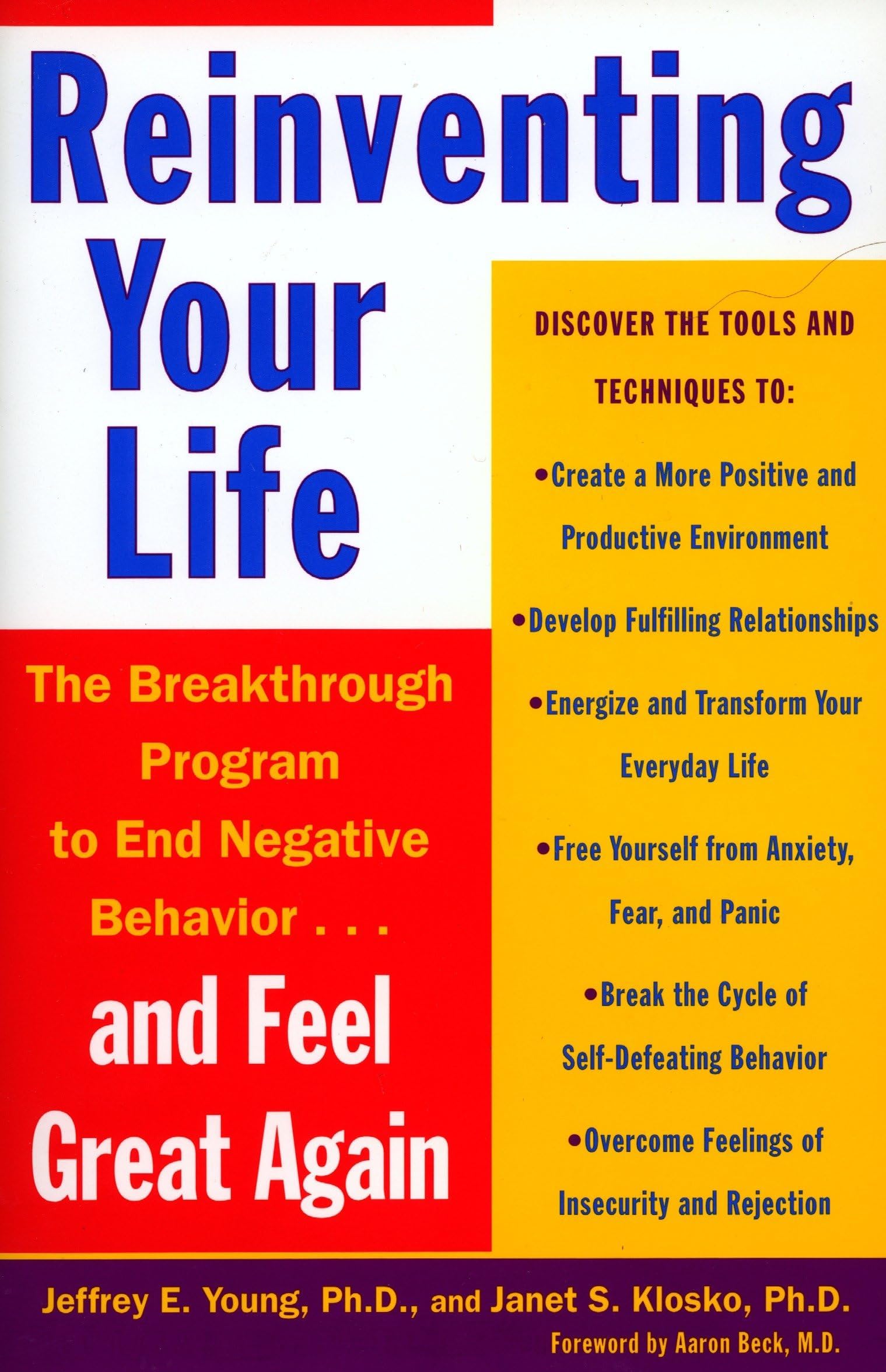
Reinventing Your Life: The Breakthrough Program to End Negative Behavior and Feel Great Again
Product ID: 6383268
📊45 in Cognitive Psychology - top niche rank
📚3,365 reviews - trusted & proven
🧠Schema Therapy-based - clinically grounded
Desertcart purchases this item on your behalf and handles shipping, customs, and support to New Zealand.
🧩 Decode your mind, redesign your life — don’t miss the breakthrough everyone’s talking about!
Reinventing Your Life is a bestselling, clinically grounded self-help book by leading psychologists Jeffrey E. Young and Janet S. Klosko. It uses Schema Therapy to help readers identify and overcome lifelong negative behavior patterns ('lifetraps') through personalized surveys and practical cognitive-behavioral strategies. With over 3,300 positive reviews and a top rank in Cognitive Psychology, this book offers a multi-faceted approach to lasting personal transformation.
| Best Sellers Rank | #104,949 in Books ( See Top 100 in Books ) #52 in Cognitive Psychology (Books) #121 in Self-Esteem (Books) #157 in Post-Traumatic Stress |
| Customer Reviews | 4.6 out of 5 stars 3,374 Reviews |
A**R
Sometimes painful to read, but one of the most insightful books you will ever read
Let me start by saying that I've read dozens of self-help books, been in therapy for 4+ years throughout my life, have a Bachelor's in Psychology and did research in a psychology lab for over a year. In other words, I'm pretty familiar with psychology and the way the brains learns. With all that said, **this is one of the best psychology books I've read** (I'd put it above Firestone's "Fear of Intimacy" - both seem to talk about the same issues of schemas but in different ways). This book has provided case studies that reflected my own life, distinct lifetraps (or schemas) that help categorize my issues, and examples of origins that explain when, how, and why these schemas developed in me. I have zero doubt that anyone who reads these pages will not benefit tremendously in their day-to-day functioning afterwards. This book is still 100% a 5-star read for me. The only two downsides are that 1) the book is a bit outdated. However, you can get a pretty good look at your life's history through these pages and look up some more up to date info on schemas/lifetraps online. 2) If your problems are minor (as some of mine are), the book offers solutions that can probably fix those. However, if your problems are deep (as others of mine are) the solutions offered by the book alone won't be enough to fix your problems. I will be in therapy, no doubt. However, the insight it can provide leads you to understand why you are the way you are - a gift I think any of us would cherish and I certainly will. This book's insight has taken the blame, guilt, shame, and self-hatred out of my life that I've carried around for so long for so much of what I have done. There are not many gifts that can surpass a feeling such as that. Buy this book, read it, understand your life, see the reasons why you are the way you are more clearly, and be kinder to others and yourself as a result.
W**S
Effective & Multi-Purpose Self-Help Book
Self-help books tend to be very broad (e.g., self-esteem) or very specific (e.g., depression, panic attacks). Not that this is a problem in itself, but what if your problems seem to float in between these extremes? Moreover, what if you are not entirely sure what your "issues" are, except that you do not like the way your life is going, are struggling in different areas--from relationships to work--and stumped as to where to put your finger on the problem? "Reinventing Your Life," which is based on Jeffrey Young's Schema Therapy, is the all-purpose, or should I say, multi-purpose book for your needs. The first 5 chapters provide the background and theory to understand your problems (what the authors call your "lifetraps") and then provide surveys to help you identify which lifetraps are interfering with your life. After this background theory section, you then only have to read the relevant chapter as each chapter is devoted to a specific lifetrap. Near the beginning of each lifetrap chapter, there's a survey to help you identify the degree to which the lifetrap is interfering in your life. The chapter then goes on to give you specific strategies with which to overcome your lifetraps. In some cases, the authors do recommend therapy in addition to self-help work as the more severe the problem, the more likely a therapist would be helpful. Now you may be wondering, "What is this lifetrap business all about?" A lifetrap can be defined as a pattern of thinking, feeling, and behaving (i.e., personality pattern) that has its origins in childhood and is a result of something that was done to us by our parents/caretakers (e.g., over-protection, harsh criticism, physical or sexual abuse, emotional neglect). Lifetraps cause us to become stuck in a repetitive pattern of interacting with others and the world that, time after time, get us into trouble with relationships and/or work. In short, life-traps lead us into self-defeating behaviour that blocks us from fully realizing our potentials and living a happy and successful life. Some of the common lifetraps the authors identify are called Unrelenting Standards (i.e., excessive self-criticism/perfectionism), Mistrust and Abuse, Abandonment, and Social Exclusion. I will briefly describe a few of them. The Mistrust & Abuse Lifetrap involves having a general distrust of others, which interferes with closeness and intimacy, but at the same time, also having a tendency to get involved in abusive relationships. The Unrelenting Standards Lifetrap involves harshly criticizing oneself when not achieving one's goals. Because this lifetrap involves perfectionistic standards (i.e., unattainable goals), this makes it easy for your inner critic to walk all over you when you "fail." You can check out the Table of Contents to see the full list of lifetraps. After coming to a full understanding of your particular lifetrap(s), each chapter then describes specific strategies to help you overcome your self-defeating pattern. To help change unhelpful thinking patterns, rational challenging of your thoughts (a cognitive strategy) and evidence-testing of your beliefs (a behavioral strategy) are suggested, which are based on the idea that changing your thinking and behaviour will change how you feel. One specific cognitive method is to write reminder/coaching cards to yourself. For instance, you could write rational statements that prepare for when you get into a situation you might get into trouble. For instance, let's say you are prone to harsh self-criticism before a high-pressure situation (e.g., a demanding work project). In your mind, if you really attend to what's going on mentally, you may notice such harsh self-talk such as, "You suck!" and "You know you'll fail!" These statements may leave you feeling inadequate, anxious, and unmotivated. Before starting the project, though, you can pull out the coaching card to help you challenge such critical thoughts and get you in a rational head space and more emotionally energized to work. In addition to cognitive and behavioral strategies, the authors also offer experiential strategies. As a psychotherapist, I have used this book with clients and will continue to do so. A person who is committed to changing and willing do the hard work will benefit greatly from its strategies.
G**S
This book will shake your core.
As someone who’s done a lot of inner work the past few years I cannot overstate the importance of this book if you suffer from or were raised by adults who suffer(ed) from personality disorders. Although I’d reached a place where I was mostly able to transcend my negative thinking and way of viewing the world, this book finally explained to me how my childhood conditioning poisoned every thought formulated by my personal mind. And this knowledge allowed me to have ever more power to let negative thinking, guilt, shame, insecurity and rejection fall away. This book is helping me heal on an even deeper level than meditation, talk therapy and spirituality because it speaks directly to the cause of each issue I suffer from. This book is not for the faint of heart. In reading this you will be asked to look deeply into a mirror and forced to reckon with the truth about who you’ve become. But the authors guide the reader with love and compassion. There truly is nothing to fear if what you seek is actual self-realization, self-compassion and self-love. Good luck to everyone on this path. It’s the most important work we will ever do. Namaste. 🙏 ✨
S**S
Insightful, but lacking...
Reinventing Your Life is an insightful book that can help one to determine self destructive patterns that may have emerged in early childhood and continue to cause havoc in your adult life. The different "lifetraps" as the author calls them are poor behavioral patterns that an adult can get stuck repeating, which can lead to absolute misery in relationships, work, and family life. There is a test early in the book to help you determine which lifetraps may apply to you, and then a chapter devoted to each of them that goes into further detail. Overall, I liked the book. I gained some insight into some of my own negative behavior patterns, and it certainly gave me some things to think about as far as relationships! With a foreword by renowned psychiatrist Aaron Beck, the book held great promise for insightful psychological breakthrough. I enjoyed reading about the different lifetrap patterns and how each could be unknowingly cultivated in a child by parents who are either absent, addicted, or well meaning and just uneducated. Young and Klosko go into great detail of childhood origins of each behavior pattern, giving examples of each and an anecdotal story of how some of their patients (of course with privacy protected) learned to overcome the self defeating behavior. The book was an easy read, used little medical jargon that was not well explained to the layperson, and will get you thinking. All that being said, there were some negative points, as to why I felt it only earned 4 stars. For starters, the information can be somewhat dated. The book has a copyright of 1993, so some of the interactions and anecdotes are not as applicable to the current world. That in of itself, however, is a minor flaw. The biggest issue I had with the book was the fact that there were just not enough time and words spent on how to fix the behaviors and how long that was going to take the average person. While a list of steps to take to remedy the behavior was presented with some explanation, I felt that wasn't enough to really assist a person in making drastic changes in thinking and interaction patterns without a professional therapist to assist. Therapy is great, but the point of a self help book is to help yourself, so they could have spent some more time explaining just how to implement these recovery steps and give more detail into how each of the examples did so in their lives. Compared to the amount of information provided on childhood origins (which provide great insight, but that is only half the battle), I think the implementation of change sections were lacking. In the end, I do recommend the book for use with your therapist in helping to determine and solve some self defeating behavior. I'm a huge fan of education and self improvement, so if you enjoy the same, this book might be worth your time to check out.
E**N
The most insightful and effective bibliotherapy…
I can’t praise this book enough. I do believe that this book is the first step to healing and changing unhealthy thoughts and responses. It is quite painful to realize how damage I am yet so enlightening to find reasons why. Most of all, it is motivating that healing is never impossible… I’m grateful for the brilliant minds and hopeful hearts of the authors.
A**A
I love this book
Very helpful, insightful, educational, and informative in switching from harmful patterns to healthy patterns in your life relationships.
C**I
Life Changer for real
I've been buying copies of this book for all my friends (and reading all related materials) for a while now. This is the first time in my life where i've found a really usable and practical tool that can help put some order inside the chaos of yours and others maladaptive actions / thoughts / magnets. Many times we all know that people does things because they had traumatic experiences in their past... Sometimes we may just think they are jerks because is way to complicate to get what is going on with them. Sometimes people hurt us but we can't get closure out of it because we don't know if it was our fault. Sometimes...you lose the control of yourself, you are in emotional situations you can't control. This book helped me make sense of it, regain control of myself and help other people regain control over themselves. If you are suffering because a love, a loved one, YOU MUST BUY IT...will save your life. A MUST read if you or a loved one is dealing with bpd or npd.
J**N
Outstanding and Applies to Almost Everyone
I am a psychologist who first read this book about 10 years ago and have purchased well over 100 copies of it to pass on to my clients. A few of them refer to it as their emotional bible or their behavioral bible. Many therapists adhere to cognitive-behavioral therapy which is empirically proven to be effective. However, many cognitive-behavioral therapists discount early learning history, perhaps b/c it's too much like psychoanalysis or psychodynamic therapy which has limitations in that there are no tools that are taught and it is known for often taking many years to heal. Schema Therapy (the therapy that Jeffrey Young, one of the authors of this book, has developed) takes the best of both worlds integrating traditional psychotherapies, with experiential methods, and cognitive-behavioral methods. It explains how we learned the unhealthy patterns (they call Life Traps) we have carried from childhood into adulthood, gives us advice on how to process the emotions experientially, and gives us tools that are helpful in overcoming the patterns. My only criticism about this book is that they blame the parents a little too much, when sometimes there are other experiences in childhood or even in earlier adulthood that bring about these life-traps. For that reason I give it 4 and 1/2 stars instead of 5 so I rounded up. If you are looking for a light read to help you manage stress without taking time out of your day in such a way that you can actually become more productive, have more energy, and greater balance try reading Active Relaxation. Active Relaxation: How to Increase Productivity and Achieve Balance by Decreasing Stress and Anxiety
F**O
Consigliato come punto di partenza
Per chi si trova un po' sperduto e alla deriva è un ottimo libro da iniziare come percorso di introspezione.
R**L
I've never read a book like THIS!
For the first time in my life, I got touched with the DEEPEST human misery. And it's not related with 'war, robbery, natural tragedies'. It's EVERY DAY suffering! I feel 'in debt' with the authors, for their extreme sense of humanity!
T**T
Life changing!
Everyone should read this book. It teaches you, in detailed steps, how to identify the specific patterns and circumstances that keep you trapped in unfulfilling aspects of your life.
M**9
Quality !
Good cover considering it’s a paper back. Haven’t read the book itself.
S**L
Excelente
Ayuda al autoconocimiento y entender porque ciertas situaciones de la vida nos afectan.
Trustpilot
2 weeks ago
2 days ago