We remain fully operational. Our teams are working around the clock to ensure your deliveries continue safely.

DOWNLOAD THE APP


Copyright © 2025 Desertcart Holdings Limited
DOWNLOAD THE APP
Buy anything from 5,000+ international stores. One checkout price. No surprise fees. Join 2M+ shoppers on Desertcart.
Desertcart purchases this item on your behalf and handles shipping, customs, and support to New Zealand.
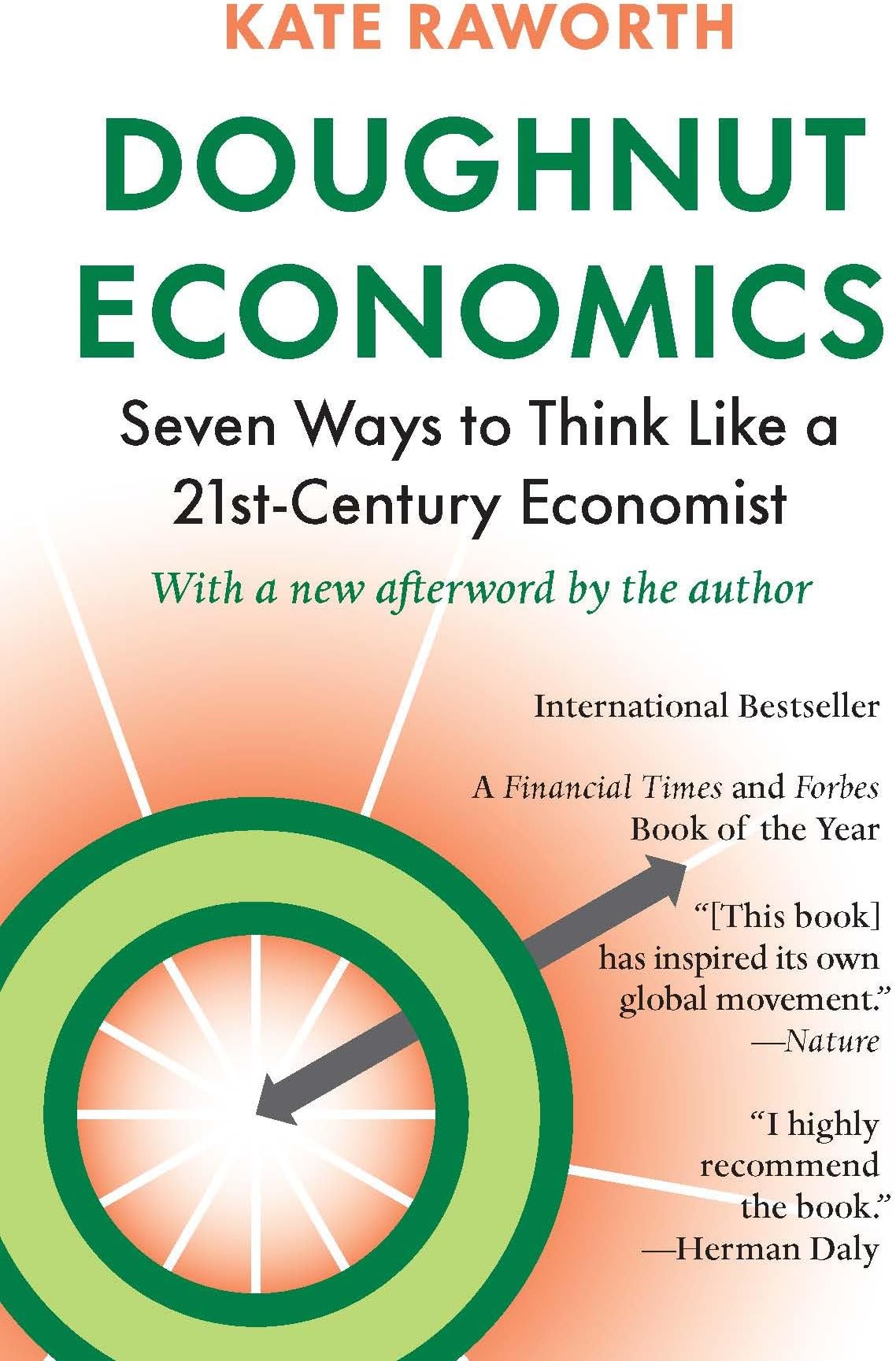
Doughnut Economics: Seven Ways to Think Like a 21st-Century Economist [Raworth, Kate] on desertcart.com. *FREE* shipping on qualifying offers. Doughnut Economics: Seven Ways to Think Like a 21st-Century Economist Review: A Must Read for All Concerned About Environmental Sustainability and How to Get There - A must read. One of the most important books on environmental sustainability. Have you wondered how public policies that stress unending GDP growth can square with a sustainable future for humanity: How can we grow indefinitely on a finite planet with definite ecological limits – several of which have already been breached? What is the economic theory behind such GDP growth policies? Is this economic theory valid as we reach the limits of growth? And if not, what sort of economic system do we need to build a sustainable future? Kate Raworth’s Doughnut Economics (DE) dissects the assumptions and implications of neoliberal economics – the economic theory that underlies GDP growth-focused public policy worldwide. DE demonstrates how its assumptions are not valid in a bounded world with a limited “ecological ceiling” – the earth’s ecological carrying capacity. DE’s exposition of today's economics is absolutely revelatory yet accessible to the non-economist. Having thus set the stage, DE proposes seven ways to think like a 21st century economist, starting with changing the goal from GDP growth to moving into “the doughnut”, the safe and just space for humanity bounded by the ecological ceiling of planetary pressure – the earth’s carrying capacity – and by the social foundation of human well-being. Raworth’s proposal for 21st century economics draws on an amazing array of research and insights from diverse fields, including physics, systems thinking, sociology, psychology, sustainability, and economics. There is much work to be done but Kate Raworth’s Doughnut Economics provides an invaluable foundation. Review: As a trained economist, hardened corporate warrior, and a father, I say you can't NOT read this book - This is an incredible book, but what is most incredible of all is that after ten months of availability it currently ranks 40k+ in desertcart’s sales ranking and has only 40 reviews. That still puts it in the top tier of books, mind you, but this book should be in a tier by itself. It is truly transformative. (I only discovered it due to a comment written in response to the review of another book.) Kate Raworth, who trained in economics at Oxford, has never quite felt comfortable in her chosen field of study. And for good reason. The neoliberal economic model that has guided us for the last three or four decades, based on fundamental assumptions that pre-date us all by several generations, are not so much flawed as they are misaligned, to the point of actual destruction, to the social, economic, political, and environmental world in which we live the 21st Century. As an economics major myself back in the 1970s, and a corporate warrior who lived, breathed, and trusted the neoliberal creed for four subsequent decades, I am both an unlikely and uber-supporter of Raworth’s perspective and ideas. The markets and the consumer are decidedly not efficient; as every leading economist has assumed but every businessperson knows is bullocks. If they were, strategic planning would be a lot more straightforward and companies would be a lot more consistently successful. Companies would not have to constantly reinvent themselves, the turnaround experts and bankruptcy attorneys would have little to do, and investors could take long holidays on the private islands they could easily afford. The resources we rely on are not unlimited. Why are we arguing about the science of climate change? Look around, and if you still don’t see it, sit down and take an inventory of the resources you personally consume and plot it against whatever happiness index you like. The imbalance, you will quickly conclude, is absurd. I lived as an ex-patriate industrialist in a part of the world where you could not drink the water or, on many days, breathe the air. On both counts I am being quite literal. And I can tell you that on both counts nothing else matters. Now back in the US Midwest I can tell you both that I continue to pay the price and that our collective attitude here in the developed world toward these issues is conscious but dismissive. In short, we have been spared true understanding in the same way the blind are spared having to look at the ubiquitous “comparative selfie” that seems to be the single most transformative accomplishment of social media at the moment. We do not assign value to the economic inputs and the assets that really matter. There is no place on the balance sheet for engagement or innovation, and nowhere is there an accounting for shared (what Raworth calls common) assets, like safety, education, infrastructure, the country’s defenses, etc. We’re measuring well-being by the quality of the creases in our trousers. I could go on, but there is no need. Raworth has already completed that task. Which is why this book should be required reading for every adolescent in every corner of the world. The universe is interconnected in ways that we have known, but largely ignored, since the beginning of time. We see the world in a linear framework that reflects and reinforces our deductive worldview in which logic and reason progress from left to right and down to up. Our top is where our smarts reside. Our backs contain the backbone that carries the weight of our ever-extending bellies (mine at least). Nowhere in economics has this been more obvious or more damaging to our long-term interests than our pre-occupation with economic growth. It’s not an assumption, really. It’s a necessity. As we’re reminded daily, we need economic growth to keep people employed and wages rising. Without new air going in each and every moment, the balloon deflates. Doesn’t that mean, however, that at some point the balloon reaches its innate capacity and ultimately bursts? Raworth’s perspective is spot on and the writing is excellent. She has an obvious knack of distilling what may at first seem complex down to the simple and straightforward without losing anything in the translation. I think of the debate in more personal terms. We currently see our world through a very individual-centric lens. In economics, as Raworth covers here, the macro exists to serve the micro. In politics we are motivated by individual rights and freedoms. In medicine we focus on individual health and well-being. Even in psychology we are absorbed with personal happiness and personal measures of purpose and contentment. The result is that our political, social, economic, and even religious spheres of influence operate in independent isolation. And that was okay in the past since there were far fewer of us, resources were in abundance, and we lived and acquired information and knowledge in a largely local ecosystem. But technology, population growth, and constant advances in science have changed all that. Those spheres are now completely inter-connected. Social media drives politics. Politics drives social identity. Economics drives social injustice. The need for security impinges religious freedom. Raworth’s donut is the perfect visual analogy for the need to think less in terms of absolutes and more in terms of balance. I also think of it in terms of balancing the deductive Western worldview with the more inductive Eastern worldview. Most importantly, we must learn to think in terms of “we” rather than “I.” All of our systems of influence, from the political to the economic, must be transformed to promote collective balance rather than individual hegemony. In the last sections of the book, Raworth addresses the question of the era: Can the plane of economic growth, as we currently define it, continue to soar ever upward; must it level out, and if so how do we fulfill our economic expectations; or is it time to land and make do? As with the rest of the book Raworth does the conundrum justice and lays out all of the options thoroughly and with clarity. I think there is only one element that is not missing, but perhaps deserves more emphasis. We continue to treat economics, politics, philosophy, sociology, psychology, and the hard sciences as distinct and discrete spheres of knowledge and influence. With advances in technology that have entirely transformed all aspects of our lives, that is simply no longer possible. We must take a page from our leaders in science who are quickly integrating all functional disciplines into, essentially, one. That is how the universe ultimately works. One of the arguments for pushing the plane higher and higher is the recognition that democracy, as we have known it, will die if we don’t. It is, however, already dying, if not already dead. The democratic justification for growth, in other words, is a specious argument. We must redefine what it means to be free. To borrow a page from Darwin, none of the current disciplines will give up its identity quietly (With perhaps the exception of philosophers, who have largely given up or gone into hiding. Sadly.). Each will fight to the death to preserve its own privilege. It’s a bit like the game of Jenga. Who goes first? I won’t say Raworth would endorse this priority but she certainly makes the case for it. I think the first to go has to be the notion of shareholder supremacy. It is an anachronism of the most abusive kind, positing, as Raworth notes, employees as the ultimate outsiders looking in. It’s an unsustainable model. And it’s pure fallacy. To say that today’s investors own our corporations is like saying that the gamblers own the casinos. (At least in the case of gambling, the gamblers at least set foot in the casino.) As in the case of poker, the gamblers may own the pot, but not the cards, the table, or the dealer. And, as Raworth futher notes, changing the perspective will require a complete transformation of the process by which we currently manage our largest corporations. So be it. If it doesn’t start there, I don’t think any of the other transformative needs are feasible. Beyond that I believe that the only viable option for transformative change is to address the problem from the consumption and expectation side of things. We just don’t need all of this “stuff” in order to live fulfilling lives. We can and should live much more locally. And technology has given us the perfect opportunity. What really matters in life is to think and dream globally and the Internet has given us that opportunity at next to zero cost. The next step should be an easy one although no gambler ever got rich betting against the power and resilience of those entrenched interests who wish to protect the status quo. (Which is why our politics are such a mess.) At any rate, this really is a great book and I do hope we can collectively push it to the top of the bestseller list where it belongs. It’s a discussion we need to have, not just with our economists, but with our children, our colleagues, and our loved ones. (Not to imply we don’t love our children.)


| Best Sellers Rank | #30,381 in Books ( See Top 100 in Books ) #10 in Macroeconomics (Books) #12 in International Economics (Books) #16 in Environmental Economics (Books) |
| Customer Reviews | 4.6 4.6 out of 5 stars (3,893) |
| Dimensions | 6 x 0.83 x 8.97 inches |
| Edition | Reprint |
| ISBN-10 | 1603587969 |
| ISBN-13 | 978-1603587969 |
| Item Weight | 2.31 pounds |
| Language | English |
| Print length | 320 pages |
| Publication date | March 12, 2018 |
| Publisher | Chelsea Green |
P**Z
A Must Read for All Concerned About Environmental Sustainability and How to Get There
A must read. One of the most important books on environmental sustainability. Have you wondered how public policies that stress unending GDP growth can square with a sustainable future for humanity: How can we grow indefinitely on a finite planet with definite ecological limits – several of which have already been breached? What is the economic theory behind such GDP growth policies? Is this economic theory valid as we reach the limits of growth? And if not, what sort of economic system do we need to build a sustainable future? Kate Raworth’s Doughnut Economics (DE) dissects the assumptions and implications of neoliberal economics – the economic theory that underlies GDP growth-focused public policy worldwide. DE demonstrates how its assumptions are not valid in a bounded world with a limited “ecological ceiling” – the earth’s ecological carrying capacity. DE’s exposition of today's economics is absolutely revelatory yet accessible to the non-economist. Having thus set the stage, DE proposes seven ways to think like a 21st century economist, starting with changing the goal from GDP growth to moving into “the doughnut”, the safe and just space for humanity bounded by the ecological ceiling of planetary pressure – the earth’s carrying capacity – and by the social foundation of human well-being. Raworth’s proposal for 21st century economics draws on an amazing array of research and insights from diverse fields, including physics, systems thinking, sociology, psychology, sustainability, and economics. There is much work to be done but Kate Raworth’s Doughnut Economics provides an invaluable foundation.
G**R
As a trained economist, hardened corporate warrior, and a father, I say you can't NOT read this book
This is an incredible book, but what is most incredible of all is that after ten months of availability it currently ranks 40k+ in Amazon’s sales ranking and has only 40 reviews. That still puts it in the top tier of books, mind you, but this book should be in a tier by itself. It is truly transformative. (I only discovered it due to a comment written in response to the review of another book.) Kate Raworth, who trained in economics at Oxford, has never quite felt comfortable in her chosen field of study. And for good reason. The neoliberal economic model that has guided us for the last three or four decades, based on fundamental assumptions that pre-date us all by several generations, are not so much flawed as they are misaligned, to the point of actual destruction, to the social, economic, political, and environmental world in which we live the 21st Century. As an economics major myself back in the 1970s, and a corporate warrior who lived, breathed, and trusted the neoliberal creed for four subsequent decades, I am both an unlikely and uber-supporter of Raworth’s perspective and ideas. The markets and the consumer are decidedly not efficient; as every leading economist has assumed but every businessperson knows is bullocks. If they were, strategic planning would be a lot more straightforward and companies would be a lot more consistently successful. Companies would not have to constantly reinvent themselves, the turnaround experts and bankruptcy attorneys would have little to do, and investors could take long holidays on the private islands they could easily afford. The resources we rely on are not unlimited. Why are we arguing about the science of climate change? Look around, and if you still don’t see it, sit down and take an inventory of the resources you personally consume and plot it against whatever happiness index you like. The imbalance, you will quickly conclude, is absurd. I lived as an ex-patriate industrialist in a part of the world where you could not drink the water or, on many days, breathe the air. On both counts I am being quite literal. And I can tell you that on both counts nothing else matters. Now back in the US Midwest I can tell you both that I continue to pay the price and that our collective attitude here in the developed world toward these issues is conscious but dismissive. In short, we have been spared true understanding in the same way the blind are spared having to look at the ubiquitous “comparative selfie” that seems to be the single most transformative accomplishment of social media at the moment. We do not assign value to the economic inputs and the assets that really matter. There is no place on the balance sheet for engagement or innovation, and nowhere is there an accounting for shared (what Raworth calls common) assets, like safety, education, infrastructure, the country’s defenses, etc. We’re measuring well-being by the quality of the creases in our trousers. I could go on, but there is no need. Raworth has already completed that task. Which is why this book should be required reading for every adolescent in every corner of the world. The universe is interconnected in ways that we have known, but largely ignored, since the beginning of time. We see the world in a linear framework that reflects and reinforces our deductive worldview in which logic and reason progress from left to right and down to up. Our top is where our smarts reside. Our backs contain the backbone that carries the weight of our ever-extending bellies (mine at least). Nowhere in economics has this been more obvious or more damaging to our long-term interests than our pre-occupation with economic growth. It’s not an assumption, really. It’s a necessity. As we’re reminded daily, we need economic growth to keep people employed and wages rising. Without new air going in each and every moment, the balloon deflates. Doesn’t that mean, however, that at some point the balloon reaches its innate capacity and ultimately bursts? Raworth’s perspective is spot on and the writing is excellent. She has an obvious knack of distilling what may at first seem complex down to the simple and straightforward without losing anything in the translation. I think of the debate in more personal terms. We currently see our world through a very individual-centric lens. In economics, as Raworth covers here, the macro exists to serve the micro. In politics we are motivated by individual rights and freedoms. In medicine we focus on individual health and well-being. Even in psychology we are absorbed with personal happiness and personal measures of purpose and contentment. The result is that our political, social, economic, and even religious spheres of influence operate in independent isolation. And that was okay in the past since there were far fewer of us, resources were in abundance, and we lived and acquired information and knowledge in a largely local ecosystem. But technology, population growth, and constant advances in science have changed all that. Those spheres are now completely inter-connected. Social media drives politics. Politics drives social identity. Economics drives social injustice. The need for security impinges religious freedom. Raworth’s donut is the perfect visual analogy for the need to think less in terms of absolutes and more in terms of balance. I also think of it in terms of balancing the deductive Western worldview with the more inductive Eastern worldview. Most importantly, we must learn to think in terms of “we” rather than “I.” All of our systems of influence, from the political to the economic, must be transformed to promote collective balance rather than individual hegemony. In the last sections of the book, Raworth addresses the question of the era: Can the plane of economic growth, as we currently define it, continue to soar ever upward; must it level out, and if so how do we fulfill our economic expectations; or is it time to land and make do? As with the rest of the book Raworth does the conundrum justice and lays out all of the options thoroughly and with clarity. I think there is only one element that is not missing, but perhaps deserves more emphasis. We continue to treat economics, politics, philosophy, sociology, psychology, and the hard sciences as distinct and discrete spheres of knowledge and influence. With advances in technology that have entirely transformed all aspects of our lives, that is simply no longer possible. We must take a page from our leaders in science who are quickly integrating all functional disciplines into, essentially, one. That is how the universe ultimately works. One of the arguments for pushing the plane higher and higher is the recognition that democracy, as we have known it, will die if we don’t. It is, however, already dying, if not already dead. The democratic justification for growth, in other words, is a specious argument. We must redefine what it means to be free. To borrow a page from Darwin, none of the current disciplines will give up its identity quietly (With perhaps the exception of philosophers, who have largely given up or gone into hiding. Sadly.). Each will fight to the death to preserve its own privilege. It’s a bit like the game of Jenga. Who goes first? I won’t say Raworth would endorse this priority but she certainly makes the case for it. I think the first to go has to be the notion of shareholder supremacy. It is an anachronism of the most abusive kind, positing, as Raworth notes, employees as the ultimate outsiders looking in. It’s an unsustainable model. And it’s pure fallacy. To say that today’s investors own our corporations is like saying that the gamblers own the casinos. (At least in the case of gambling, the gamblers at least set foot in the casino.) As in the case of poker, the gamblers may own the pot, but not the cards, the table, or the dealer. And, as Raworth futher notes, changing the perspective will require a complete transformation of the process by which we currently manage our largest corporations. So be it. If it doesn’t start there, I don’t think any of the other transformative needs are feasible. Beyond that I believe that the only viable option for transformative change is to address the problem from the consumption and expectation side of things. We just don’t need all of this “stuff” in order to live fulfilling lives. We can and should live much more locally. And technology has given us the perfect opportunity. What really matters in life is to think and dream globally and the Internet has given us that opportunity at next to zero cost. The next step should be an easy one although no gambler ever got rich betting against the power and resilience of those entrenched interests who wish to protect the status quo. (Which is why our politics are such a mess.) At any rate, this really is a great book and I do hope we can collectively push it to the top of the bestseller list where it belongs. It’s a discussion we need to have, not just with our economists, but with our children, our colleagues, and our loved ones. (Not to imply we don’t love our children.)
M**N
Makes You Think
Kate Raworth does an excellent job of making sustainable economics approachable for neophytes like myself. Economics theory and history is discussed throughout but there is none of the advanced calculus that typical university students would have to learn during their studies. While I have never been a "tree-hugger", "greenie", or "crunchy" type of person, I have always appreciated nature and its beauty. Doughnut Economics opened my mind to the possibility of economic changes that could help do a better job of protecting the planet. Admittedly, much of what the author advocates for would take a massive change in not just economics but also politics, global society, and culture. Some critics will dismiss the ideas in this book as socialist drivel, or outright impossible. I am not one of those as I choose to have any open mind to the concepts laid out in this book. Our planet is worth at least considering a "new way to do business". The reason that I took one star away is that the author does let their opinions get a little strong in a couple of places where I almost considered putting the book down for fear that it would turn into a 240-page rant. I am glad that I decided to soldier on as the overall book was passionate but not overly zealous or aggressive in tone. The author also has excellent knowledge of their subject and I learned some new things. Overall, I would recommend this book as a good starting point for anyone interested in learning about what a sustainable economy may require.
A**R
Best book on this subject
Raworth offers specific insights with documentation and data that allow the reader to gain economic insights. Without giving away the book, I was especially drawn to the sections where humans should rethink 'growth' and redefine sustainability. There are no technology fixes for the planet. Science and progress are not the open sesame to the good life. WE need to understand the interaction between the built and the human and have a more ecological understanding of how we can redefine and redesign the systems that distribute goods and services needed for the good life. After reading this (and becoming an 'economist'), it will be hard to listen to, for example, dull GDP reports without wondering: at what cost?
D**K
Respondeu às minhas dúvidas e ansiedades sobre como seria o mundo pós pandemia. Um roteiro para enfrentarmos enormes desafios que já enfrentamos.
G**O
Ottimo libro che mostra come non solo è possibile ma anche conveniente cambiare sistema economico
C**E
Easy to understand for non economists, fresh and positive approach, full of solutions only politicians would oppose to keep their power, but all possible
R**D
At its worst, economics is a highly mathematical undertaking that is completely useless for understanding anything about the real world. Rather than explain inflation or international trade, you get utility functions, aggregate supply and demand curves that were supposed to wind up in some incomprehensible equilibrium, so obscure and bound up in such highly abstract assumptions that only a mathematician could understand it all and that utterly lacked any real-world relevance. For all of these reasons, I found Doughnut Economics both fascinating and useful. Raworth challenges academic "economic science" and offers a number of new notions that I hope will fundamentally re-shape the field. In addition, the book is lucidly written, which stands in stark contrast to the abstruse crap that so many economists churn out, where they twist logic into bizarre configurations and examples. It is practical, based on common sense notions, and relatively easy to understand. Raworth offers 7 "ways to think". First, we need to change the goal from one of unending "growth" of GDP to an equilibrium state inside the doughnut shape: in the hole, social needs are neglected; outside the edge, ecological concerns are violated. The doughnut encompasses a number of factors in dynamic balance, including social equity, work and income, global warming, resource depletion, etc. Second, instead of a hermetically sealed engine that flows between business and households in an unending circle, which neglects the bigger picture, we need to view the economy as embedded in both an evolving society and the larger ecosystem. Third, we must concentrate not on a single, abstract, selfish individual maximizing his/her well being in consumption of goods, but on socially adaptive communities of individuals who must work together for many other intangible values. Fourth, we need to integrate a systems approach, replacing the artificial calculation of an abstract equilibrium state, i.e. feedback loops of factors offer a more realistic image and concept of the economy than the simple assignment of an optimal overall price. Needs change and act upon each other dynamically, there is no "Pareto optimality". Fifth, the economic system should be designed to distribute resources fairly; inequality, in her view, is a failure of the system, not its inevitable outcome. This introduces a strong, legitimate role for public policy and activist government rather than some assumption that the "market" will achieve fairness or efficiency. Sixth, taking sustainability into account, the system can be set up to regenerate itself rather than simply use natural resources as inputs. Seventh, we have to give up the notion that GDP growth is the most important measure of how well the economy functions. Not only is perpetual growth a physical impossibility - indeed we are reaching the limits of capitalist growth rates at the levels we knew from 1870 to 1970, the golden age - but it diverts attention from more pressing tasks. Raworth gets into lots of technical detail. I could not do justice to her model in this description, indeed I will have to go back and re-read the book a few more times before I fully grasp it myself. Whatever, this is a marvelously stimulating intellectual journey that is also of vital importance. I do have a criticism of the tone of the book. Some of it reads like a TED talk, a formula that bores me to tears. The examples given are also too brief for my taste and need to be expanded upon in much great detail. Finally, there is a bit of zaniness in it that bothered me on occasion. For example, I would rather call it a torus than a doughnut, as I believe the associations with that are more serious. Perhaps it's nitpicking. Recommended with enthusiasm.
M**D
A solid overview of how economics can be remade as a discipline that focuses on delivering a more balanced, more prosperous society.
Trustpilot
5 days ago
1 month ago