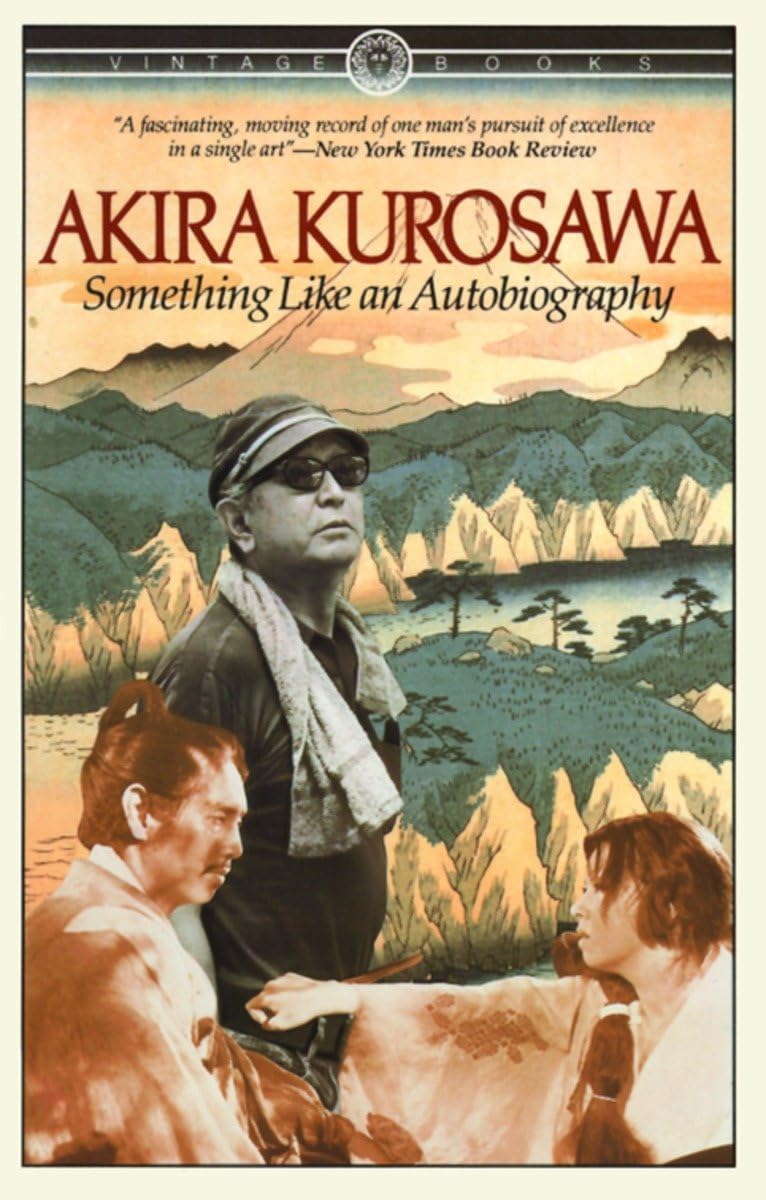
Something Like An Autobiography
Product ID: 8598798
Something Like An Autobiography [Kurosawa, Akira] on desertcart.com. *FREE* shipping on qualifying offers. Something Like An Autobiography Review: A wonderful book on the life and mind of Akira Kurosawa. - Purchased used - good from Blue Cloud Books for $0.94 plus $3.99 shipping. Very happy with the condition of the book. The Kindle edition seems a good price at $9.99. but I prefer the actual book in hand. The book is an autobiography of sorts written in 1982, in the waning years of Kurosawa's life and career. It seems it was dictated to another person since it follows a train of thought progression. Either that or Kurosawa penned it this way. Either way, there is a purity to the storytelling that feels as if the reader is sitting across from the director, conversing over tea. A lot of the book focuses on his early life, and the reader empathizes greatly with the young Kurosawa. There was much tragedy in his young life, both within his family, but also with the nation of Japan during the years leading up to and including the war. Much of his early career was spent trying to work on and create good films while appeasing the Japanese censors. Then post war, the American military was censoring the films. The guy couldn't win! A lot of the book also praises a lot of the directors, actors, and staff that Kurosawa worked for or worked with. He gives somber praise to his predecessors, especially his mentor, Kajiro Yamamoto. Kurosawa is very self deprecating at times, looking back and considering his actions at the time or decisions he made in his youth. But with those he admired, he gives credit where credit is due. Which is not to say this is a look back in regret. Instead Kurosawa touches on times, events, and emotions from the past. His laments are brief and heartfelt. In a few chapters he admits that he had a fiery temper, so he often writes about regret at letting his anger get the better of him. This isn't truly a look at Kurosawa's films, but instead a look at his life and the events surrounding his career. I would say this is not the same style of biography as Bergmann's "A Life in Film" which focuses on the films themselves. Much of this book also touches on the events surrounding life in Japan during Kurosawa's life. We feel the horror he felt after the great Kanto earthquake or the helplessness of the life of an artist leading up to World War 2. We sense that his films had depth and impact because Kurosawa worked so hard to get results during such trying times. It is a testament to his stubbornness, ambition, and dedication that he was able to craft the best films of his career during these times (pre-war, during war, and post-war). If you are a fan of Kurosawa and want to know more about the life and mind of this genius director, then this is a wonderful book to read. If you are expecting a point by point synopsis of his films, there are better texts out there (often much more expensive), such as 'The Films of Kurosawa' by Donald Richie (which is excellent by the way!). Review: Very good. - "No matter where I go in the world, although I can't speak any foreign language, I don't feel out of place. I think of the earth as my home. If everyone thought this way, people might notice just how foolish international friction is, and they would put an end to it." (pg. 61) The Japanese style of film production was so different than ours... particularly compared to Hollywood today... anyhow, if you like Kurosawa's work, you'd probably really enjoy reading his autobiography. "During youth the desire for self-expression is so overpowering that most people end up by losing all grasp on their real selves." (pg.88) He recalls his spartan childhood, his supportive parents, an eye-opening earthquake, his brother's suicide, and his final arrival on the Toho studio lot. Interspersed with stories about fellow professionals and self-realization, Kurosawa delves into the creation of his films and screenplays. He tells of throwing a lightbulb at a director, his problems with alcohol, and his affection for his crew. In fact the least talked about aspect of his life if his family who obviously took second seat to his love affair with film. "My films emerge from my own desire to say a particular thing at a particular time." (pg.192) The book is chock full of good advice for aspiring directors and even includes an addendum with related notes on filmmaking. While you may not agree with all of Kurosawas theories, I think everyone can learn something from his experiences. "I am not a special person. I am not especially strong; I am not especially gifted. I simply do not like to show my weakness, and I hate to lose, so I am a person who tries hard. That's all there is to me." (pg.159)
| Best Sellers Rank | #129,683 in Books ( See Top 100 in Books ) #40 in Movie Director Biographies #112 in Movie Direction & Production #816 in Actor & Entertainer Biographies |
| Customer Reviews | 4.7 4.7 out of 5 stars (625) |
| Dimensions | 5.19 x 0.67 x 7.99 inches |
| Edition | First Edition Thus |
| ISBN-10 | 0394714393 |
| ISBN-13 | 978-0394714394 |
| Item Weight | 7.8 ounces |
| Language | English |
| Print length | 205 pages |
| Publication date | May 12, 1983 |
| Publisher | Vintage |
C**T
A wonderful book on the life and mind of Akira Kurosawa.
Purchased used - good from Blue Cloud Books for $0.94 plus $3.99 shipping. Very happy with the condition of the book. The Kindle edition seems a good price at $9.99. but I prefer the actual book in hand. The book is an autobiography of sorts written in 1982, in the waning years of Kurosawa's life and career. It seems it was dictated to another person since it follows a train of thought progression. Either that or Kurosawa penned it this way. Either way, there is a purity to the storytelling that feels as if the reader is sitting across from the director, conversing over tea. A lot of the book focuses on his early life, and the reader empathizes greatly with the young Kurosawa. There was much tragedy in his young life, both within his family, but also with the nation of Japan during the years leading up to and including the war. Much of his early career was spent trying to work on and create good films while appeasing the Japanese censors. Then post war, the American military was censoring the films. The guy couldn't win! A lot of the book also praises a lot of the directors, actors, and staff that Kurosawa worked for or worked with. He gives somber praise to his predecessors, especially his mentor, Kajiro Yamamoto. Kurosawa is very self deprecating at times, looking back and considering his actions at the time or decisions he made in his youth. But with those he admired, he gives credit where credit is due. Which is not to say this is a look back in regret. Instead Kurosawa touches on times, events, and emotions from the past. His laments are brief and heartfelt. In a few chapters he admits that he had a fiery temper, so he often writes about regret at letting his anger get the better of him. This isn't truly a look at Kurosawa's films, but instead a look at his life and the events surrounding his career. I would say this is not the same style of biography as Bergmann's "A Life in Film" which focuses on the films themselves. Much of this book also touches on the events surrounding life in Japan during Kurosawa's life. We feel the horror he felt after the great Kanto earthquake or the helplessness of the life of an artist leading up to World War 2. We sense that his films had depth and impact because Kurosawa worked so hard to get results during such trying times. It is a testament to his stubbornness, ambition, and dedication that he was able to craft the best films of his career during these times (pre-war, during war, and post-war). If you are a fan of Kurosawa and want to know more about the life and mind of this genius director, then this is a wonderful book to read. If you are expecting a point by point synopsis of his films, there are better texts out there (often much more expensive), such as 'The Films of Kurosawa' by Donald Richie (which is excellent by the way!).
C**E
Very good.
"No matter where I go in the world, although I can't speak any foreign language, I don't feel out of place. I think of the earth as my home. If everyone thought this way, people might notice just how foolish international friction is, and they would put an end to it." (pg. 61) The Japanese style of film production was so different than ours... particularly compared to Hollywood today... anyhow, if you like Kurosawa's work, you'd probably really enjoy reading his autobiography. "During youth the desire for self-expression is so overpowering that most people end up by losing all grasp on their real selves." (pg.88) He recalls his spartan childhood, his supportive parents, an eye-opening earthquake, his brother's suicide, and his final arrival on the Toho studio lot. Interspersed with stories about fellow professionals and self-realization, Kurosawa delves into the creation of his films and screenplays. He tells of throwing a lightbulb at a director, his problems with alcohol, and his affection for his crew. In fact the least talked about aspect of his life if his family who obviously took second seat to his love affair with film. "My films emerge from my own desire to say a particular thing at a particular time." (pg.192) The book is chock full of good advice for aspiring directors and even includes an addendum with related notes on filmmaking. While you may not agree with all of Kurosawas theories, I think everyone can learn something from his experiences. "I am not a special person. I am not especially strong; I am not especially gifted. I simply do not like to show my weakness, and I hate to lose, so I am a person who tries hard. That's all there is to me." (pg.159)
B**A
"Something LIKE an autobiography"
This is a good book for Kurasawa fans interested in what a few of his life experiences informed his vision. It is by no means a complete biography. It is limited and the reading is a bit dull.
K**M
A Must Read For Filmmakers
This is my first memoir to read in general, and since I wanted to pursue a career in filmmaking I tried to look for memoirs of directors to know more about their lives and influences. I came across this book from a random search and having read it I can say it’s one hell of a journey to read about one of the greatest Japanese film directors that ever existed. The way it’s written was honest, sincere, it felt like as if he is alive and sitting next to you talking about his journey leading up to his success. I highly recommend this book to anyone who is a fan of Akira Kurosawa, and wanting to know the journey itself of one to become great. I’ve learned a lot from this book and it has given the confidence to endure and enjoy the journey of filmmaking.
J**V
I feel like I just made a new friend
As I reached the end of this book I went and searched up if Akira had won an Oscar. It turns out he did. As I watched the video of him accepting the award I couldn’t help but feel and an amazing happy feeling inside of me. I was overcome with joy seeing him on the stage. Almost like I was seeing a lifelong friend up on the stage and being very proud of his achievements.
G**O
Muy bueno, introspectivo y nada tedioso
A**R
Essential book for a film maker to know how much a Auteur like Akira Kurosawa enjoyed the process.
G**N
Arrived in time. This is one of the best autobiography book ever I read. Recommended to everyone.
F**B
Pre-war Japan is a very foreign country, and this book gives a bit of insight into the culture. It illuminates Kurosawa's work and shows where he's coming from.
F**R
A startlingly honest and wonderfully detailed account of the beginnings of AK's life and early career. He paints a warts and all self-portrait, almost a confessional at times:from open and honest stories about his childhood, then onwards to the successes and failures of the earliest films in his oeuvre. It is all achieved with a guile-less charm, wit and perception, and entirely lacking pomposity or self-deception. He has a justifiable go every so often at critics and other filmmakers who misread his work, and he is utterly honest in assessing his own successes and failures. Even when it's not specifically about his film-making, the book is a marvellous reminder of how the most apparently small insignificant incidents in life can be grist to the mill of a great artist. When the big stuff happens- the great Kanto earthquake of his childhood, the war in the Pacific when he was starting out as a director, his memories are described with the vivid detail of a great screenwriter as well as director. All this is enhanced by a fine translation from Audie Bock, who, like Donald Ritchie before her, was as close to Kurosawa as any westerner could be.
Trustpilot
2 weeks ago
1 month ago