Desert Online General Trading LLC
Dubai, United Arab Emirates
Desert Online General Trading LLC
Dubai, United Arab Emirates
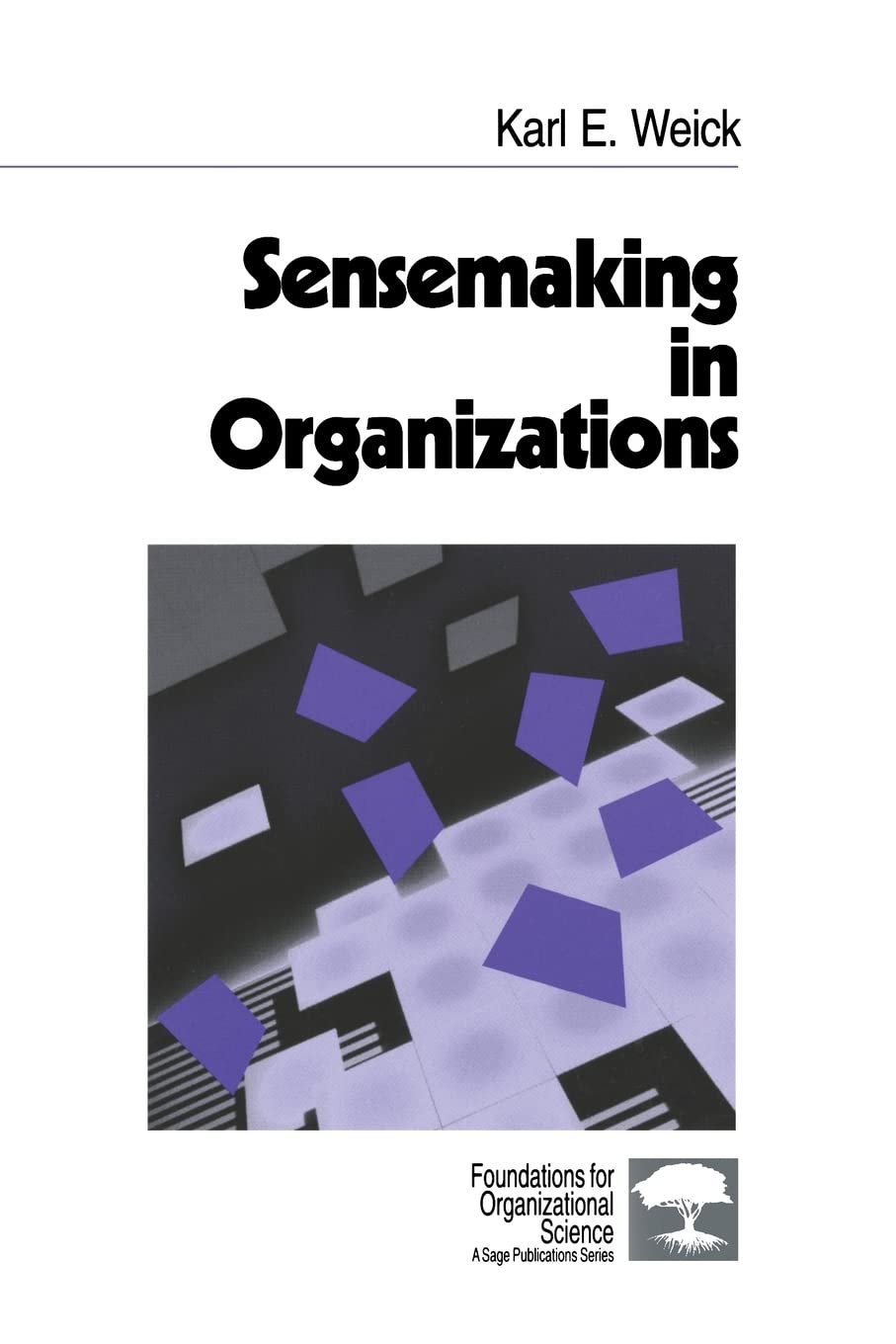
Sensemaking in Organizations (Foundations for Organizational Science)
W**D
The Story of Sensemaking
This review is different than most, because rather than dissecting the book, I will provide a few overall ideas about the concept of Sensemaking and why it is worth your consideration. This is an academic and theoretical book, but the more casual reader should not miss out on its core principles. For an academic treatment of Sensemaking, see pages 57-64 of my dissertation which is available on my website.Sensemaking is a process that applies to both individuals and groups who are faced with new information that is inconsistent with their prior beliefs. In some cases, it can be the lack of expected information that triggers the Sensemaking process. Weick's work is based in part on Festinger's theory of cognitive dissonance, which holds that people are uncomfortable with inconsistent beliefs and are driven resolve the dissonance it creates.Consequently, Sensemaking posits that people will resolve their cognitive dissonance through plausible (but not necessarily accurate) narratives, which then become entrenched over time and resistant to change. This explains how, for example, religious groups can have such stringent beliefs, how political parties can be confident in their diametrically opposed positions, how organizations can develop very different cultures, and how individuals can develop very different interpretations for the same events.Underlying assumptions in Sensemaking:1) The world is complex and ambiguous2) Available information is massive and contradictory3) Individuals have limited ability to process information4) Individuals are uncomfortable with unresolved ambiguity or contradictory information (cognitive dissonance)5) Most actions, beliefs, and cognitions are socially influencedThe Sensemaking process:1) Sensemaking starts with an event or act (or sometimes the lack of an expected event).2) Individuals construct meaning for the event or act (interpret it) by selecting only certain cues from their past experience based on their existing beliefs and biases. Disconfirming cues are often not observed at all, deemphasized, or ignored.3) Commitment forms around the interpretation to bind the interpretation to future action. When publicly communicated, commitment is especially strong.4) Individuals are motivated to justify their commitments, so they initiate future actions and continually refine their interpretation of the original event so that their commitment to a course of action is deemed appropriate.5) These new actions produce "evidence" that validates the interpretation and are used to increase decision confidence.6) Over time, the ambiguous nature of the original event or act is forgotten and other possible "right answers" are never developed. More importantly, the commitment that was made to a specific decision or course of action increasingly becomes seen as the only rational, logical, and appropriate outcome.For a more business-friendly, but still challenging book, which includes numerous examples, please consider Weick's "Making Sense of the Organization".Making Sense of the Organization (KeyWorks in Cultural Studies)If you found this review helpful please click "Yes".
S**A
Making of sense
This is a very difficult book to read but very intersting and revelas a lot of things that one could not understand in any setting.It is a book that could be recomende to relirgious leaders, politicians,managers and leaders across all sectors
R**T
This book makes sense!
Fundamental work in Work and Organizational Psychology; a must in times of enhancing complexity and unpredictability.
J**R
Good Book
Very good condition. I have not read the entire book yet. But I will read it soon to get an opinion.
H**N
Five Stars
This is the foundation for organization research
D**S
Great review of what works in organizations
This book attempts to illustrate how organizations come to shape the behavior of their members. Weick argues that it rests in the fact that the organization comes to form the mental frame through which members are socialized as they are brought into the organization. Some aspects of the organization will be undefined ,change, or held back from the new member. The member is then forced to attempt to discern what they should do from multiple sources of information within the organization. Weick lays out how this process might look like. All in all, an important book on organization theory.
M**T
Sensemaking fails to translate theory into practice
Weick's book is thoroughly researched, drawing its insights from psychological and organisational studies.It offers new views on how organisations operate, and how they generate meaning. It points out that reality is not something outside the organisation, but something that is constructed by people within the organisation - an empowering insight. Weick also extensively discusses where and how this 'making of sense' happens.But the book fails largely in linking this theory to practice. After making sense of 'Sensemaking', (which requires some mental acrobatics!), I still don't know how a leader can influence the sensemaking process to the benefit of the organisation. I'm still left with the basic question: So what?
D**9
The book is of low quality - not sure it ...
The book is of low quality - not sure it is the distributors fault nut the glue in the spine if the book is just not effective and the pages come lose.
Trustpilot
3 weeks ago
1 month ago