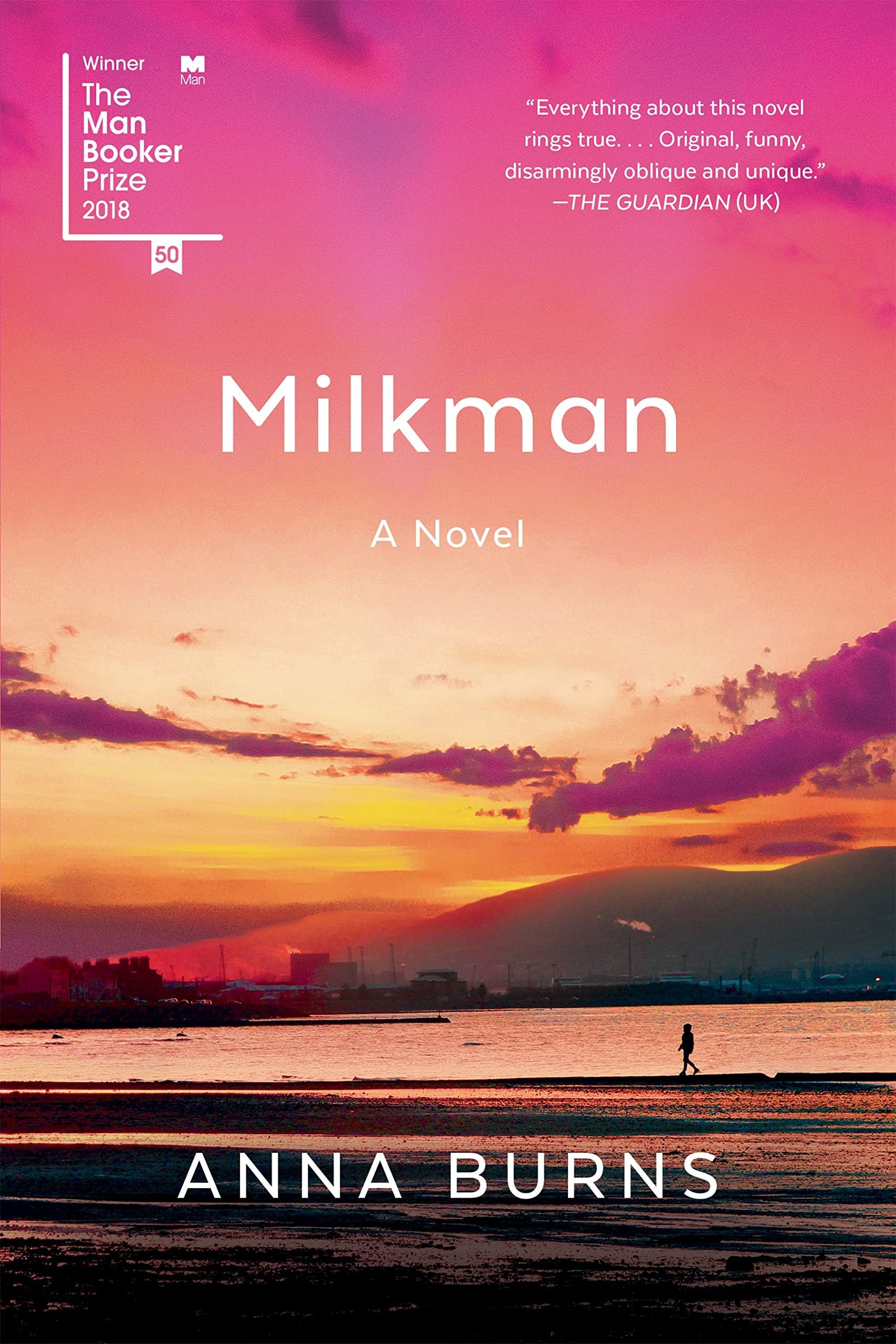
Milkman: A Novel
Product ID: 88385759
Desertcart purchases this item on your behalf and handles shipping, customs, and support to New Zealand.
Winner of the Man Booker Prize “Everything about this novel rings true. . . . Original, funny, disarmingly oblique and unique.”― The Guardian In an unnamed city, middle sister stands out for the wrong reasons. She reads while walking, for one. And she has been taking French night classes downtown. So when a local paramilitary known as the milkman begins pursuing her, she suddenly becomes “interesting,” the last thing she ever wanted to be. Despite middle sister’s attempts to avoid him―and to keep her mother from finding out about her maybe-boyfriend―rumors spread and the threat of violence lingers. Milkman is a story of the way inaction can have enormous repercussions, in a time when the wrong flag, wrong religion, or even a sunset can be subversive. Told with ferocious energy and sly, wicked humor, Milkman establishes Anna Burns as one of the most consequential voices of our day. Review: The Milkman Burns - Perhaps it’s not right to invent a title for a review that concatenates the title and author of the book under consideration but in this case it seems so appropriate. This novel so well written, so lyrically Irish, such dark humour hurt me, burnt me. I’ve not read anything else that so successfully conveys what it must have been like to live through The Troubles of Northern Ireland and the impact this had on the minds of the people who felt they had no choice but to endure and survive those times as best they could. We are told the active voice of the principal character, nameless Middle Sister, a girl of 18 , of events unfolding around and over her, covering a period of just a few months. Through rambling sentences spiced with recall and speculation a current and historical profile of unnamed neighbourhoods (I guess Belfast) emerge populated by lithe, criminally inclined, politically bloated, blighted as well as delightful inhabitants. Burn’s skilfully conveys the agony of living in a repressive society beset with tribal loyalties and fear. I had to force myself to keep reading Burn’s intimately affective, ‘fictional’ account and accept the shadowy presence of clumsy British occupying soldiers and violent IRA patriots. Middle Sister is stalked by a powerful figure in the resistance: Milkman. He is married, in his thirties, a looming criminal. The threat of his presence alone in the absence of touch is nevertheless too close, visceral, overwhelming. She is incredibly brave. She feels she must protect her bisexual Sometime Boyfriend, watch out for more than poisoned words,defend herself from the unsympathetic narrative of her best Old Friend, ignore the constant harassment of her mother, First Older Sister and others.She must deal with the attention of a rejected suitor Somebody McSomebody, a young, pathetic pistol packing neighbour who attacks her in the loo. Perhaps most terrifying of all, our narrator, Middle Sister is caught in a culture of hostile gossip whose actors compulsively invent false stories about her, disarm and imprison her in a silo of alienated silence. We wait with growing impatience under salvos of words for something to break her entrapment. Burn’s conveys the tension between Middle Sister and those closest to her and the events that surround her in a simultaneously frightening, funny and entirely convincing way. We forget the inherent contradiction between who the truly articulate Middle Sister is who is writing the text and the girl who cannot ask for help from those in a position most likely to provide it is the same person. The Middle Sister who wrote this novel may not be the author but the author knows her so well I feel it is her alter ego talking to her younger self. Burn’s describes the prison of what seems to be her own internment. There is no need for her to explain why her eminently capable narrator is incapable of helping herself. The profound message intended or not is the way this wonderful story captures a time and place, a state of mind, what is was to be living inNorthern Ireland during The Troubles. In such a milieu, such a volatile and dangerous space it is best to fain ignorance, avoid extending to much trust in others, sensible to remain silent. There is nothing as boring as didactic intent in Burn’s wonderful novel but the lessons are there. What of current day tribalism and where it could take us? Why so many closed narcissistic minds? Why the unwillingness to listen to and respect other people’s point of view? How come we never learn? Yes, it’s complicated. Let me make it even more so. Oscar Wilde writing of a much earlier phase of The Troubles wrote something like this “if only the English would learn to talk and the Irish to listen we would have a very civilised society” Review: A brutal, difficult read – but worth the effort - “‘It’s not about being happy,’ he said, which was, and still is, the saddest remark I’ve ever heard.” (p63) This book, set in 1970’s Northern Ireland during “The Troubles”, is rough going -- both the style and content make it a brutally difficult read. The protagonist is a thoughtful, traumatized young woman who tells her story in long, meandering, complex stream-of-consciousness prose. It’s an account of people trying to live their lives in the face of unspeakable threats and horrors. How do they cope? How deep are their psychic wounds? A vile, omnipresent, omniscient, mysterious stalker anchors the story: his words and actions are especially creepy because they are understated. Yes, there are moments of hope (and dry, sarcastic humor), but the general tone conveys the feeling of life weighing everybody down. The people in the community – all traumatized in their own ways – are unable (often unwilling) to distinguish the real from the imagined and the deliberately distorted. As the book proceeds, you’ll sometimes find yourself unable to make the distinction yourself. This, of course, is exactly what the author has in mind. Pay close attention to the author’s ostentatious reluctance to use proper names. They are extraordinarily rare in the book – the nameless narrator uses functional descriptions like maybe-boyfriend, chef, tablet girl, and third brother-in-law. Even ordinary dialog avoids proper names. There are exceptions, however, and I’m certain those exceptions are important. I’ll withhold my own rather incomplete and uncertain thoughts on what I think the author intends by that. If this book resonates for you, I recommend “Prophet Song” by Paul Lynch (Booker Prize, five-star, also set in the “The Troubles”), and “Hard by a Great Forest" by Leo Vardiashvili (set in the Soviet-era republic of Georgia).
| Best Sellers Rank | #40,671 in Books ( See Top 100 in Books ) #570 in Coming of Age Fiction (Books) #1,935 in Literary Fiction (Books) |
| Customer Reviews | 3.9 out of 5 stars 11,526 Reviews |
J**N
The Milkman Burns
Perhaps it’s not right to invent a title for a review that concatenates the title and author of the book under consideration but in this case it seems so appropriate. This novel so well written, so lyrically Irish, such dark humour hurt me, burnt me. I’ve not read anything else that so successfully conveys what it must have been like to live through The Troubles of Northern Ireland and the impact this had on the minds of the people who felt they had no choice but to endure and survive those times as best they could. We are told the active voice of the principal character, nameless Middle Sister, a girl of 18 , of events unfolding around and over her, covering a period of just a few months. Through rambling sentences spiced with recall and speculation a current and historical profile of unnamed neighbourhoods (I guess Belfast) emerge populated by lithe, criminally inclined, politically bloated, blighted as well as delightful inhabitants. Burn’s skilfully conveys the agony of living in a repressive society beset with tribal loyalties and fear. I had to force myself to keep reading Burn’s intimately affective, ‘fictional’ account and accept the shadowy presence of clumsy British occupying soldiers and violent IRA patriots. Middle Sister is stalked by a powerful figure in the resistance: Milkman. He is married, in his thirties, a looming criminal. The threat of his presence alone in the absence of touch is nevertheless too close, visceral, overwhelming. She is incredibly brave. She feels she must protect her bisexual Sometime Boyfriend, watch out for more than poisoned words,defend herself from the unsympathetic narrative of her best Old Friend, ignore the constant harassment of her mother, First Older Sister and others.She must deal with the attention of a rejected suitor Somebody McSomebody, a young, pathetic pistol packing neighbour who attacks her in the loo. Perhaps most terrifying of all, our narrator, Middle Sister is caught in a culture of hostile gossip whose actors compulsively invent false stories about her, disarm and imprison her in a silo of alienated silence. We wait with growing impatience under salvos of words for something to break her entrapment. Burn’s conveys the tension between Middle Sister and those closest to her and the events that surround her in a simultaneously frightening, funny and entirely convincing way. We forget the inherent contradiction between who the truly articulate Middle Sister is who is writing the text and the girl who cannot ask for help from those in a position most likely to provide it is the same person. The Middle Sister who wrote this novel may not be the author but the author knows her so well I feel it is her alter ego talking to her younger self. Burn’s describes the prison of what seems to be her own internment. There is no need for her to explain why her eminently capable narrator is incapable of helping herself. The profound message intended or not is the way this wonderful story captures a time and place, a state of mind, what is was to be living inNorthern Ireland during The Troubles. In such a milieu, such a volatile and dangerous space it is best to fain ignorance, avoid extending to much trust in others, sensible to remain silent. There is nothing as boring as didactic intent in Burn’s wonderful novel but the lessons are there. What of current day tribalism and where it could take us? Why so many closed narcissistic minds? Why the unwillingness to listen to and respect other people’s point of view? How come we never learn? Yes, it’s complicated. Let me make it even more so. Oscar Wilde writing of a much earlier phase of The Troubles wrote something like this “if only the English would learn to talk and the Irish to listen we would have a very civilised society”
D**J
A brutal, difficult read – but worth the effort
“‘It’s not about being happy,’ he said, which was, and still is, the saddest remark I’ve ever heard.” (p63) This book, set in 1970’s Northern Ireland during “The Troubles”, is rough going -- both the style and content make it a brutally difficult read. The protagonist is a thoughtful, traumatized young woman who tells her story in long, meandering, complex stream-of-consciousness prose. It’s an account of people trying to live their lives in the face of unspeakable threats and horrors. How do they cope? How deep are their psychic wounds? A vile, omnipresent, omniscient, mysterious stalker anchors the story: his words and actions are especially creepy because they are understated. Yes, there are moments of hope (and dry, sarcastic humor), but the general tone conveys the feeling of life weighing everybody down. The people in the community – all traumatized in their own ways – are unable (often unwilling) to distinguish the real from the imagined and the deliberately distorted. As the book proceeds, you’ll sometimes find yourself unable to make the distinction yourself. This, of course, is exactly what the author has in mind. Pay close attention to the author’s ostentatious reluctance to use proper names. They are extraordinarily rare in the book – the nameless narrator uses functional descriptions like maybe-boyfriend, chef, tablet girl, and third brother-in-law. Even ordinary dialog avoids proper names. There are exceptions, however, and I’m certain those exceptions are important. I’ll withhold my own rather incomplete and uncertain thoughts on what I think the author intends by that. If this book resonates for you, I recommend “Prophet Song” by Paul Lynch (Booker Prize, five-star, also set in the “The Troubles”), and “Hard by a Great Forest" by Leo Vardiashvili (set in the Soviet-era republic of Georgia).
C**E
Cool but Boring
I like this book when things happen in it. Else I don’t really like it. Although it’s a book with plenty of good things in it — the claustrophobia, the suspense, the combination of claustrophobia and suspense —, the style is so redundant that it’s exhausting even if stream-of-consciousness books have redundant styles. It goes on and on and on, all interpretation, no action, barely a smidge of action, and even without the action the book isn’t very profound. Books can be enjoyed if they’re full of action but not profound or profound and not full of action, but Milkman is neither. Though the book is a good portrait of Belfast during the Troubles, the book is tedious and unending.
K**H
One of the more amazing books I read in a long time!
I am so glad I didn't rely on the reviews for this book because it sadly seems that way too many people just didn't get it. I just read the first few sentences and I was hooked and then in got harder and more and more uncomfortable. I agree with other reviewers that it is a difficult read. In fact it is very easy to get lost in the endless passages. For myself I am forced to read a passage over and over, forced because I want to understand, because it is worth it and most important because I immensely enjoy rereading passages in this book. I feel every sentence and every passage is so intricately constructed that it is imperative for the story to understand. I don't want to miss not the slightest thing in this weird language which is incredibly simple and complicated at the same time with many beautiful phrases. To me it sound like a unique language not old, not modern but always spot on, authentic and familiar in it's universality of describing very basic human conditions. I would not recommend the audio book as the speaker sounded brash and annoying and very far removed from this almost speechless person described there. When I just recently stumbled over a newspaper article about the unimaginable horrors of the 'troubles' in Northern Ireland in the 70ties, of which I knew nothing about, it crossed my mind that this book gives an amazingly accurate account of the atmosphere of fear and violence and the helplessness in the face of it. As always in great literature the conflict is universally applicable. I disagree with reviewers that claim nothing is happening in this book in terms of story. That of course depends all on ones expectations on a story. For what it is worth I find the psychological tension and the potentiality of bombs going of so much more intense then actual explosions. Definitely not a book for people who like to get their stories served in easy digestible bites or have their literal comfort zone challenged.
R**L
Just Glorious
So <i>Milkman</i> won the Man Booker Prize and everybody was like, who is this Anna Burns and why has her pink book won the big prize, except for "everyone" substitute "me," because that was my reaction. Everyone else was probably fine. So <strike>everybody's</strike> my next reaction to <i>Milkman</i> came a few pages in and can best be summarized as "wow, wow, wow," because this is a fantastic book with a unique and marvelous voice and I'm so happy to have read it, except I'd like to still be reading it. Middle Sister lives in a city in Northern Ireland in the late seventies. She lives in a no-go area but survives by keeping her mind firmly in nineteenth century literature, her not quite relationship with maybe boyfriend and in her evening French class in the center of town. Then she is noticed by a man high up in the IRA, named Milkman, which throws her life into chaos as she tries to figure out how to protect herself. As his attentions are noticed by her neighbors, she's forced into ever tighter control of her actions and words. What's so delightful about this novel is the protagonist's voice. It's impossible not to hear her accent as she speaks and my reading slowed down to the speed of a person speaking, telling a story of what happened back in the seventies. Here she is talking about maybe boyfriend's house, which is filled with parts of cars and various machines, to the point of being almost unlivable. <i>As for my reaction, I could bear the cluttered state of </i>'Come in and welcome, but you're going to have to squeeze a little'<i> during times I stayed over because of the normality of the kitchen and of his bedroom and the half normality of the bathroom. Mainly though, I could bear it because of the 'maybe' level of our relationship, meaning I didn't officially live with him and wasn't officially committed to him. If we were in a proper relationship and I did live with him and was officially committed to him, first thing I would have to do would be to leave.</i> <i>Milkman</i> is told from deep within the musings of Middle Sister, and like thoughts do normally, themes and subjects circle in and out of her mind as she goes about trying to live her life in a place that isn't entirely compatible with life. This is a very, very good book, but it requires attention and a willingness to slow down and allow Middle Sister to tell her story in her own way.
K**K
Impressive though not easy to read work of literature
This book took me on quite a journey. It took me forever to get into it, and honestly, if it hadn’t been a book club read, I might have put it aside. I’m glad I stuck it out. The structure and narrative form are different than most other books I’ve read, though comparisons to Beckett and Flann O’Brien are right on. The inside-the-head-of-the-narrator POV was rough at the outset. It gave the book a relentlessness that put me off. I would fall asleep or get exhausted after 5 pages. When I switched from the library book (really light, small type on the paperback!!) to Kindle and Audible, I got more into the groove. I have to say, the audiobook narration was fantastic. This book has a lyricism that works well when read aloud. On the page, it can seem very repetitive, with the long serial phrases of synonyms and such. But read aloud in the northern Irish accent, it works beautifully. (Like when I read and loved Angela Ashes, but years later listened to Frank McCourt’s reading on Audible. It was a completely different experience. Both are great, but the audio was heartrending.) Anyway, the relentlessness. The book was dense, with all the thoughts of the protagonist dumped out for the reader. But as I read on, I realized it encapsulated what life in such a time and place (Catholic area of Northern Ireland in the 1970s) must have been like. The state police, the renouncers, the town gossips. Everyone under the eye of suspicion at all times. Having your life ruined or taken because one person had one wrong take on something you did or said. Middle sister shuts down and lives inside her own head as an act of self-preservation, but even that causes her to become a pariah and threatens the lives of those around her . Talk about relentless. There were parts that made my chest tight, and I think that discomfort is what great literature can do. There were parts that actually made me bark with laughter despite myself. Burns’s take on gender were the best parts of the book for me. There’s been so much more written about Milkman (it did win the Booker) that I won’t go on too much... But I’m giving this 4 stars because it was quite the slog at the beginning for me. It is, though, a remarkable piece of literature.
J**R
Life is too short to waste reading something so atrocious
I know everyone has their own literary tastes, but I cannot fathom how anyone can like this book. It's a seemingly endless incoherent stream of consciousness written in a presumably imagined vernacular. I actually had to read about the book to figure out that it may or may not be about Belfast during the 70s (There! Saved you $10 and a few hours). The book's plot is almost non-existent. The character development equals that found in mid-term papers from 7th grade creative writing classes. The narrative is vague and non-sensical to the point of giving you anxiety. Every now and then the Man Booker judges miss the mark. Man Booker winners share common surrealistic themes, with winners being unique and bleeding edge...something that hasn't been done before. Sometimes the judges choose art over literature, discounting the literary deficiencies for the artistic vision and creativity. In this case, the judges selected an art installation. Literary garbage. But unique...a writing style that has never been tried before. The problem is, there is a reason it has never been tried. Because it doesn't work. It is miserable and nauseating to read and should have never been published. I would rate this zero starts if I had the option.
A**R
Tight, claustrophobic,paranoid and hysterical book. I absolutely loved it.
I loved this book. I won’t get into specifics but it’s amazing. It’s Joycean and has such a strong voice.
M**W
Entrega conforme anunciado.
O produto (livro) e entrega sem problemas.
M**N
Renouncers
Milkman is a stream of consciousness story narrated by an unnamed young woman living in an unnamed part of Belfast (probably the Ardoyne), some time in the late 1970s. By way of context, the intensity of the killings in the early 1970s – especially the civilian deaths – had subsided; there had been population movement and people had retreated into small, “safe” pockets exclusively populated by people of the same political tradition (which was also generally correlated to people’s national identity and religion). Both unionists and nationalists still thought they could win the war through armed conflict, and the political voice of Sinn Féin had not yet come to the fore. The Hunger Strikes were still a couple of years into the future and most people could remember a time before the British Army was deployed to assist the civil power… So the novel is almost a love story set in this quite specific time period. Our narrator lives in a Catholic enclave of North Belfast. She reads 19th century novels while walking, which marks her out as a bit odd. Her maybe-boyfriend is a car mechanic from another unspecified Catholic district of Belfast. She is from a large family, four-ish brothers and three sisters and Ma. Da is dead. Our narrator talks to herself extensively in a colloquial Belfast voice that hinges on repetition and over-explanation. It is a sarcastic voice, cynical about the sectarian conflict and the motives of those who engaged in it. She narrates in euphemisms: the Sorrows, Renouncers of the State, Defenders of the State, the country across the water, the country across the border. People are second sister, the real milkman, chef, the tablets girl, Somebody McSomebody. Similarly places are not names and although most are recognisable – the reservoirs and the parks is Cavehill Road; the ten minute area is Carlisle Circus; the usual place is Milltown cemetery – the euphemisms allow liberties to be taken with the geography. The resulting text is very dense, often circular (at the very least non-linear) and pretty intense. It is like Eimear McBride crossed with James Kelman. The story is one of personal love and personal tragedy set within a dysfunctional society. Our narrator wants to be with maybe-boyfriend, but is admired by Milkman (a senior ranking paramilitary) and Somebody McSomebody (a wannabe paramilitary – was this a time before spides?). In a world where normal law and order does not operate, where law is made by the paramilitaries and is mutable, where whispers and innuendoes constitute evidence, this is a dangerous space. Our narrator knows the perils and even the most mundane activities – jogging by the reservoirs, buying chips, learning French, winning a scrap Blower Bentley supercharger – can be fraught with danger. Her quirky narration and eccentric world view manage to create deliciously black comedy from these dangers. Milkman is a timely novel. This period of the late 1970s has been largely airbrushed out of both world and Northern Irish history. Nowadays the Republican movement has been rehabilitated. They are seen to champion human rights and to lead the equality agenda. Its history is seen to be the ballot box in one hand and the armalite in the other. Their community justice is seen to have been a viable – almost legitimate – alternative to the RUC and the state agencies. It is often almost assumed that those who lost their lives (apart from in the early 1970s) had been “involved”. But what we see is a violent society with kangaroo courts based on self-interest and hypocrisy, arbitrary expulsions, witch hunts, suspicion. Paramilitaries tyrannise their own communities but the communities seem to lap it up. Each fresh atrocity is just casually dropped into conversation. More than anything, our narrator, her family and friends needed stability and predictability. What they got was the law of the jungle. And we know from history that they had 15 more years of this ahead of them before the first signs of the re-emergence of normality. Of course all this is viewed from a nationalist vantage point but we can safely assume that the situation was mirrored in the loyalist community across the road. And Milkman is also relevant to current developments as we start to see the emergence of an anti-political movement based on extreme and ill-planned actions. Brexit as a response to immigration and crime. Walls and travel bans and flip-flopping between nations and leaders being best friends and beyond the pale. If Milkman has a failing, it is that the meandering narration can frustrate the reader. There are few natural pauses, there can be a feeling that we have already covered this ground, ideas and phrases repeat. But they do add up to a work that is strong enough to carry the frustration. Milkman is a mature work that does say something new (or at least say it in a new way) in a field that has been ploughed often before.
J**E
Hard to read - and hard to put down.
Milkman is written in a very innovative and to me very modern style. In a s0-called unknown city that was clearly Belfast - I couldn't help hearing the rough Northern Irish accent jump off the page at me - and by the way - very often knocking me to the floor. I found the work hard to read - and hard to put down. The themes of family, neigbourhood and state in contest with one another were compelling. Add to that the #metoo oppression at the core of the book and this is not a book to be taken lightly. Still for all that I laughed loud and often at the interplay between colourful characters and a personally familiar model of mothering and sistering perhaps fading into history. I can understand the lack of resonance for those too distant from 'The Troubles' - but surely the emotional clarity of the writing on community descent into tribalism, the impact on mental health and an understanding of the ground to be made up by afflicted places surely makes the book a must read. I really can't speak highly enough of this book.
J**T
Humour and resiliency
This is one of the best novels I’ve read in awhile. It is funny, which is a feat to achieve with the setting being the Troubles in N Ireland in the late seventies and the central issue being the psychological weight of being stalked and/or being a woman in a patriarchal society. It’s unusual narrative style seems to have defeated some readers, but I found it rythmic and similar to reading our own thoughts narrated during the course of a day. Similarly, by referring to others by what they represented to the protagonist rather than by name, we are consistently kept within the spell of her inner world.
A**N
A fascinating study of a sick community
Anna Burns does not make for easy reading. The format of a single monologue from beginning to end is tiring (in fact, rather “nineteenth century” - the period the narrator claims to love). Hence four stars rather than five. But the subject matter - the psychological abnormalities that develop in an isolated and violent community - is gripping. It also happens to be a a warning of what can happen when “identity politics” go mad. And it has the sound of reality about it, which is not surprising since the author lived in the Ardoyne, a particularly violent part of Belfast during the “Troubles”.
Trustpilot
2 days ago
2 weeks ago